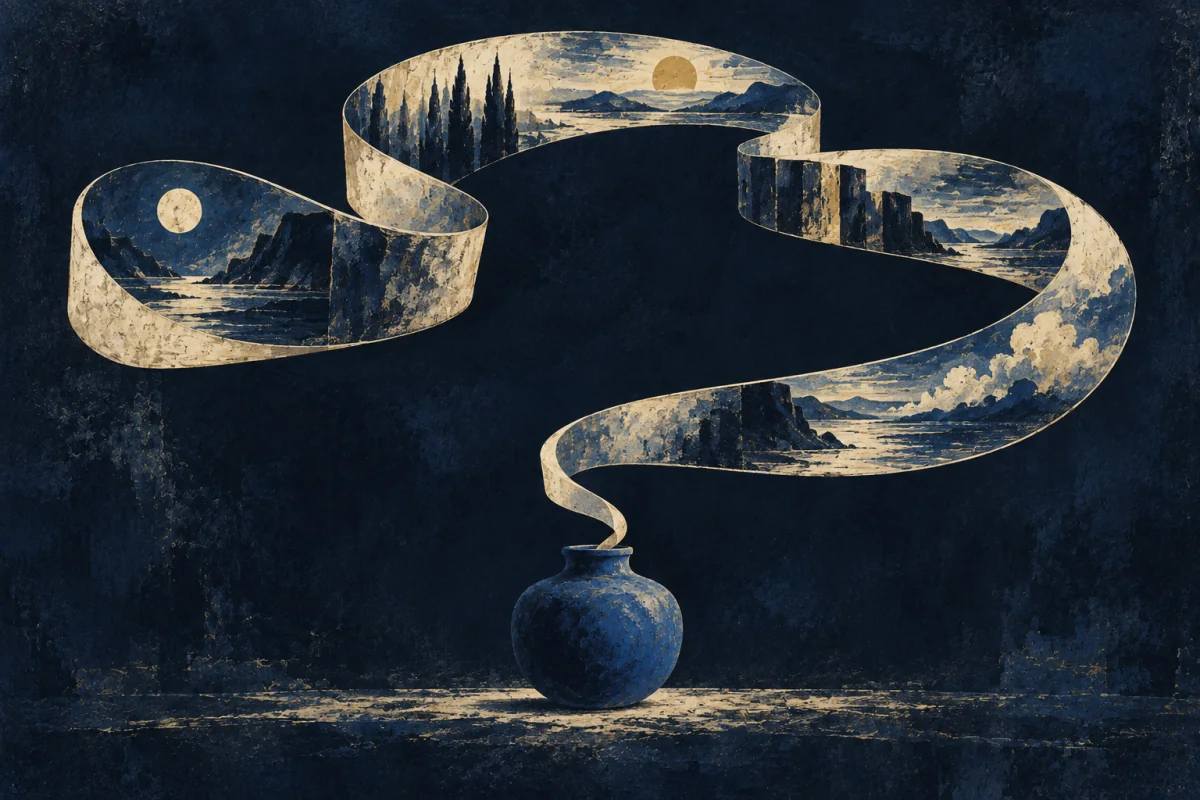
In Plain Sight
Some people carry enormous stretches of story by voice alone. Verse, melody, gesture and breath braided together into performances that run for hours or across several nights. The thread holds across thousands of lines, the room is shaped by cadence, and the body is managed for the long haul of the telling. You'd notice this in the one whose voice still finds the next stanza without reaching.
The Pattern at Work
The memory is not what anybody assumes. What is held is a sequence of events and a stock of phrases that fit the metre, so the line is assembled as it is sung rather than recalled word for word. That is why two performances of the same epic differ in wording and not in substance, and why a singer can be interrupted, asked a question, and pick the thread up exactly. Anybody trying to do it by rote fails within a year.
Melody carries the structure. A tune with a fixed shape tells the singer where they are and tells the audience what kind of passage is coming, and it is why material of this length is sung rather than spoken. The rhythm also does the retrieval: the metre constrains what can come next so tightly that the right phrase is often the only one that fits.
Pacing across hours is a separate craft again. A three-hour telling needs variation the way a symphony does — a fast passage, a quiet one, a place where the audience can talk, a return. Somebody experienced is managing attention over a whole evening, and will cut or extend an episode by twenty minutes according to what the room is doing.
And the body has to last. Voice, breath and stance held for hours, across several nights, which means the delivery is pitched well below maximum from the start. A singer who gives everything on the first night has nothing for the third, and the tradition knows it: the big passages are placed where the voice can still reach them.
What the Examples Show
It gets read as an extraordinary memory, or as a folk tradition, or as a performer with a very long repertoire.
The first element is that it is composed in performance rather than recalled. The apparent feat of memory is really a structure plus a stock of usable phrases, which is a different and more robust thing.
The second is that music does the work of holding it together. Melody and metre are the scaffolding for both retrieval and comprehension, and the same material spoken would collapse in twenty minutes.
The third is stamina and pacing. This is an athletic event as much as an artistic one, and the judgement about how to use a voice across three nights is as real as anything in the material.
Going Deeper
Long oral narrative is one of the great human achievements and it has been disappearing steadily for a century.
The Homeric poems were composed and transmitted this way long before they were written, and the formulaic phrases that puzzled scholars turned out to be the mechanism. South Slavic guslars were recorded in the twentieth century still performing epics of comparable length, which is how the mechanism was understood at all. The Kyrgyz Manas runs to hundreds of thousands of lines and is still carried by singers trained from childhood. West African griots hold genealogy, history and judgement in the same form, and Indian and Tibetan traditions do something similar with religious epic.
The costs are severe and mostly about transmission. The training takes a childhood and a teacher, and neither is easy to arrange in a society organised around school and employment. The audience has to exist: this material needs people who will sit for three hours, several nights running, and that audience has largely gone. Recording changes the art itself, since a fixed version becomes the correct one and the composing-in-performance stops. And the economics never supported it well even at its height, so the singers were dependent on patronage, festivals or hospitality, all of which have moved on. Where the form survives at all, it is usually because a state or a community decided deliberately to keep it, which produces its own problems: a tradition maintained as heritage tends to fix itself, and fixing is exactly what this art was built to avoid.
The Image
The phrase that fits.
Not a remembered line. A formula of the right shape, from a stock of thousands, dropped into the metre because it fits and it is true.
This is why the epic never quite repeats and never breaks down. The singer is not retrieving a text; they are building one, live, inside a frame tight enough that it can only be built one way. The feat is architectural rather than a matter of recall.
Where It Stops
Having a good memory is not this, and neither is knowing a lot of songs. The mechanism is structural, and somebody who has learned a long text by heart will break the first time they are interrupted.
It goes wrong as museum performance. Material that was alive because it was rebuilt every night can become a fixed recitation of a published version, which is accurate, dead, and much easier to arrange.
It also fails without a listening culture. This form assumes an audience that knows the material, expects variation, and will sit for hours, and in front of a modern audience the same performance is often experienced as a curiosity.
Take the plainer explanation first. Anybody trained in a long-form tradition performs at length, because that is the form. The test is whether the same mechanism appears elsewhere — improvising a story to the right rhythm, holding a thread for an hour with no notes.
Where It Pays
Inside a job. Traditional and heritage performance, storytelling at festivals, theatre and solo performance, teaching in oral traditions, ethnomusicology and folklore work, and religious performance where long narrative is part of the liturgy. Also voice work and narration, where the stamina and pacing transfer directly.
What is being bought is attention held for an unusual length of time by one person with nothing but a voice. In festivals, education and heritage that is both cheap to stage and almost impossible to replace, and the few people who can genuinely do it are known by name across a whole country.
Where it pays badly is essentially everywhere, since the audience that supported it has gone and what remains is festival fees and occasional institutional funding. It pays badly wherever the work is treated as a curiosity to be documented rather than a practice to be supported, and in any arrangement that wants forty minutes of something built for three hours.
Outside one. Communities that still hold these traditions, family transmission, and the small number of people learning them now out of deliberate choice. The cost worth naming is that a singer may be the last person carrying a particular cycle, and they usually know it.
Try This
Take a story you know well — a family story, a film, a myth — and tell it for twenty minutes without notes.
Do not try to remember sentences. Hold the sequence of events, and let the words come as they come.
Then tell it again the next day and notice what changed. The wording will have moved and the structure will not, which is the mechanism working.
Then tell it to a beat, and notice how much the rhythm decides.
Carrying a long thread is a tool, not a self. Pick it up where people will sit and a story needs to be lived rather than read. Put it down when the room has twenty minutes, because a form built for three hours cannot be cut down without losing what it was for.
If This Isn't You
Most people tell a story in five minutes, get to the end, and would find three hours of anything unendurable. Not carrying the long form is an answer, not a shallowness.
Where To Go Next
Its near-twin — Story Keeper. Both hold a community's long narratives. Story Keeper is custodian of what the stories are and makes sure they survive. This one performs them at length, and the survival happens through the performing.
Its shadow — Word-Weaver. Word-Weaver builds a text on a page, revising until each sentence is exact. This one never writes anything down and would find a fixed wording a kind of death.
Most often confused with — Body-Storyteller. Both tell at length with the whole body. Body-Storyteller works in single tellings, shaped and reshaped over years. This one is carrying a cycle of thousands of lines, held together by melody and metre rather than by shape.