In Plain Sight
Most people walk past the broken pieces. This person sits down with them, matching edges and reading glaze, until a fire from eight hundred years back comes into view. They stake one careful claim from objects nobody thought to connect. You'd notice this in the forensic analyst who puts a date on a crime scene before the detective asks.
The Pattern at Work
The three below are one operation carried out in three trades. None of them begins with a hunch.
A trench on a hillside, and the finds tray holds two hundred pieces of broken pot that nobody would look at twice. One person sorts them by fabric rather than by size, notices that a particular gritty ware stops occurring above a certain depth, and that the layer where it stops is full of burnt daub. Two coins from the same layer give a range. The conclusion is narrow and defensible: this building burned, roughly then, and was not rebuilt. It is four sentences, and it took eleven days.
A house fire, and the family say it started in the kitchen. The investigator does not ask them again. She reads the depth of charring along the joists, finds the low burn under a doorway that should have been the coolest point in the house, and traces the V on the wall back to a socket behind a sofa that has been pushed against it. The kitchen theory dies on the physical record, which does not care what anybody remembers.
A woman is trying to find out why her great-grandfather left in 1912, which nobody in the family ever explained. She has three objects: a ship's manifest, a christening record dated five months after a wedding, and a pawn ticket for a set of tools. Separately they mean nothing. Placed in order they mean a man who sold his trade to buy a passage, and the month he did it.
What the Examples Show
Read quickly, this looks like deduction of the fictional kind — the brilliant leap, the small detail that cracks everything open. The eleven days in the first scene are the argument against that reading.
The actual method is closer to bookkeeping. Each fragment is recorded, placed, and left alone until enough of them are in place for a pattern to be forced rather than guessed. The discipline is in refusing the story early, because fragments will always suggest one, and the first story they suggest is nearly always the one the finder already had in mind.
The other half is trust in material over testimony. A family remembers the kitchen. Charring does not remember anything, and it was not trying to make a point. That is precisely why it can be read: an object becomes reliable evidence by never having been intended as evidence at all.
Going Deeper
Flinders Petrie worked out in the 1890s that Egyptian graves could be put in order with no dates at all, purely from how pot handles shrank over generations, and the method stood. Andrew Ellicott Douglass, an astronomer chasing sunspots, noticed that tree rings recorded wet and dry years and built a ladder of overlapping timbers back through centuries, which then dated the Pueblo ruins nobody could date. Kathleen Kenyon dug Jericho in layers rather than by object, and the layers overturned what the objects had been saying for fifty years. The Antikythera mechanism sat in a museum as corroded lumps until somebody X-rayed it and found gear teeth. Edmond Locard put the principle in one line: every contact leaves a trace.
What connects them is a refusal to privilege the account over the residue. Records are written by people with reasons. Pot handles have no reasons, tree rings have no reasons, and the gear ratios inside a corroded lump were not calculated to impress anybody in 1900. The material is dumb and therefore honest, and reading it is slow precisely because nothing in it was arranged to be legible.
The work exacts a particular kind of patience. Most of it produces nothing publishable, since most fragments genuinely do not connect to anything and the honest outcome is to say so. A claim staked carefully from objects is then defended for the rest of a career, because somebody will always prefer the documented story, and documents are easier to quote. Petrie was doubted for years. And there is a smaller, daily erosion in it too — a mind trained to withhold the conclusion until the evidence forces it does not switch that off on the way home, which makes for uneasy company in any conversation that runs on what everybody knows.
The Image
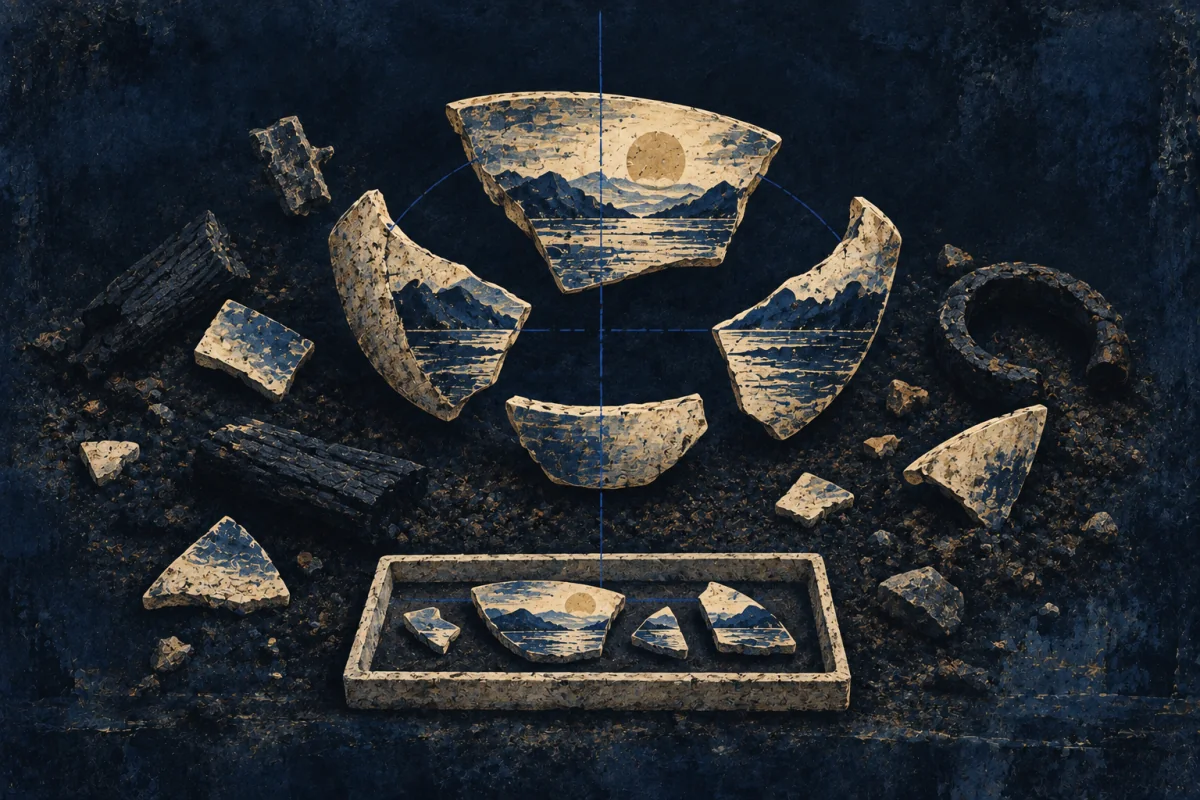
The broken edge.
Two fragments either fit or they do not, and no amount of wanting will make them. The edge is the least interesting-looking part of a pot and the only part that can be tested. Everything decorative on the front is what draws the eye and tells you nothing about what happened.
Take that to any wreckage. Stop looking at the pattern. Turn the piece over and look at where it broke.
Where It Stops
Liking old things is not this, and neither is a good memory for detail. Collectors know enormous amounts and rarely reconstruct anything, because the object is the destination rather than the route.
It goes wrong as over-reading. Fragments are generous: they support several stories, and a person who enjoys the reconstruction more than the constraint will build the most satisfying one and then find support for it. That failure is invisible from inside.
It goes wrong the other way as paralysis, where nothing is ever quite sufficient and the claim never gets staked at all, which protects only the person not staking it.
It also fails where the record is complete. Where there are minutes, a signed contract and three witnesses, this is a long walk to a place somebody could have driven to.
Take the plainer explanation first. Anyone in forensics or field archaeology works this way on duty because the protocol imposes it. The test is whether it appears with no protocol — in a junk shop, over a photograph nobody can explain.
Where It Pays
Inside a job. Fire and accident investigation, forensics, conservation science, archaeology, failure analysis in engineering, fraud examination, provenance research, and the whole of industrial safety, where the question is always what actually happened rather than what got reported. The contribution is that an organisation stops running on the first plausible account, which is nearly always the account of whoever spoke earliest and had most at stake. Insurance and litigation run on it too, since the difference between a payout and a refusal is usually a physical question nobody asked properly.
It pays badly where a conclusion is needed this afternoon, and badly again wherever the organisation has already announced what happened.
Outside one. Family history, house history, old photographs, probate, the long argument about what really happened in 1987 that no two relatives tell the same way. It is also what makes a probate dispute survivable: objects settle arguments that memory cannot. The cost worth naming is that the answer often disappoints — reconstruction produces a smaller, duller truth than the family legend, and delivering it is rarely thanked for. The second is pace. Nobody else wants eleven days, and a person who needs them will be asked, over and over, for a view they do not yet have and are unwilling to invent.
Try This
Find something in your own house whose story nobody can quite tell — an inherited object, a photograph with no names, a document that does not match what you were told.
Do not ask a relative yet. Lay out everything physical you have and write down only what each item proves on its own: this was made after this date, this has been repaired twice, this handwriting is not his.
Then see what is forced when you put them in order, and write down separately the story you were hoping for. Comparing those two lists is the exercise.
The broken edge is a tool, not a self. Pick it up where the record is missing. Put it down where somebody has simply told you the answer.
If This Isn't You
Most people take the account they are given and get on, and they are right to, since the reconstructed version usually changes nothing that can still be changed. Feeling no pull toward a tray of broken pieces is an answer, not a gap.
Where To Go Next
Its near-twin — Track-Counter. Both refuse to guess from a mark and insist on checking it. The Track-Counter counts what is actually there — repeats, tracks, quantities — and the count is the answer. This one sets fragments in relation to one another, and the answer is an event that nobody counted.
Its shadow — Riddle Maker. The Riddle Maker hides a structure deliberately and builds the road back for somebody else to walk. This one walks a road nobody built, through material never arranged to be understood.
Most often confused with — Object-Restorer. Both spend their lives with damaged objects. The Restorer returns the thing to use. This one would rather leave it exactly as broken as it is, because the break is the information.