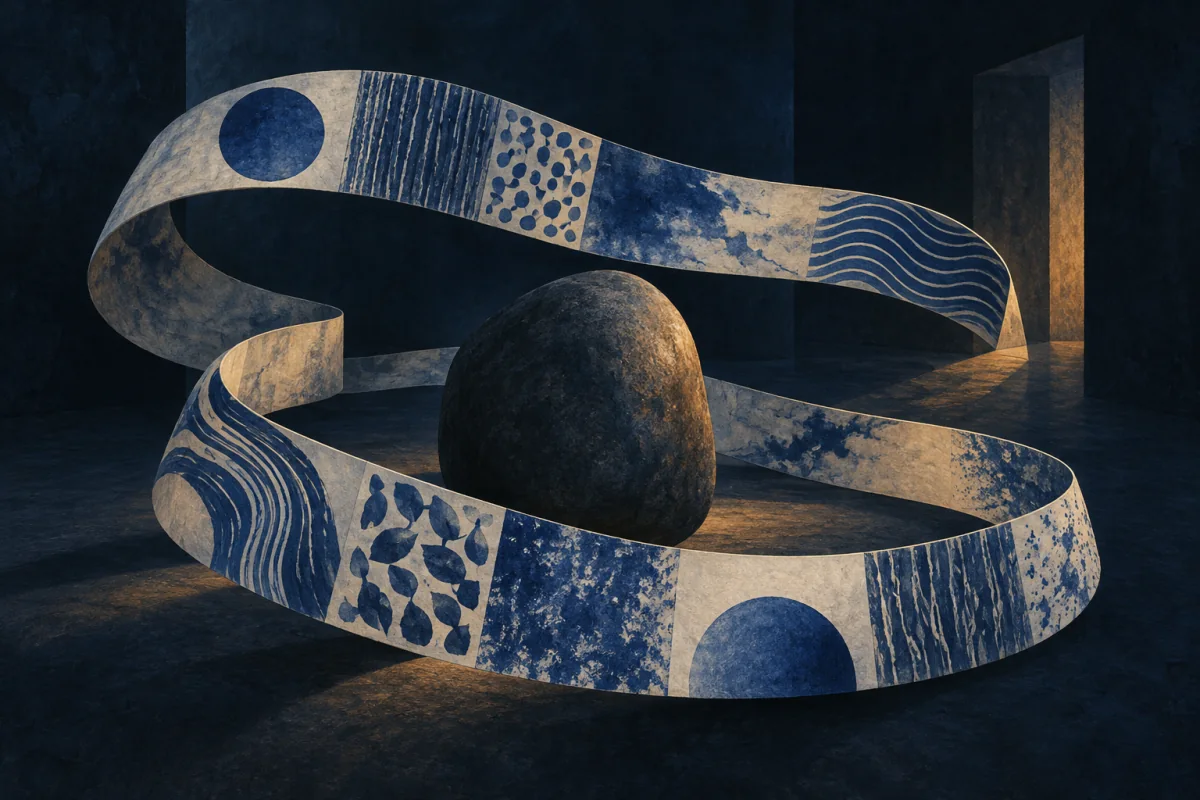
In Plain Sight
Certain people keep a group's memory alive by telling it well. They are not reciting a script; they change the surface so listeners stay with the story, while the main thread stays true. You'd notice this in the cousin who tells the same family story at every gathering and always adds the detail the quiet person missed.
The Pattern at Work
The same table, the fortieth telling of how the grandfather got across the border in 1951. It has been told at this table since before most of the people sitting at it were born, and this year's version is not last year's. There is a seventeen-year-old present who was a small child the last time, so the telling starts later, skips the paperwork entirely, and spends its whole length on the three days in the orchard. Nothing has been invented. The story has been re-cut for the room.
A branch meeting, and someone stands up to talk about a strike that ended forty years ago. Half the people there were not alive for it. This is not nostalgia and it is not a lecture — it is twelve minutes about one winter, one household, and one decision that went the wrong way, told by somebody who was in the house, at a meeting where a vote is coming in an hour. The vote goes differently than it would have gone.
A new intake at a company that nearly folded in its second year. The person running the induction spends twenty minutes on that year, which is on none of the slides. The point being made is not survival or heroism. The point is that one of the rules everybody finds irritating exists because of a particular Thursday in March, and a rule with a Thursday attached to it gets followed.
What connects the three is that the surface moved every time and the thread did not.
What the Examples Show
This gets called a good memory, and that is most of what is wrong with it.
Recall is the smallest part of it. Plenty of people can repeat a story exactly and empty a room doing it, and a story that empties a room is not being kept. It is being stored, which is a different thing and a worse one, because storage looks like success right up until the moment nobody asks for it again.
What runs instead is a live read of the listeners held alongside a fixed sense of what the story is for. The purpose stays constant. Everything else — where to start, how long to take, which details survive and which get dropped — is negotiable, and gets negotiated while the telling is happening.
Which is why the changes are not errors. A story reshaped for a room is a story that will be told again. A story preserved perfectly is usually one that is about to be lost.
Going Deeper
The Mande griot held the genealogies of whole families, sometimes across four centuries, and was honoured and fenced in at the same time: a caste apart, marrying within it, kept by the families whose past they carried. The honour and the fence arrived together, because a group that hands its memory to one person has to decide what that person is allowed to do with it.
The Icelandic saga-tellers worked for three hundred years before anything was written down, and what survives on the page is not a transcript but the shape of a performance. The Irish seanchaí, keeping townland history and genealogy in a country where the written record had been someone else's instrument. The custodian of a songline, where the route across the country and the song describing it are a single object, so that forgetting the song and losing the road are the same event.
Every one of them paid the same three prices.
The first is that the archive is a body. When the person goes the material goes, and the group usually finds out what it had at the funeral.
The second is the pull of the audience. A teller who lives on being listened to will, slowly and without ever deciding to, keep what lands and quietly drop what does not, and the thread bends a degree a decade. Nobody is in the room who can measure it.
The third is that this person is holding the inconvenient version — the uncle who was not a hero, the strike partly lost to somebody's vanity, the founder who was simply wrong. A group wants its memory kept and also wants some of it kept quiet, and it will ask the same person for both.
The Image
The load, not the cart.
Every generation builds its own cart — its own idioms, its own attention span, its own idea of what a good story sounds like. The cart was never meant to last and is not the point. The load is what got handed over, and the entire job is getting it onto the next cart without spilling any.
Carry that one into any room where something true is going to be lost because the telling of it has gone stale.
Where It Stops
Loving an audience is a different thing, and a great many entertaining people are carrying nothing at all. So is a good memory: recall and transmission come apart more often than they travel together.
It goes wrong as improving the story. The licence to move the surface is wide, and it shades — never in a single step — into moving the thread, until the version being told is better than what happened and no longer has anything to teach. The test is whether an alteration serves the listener or the teller.
It also fails where the record is the deliverable. Testimony, minutes, a medical history, a statement to the police: those want it flat and exact, and a reshaped telling there is not a gift, it is a problem.
Take the plainer explanation first. Anyone raised in a family with a strong talking habit will do a version of this with that family's material. The test is whether it appears in a group joined at forty, whose past belongs to other people.
Where It Pays
Inside a job. Induction, institutional memory, any organisation more than about eight years old, and above all any team that keeps rediscovering a lesson it has already paid for once. Regulated work, where the reason behind a rule carries more weight than the rule.
The real contribution is not culture and it is not morale. It is that the same mistake stops being bought twice. Organisations lose their reasons long before they lose their procedures, and a company running rules whose origins nobody remembers is a company that will delete the load-bearing ones in the next efficiency drive. It pays badly, though, wherever the document itself is the deliverable, and badly again in a place that has decided its own past is an embarrassment.
Outside one. Families, congregations, clubs, unions, any community that moved country. This is where nearly all of it happens and none of it is paid for.
The cost worth naming: you become the one who gets asked, and the asking arrives at funerals, at weddings, and in the week after a diagnosis. That is a great deal of weight to be handed at short notice, and nobody in the family thinks to check whether you ever wanted it.
Try This
Take a story you have told more than five times.
Before telling it again, write one sentence saying what it is for — what a listener should be able to do, or avoid, or understand, because they heard it. One sentence, not three.
Then tell it to somebody who has never heard it, and afterwards write down which details you dropped. Those are the cart. What you could not bring yourself to drop is the load.
Do it twice more with different listeners and compare the three lists, because the comparison is the evidence — not whether the room enjoyed it.
The load is a tool, not a self. Pick it up where a group needs to know why it does what it does. Put it down where somebody needs the record exactly as it was.
If This Isn't You
Plenty of people receive a story, hold it privately for fifty years, and never once feel moved to pass it on. The past can matter enormously to someone who has no wish to be its mouth.
Where To Go Next
Its near-twin — Route-Changer. Both hand something across a gap. Route-Changer carries no content in particular and builds the road to it. This one carries the thing itself and will rebuild every road rather than alter the cargo.
Its shadow — Order-Keeper. Order-Keeper protects the record by keeping it identical and refuses the drift outright. This one protects it by letting the surface move every single time. Both are guarding the same thing, and each looks negligent to the other.
Most often confused with — Story-Teller. Story-Teller builds a story to do something to a listener now, and is free to invent. This one is holding material that belongs to a group, and has no such freedom.