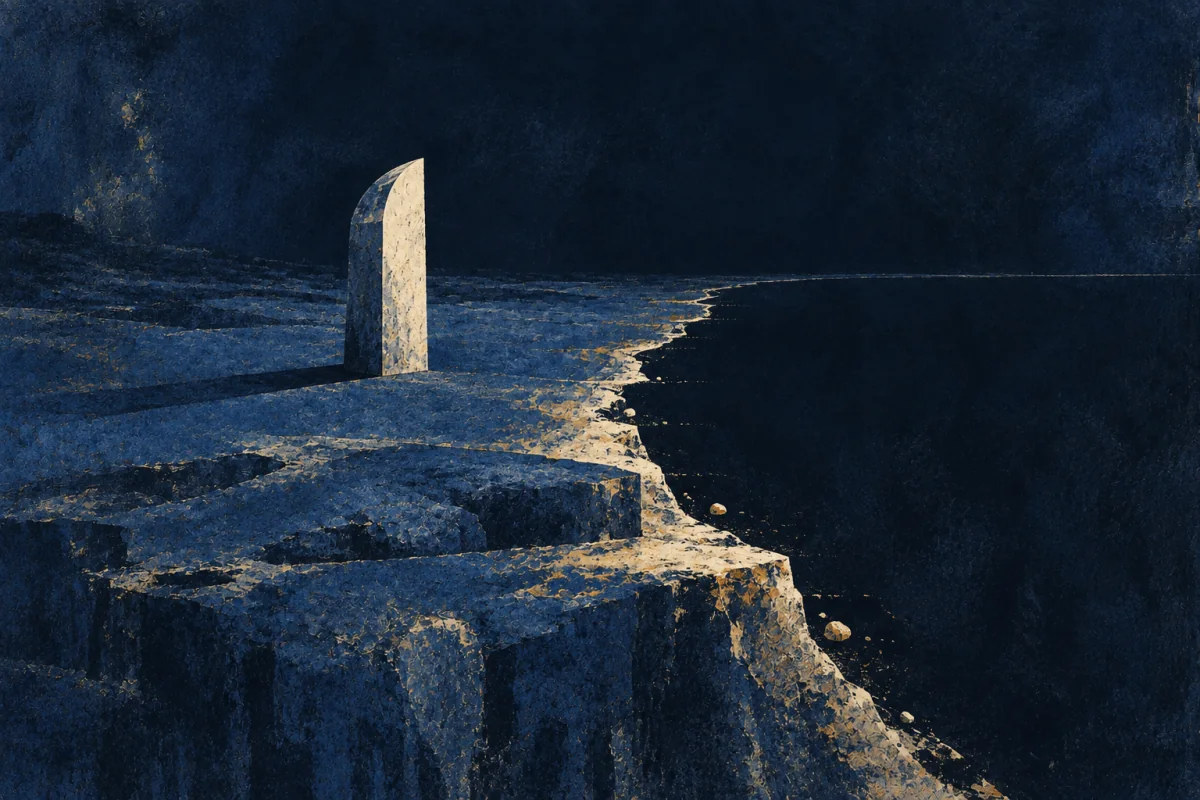
In Plain Sight
Some people are pulled to the line where the known thins out. A ridge, a shoreline, a treeline, the last place anybody bothered to map. They stay there and read what the boundary is doing, watching light, weather, animals and traffic for signs that it is settling or about to turn. You'd notice this in the one who can tell by the wind which way the pass will close.
The Pattern at Work
The pull is towards the boundary itself rather than past it. Where forest becomes scrub, where cultivated ground gives out, where the tide leaves a band that belongs to neither sea nor land. These are the places where most of the information is, because an edge is where two systems are negotiating and the negotiation is visible. The middle of a wood is settled and says very little. The middle of a field says less. Everything interesting is happening in the forty yards where one gives way to the other.
Standing still is the method.
Half an hour on a treeline says more than a day of walking through it. The birds using the edge are different from the ones a hundred yards either side, and their behaviour changes first when weather is coming. Deer tracks crossing in one direction at dusk and not returning mean something. Young trees advancing into open ground on one flank and not another say which way the edge is moving over years, not hours. Human traffic reads the same way: a path worn where none is marked, a gate that has started being left open, rubbish at a particular distance from a road. Somebody with this reading builds a picture of whether a boundary is stable, creeping, or about to shift, and the picture is assembled from things that individually mean nothing at all. The conclusions arrive slowly and are held loosely, and the person holding them would usually rather sit for another hour than commit. Asked directly, they will often say only that something is changing and they are not yet sure what, which is an honest answer and a useless one to anybody who wanted a number.
What the Examples Show
It gets read as restlessness, or as a taste for solitude, or as somebody who likes a view.
The first element is that the boundary is the subject. Not the wild side and not the settled side, but the band between them, which is where change is legible earliest.
The second is patience used as an instrument. The reading requires being in one place long enough for the ordinary rhythm to show itself, which is why this attention looks so much like idling.
The third is that it integrates weather, animals, plants and people into one picture. Anything crossing the edge is evidence, and the person doing the reading does not much distinguish between a bird's behaviour and a farmer's.
Going Deeper
Edges have always been worth watching, and the people who watched them occupied a particular social position.
Transhumant herders across the Alps, the Pyrenees and Central Asia read the line where grazing gives out, and the timing of a move up or down was a judgement about an edge rather than a date. Coastal communities everywhere built a body of knowledge about the band the tide works over, which belongs to nobody and feeds many. Forest peoples in Scandinavia and North America held detailed accounts of where the treeline sat in living memory and which way it had gone. Frontier settlements have always contained somebody whose standing came from knowing what the boundary was doing this season. None of these people were explorers. They stayed put, at the margin, and their value was continuity rather than range.
What has followed the role consistently, and what it has cost, is worth saying plainly. The edge-dweller belongs fully to neither side and is treated with suspicion by both, which is a durable social fact rather than a misunderstanding. The knowledge is slow and unprovable: saying a boundary is about to move is a forecast that takes years to test, and nobody funds that. It attaches to one edge and does not transfer, so the person is tied to a place that is itself unstable. And the edges themselves are now moving for reasons that outrun local reading entirely, which means a lifetime of careful observation can be overtaken by a climate that no longer repeats.
The Image
The half hour.
Sitting down at the treeline and not moving, when walking on would cover ten times the ground.
Almost nothing is happening, which is the point. The ordinary rhythm of an edge only shows itself to somebody who has outlasted their own restlessness, and everything worth knowing about a boundary is a departure from a rhythm that has to be learned first.
Where It Stops
Liking wild places is not this, and neither is walking a long way into them. The attention sits on the boundary and is largely uninterested in what is beyond it.
It goes wrong as preferring the edge to any of the living that happens either side. A person can organise a whole life around being at the margin, and call it attentiveness when it has become an unwillingness to be in a community.
It also fails where the reading gets stated as prediction. Edges move for reasons that include policy, money and climate, and somebody reading only the physical signs will be confidently wrong about a treeline that is actually being decided in an office.
Take the plainer explanation first. Anybody who works the margin of cultivated land watches it closely, because the job depends on it. The test is whether the same pull appears where nothing depends on it — a city's last street, a carpark backing onto scrub, the end of a pier.
Where It Pays
Inside a job. Ranger and warden work, ecological survey and monitoring, conservation land management, forestry at the margin, coastal and estuarine work, grazing and transhumance, field research, and the observation end of climate and habitat science. Also land management for fire risk, where knowing what a boundary is doing this season is the whole of the job.
What is being bought is early notice of a change that instruments detect late and surveys detect annually. Somebody sitting on the same edge for years supplies a continuous record that no funded programme could afford, and it is frequently the only evidence that something began before anybody was measuring.
Where it pays badly is anywhere results are wanted inside a funding cycle, since this reading produces a sentence a year. It pays badly wherever observation must be converted into data by a protocol that discards exactly the peripheral things the reading is built from, and in any role that moves staff between sites.
Outside one. Smallholders, hunters, walkers, sea swimmers, and everybody who has kept an eye on the same stretch for decades. The cost worth naming is that this attention notices loss first, and watching an edge move the wrong way for twenty years is a particular kind of grief with no name and no audience.
Try This
Find an edge you can reach easily. Where mown grass becomes rough, where trees stop, where a beach turns to shingle, where a town's last building gives out.
Go there four times over a month, at different hours, and stay half an hour without walking on.
Write down only what crosses the line and in which direction. Birds, people, dogs, water, litter, light.
At the end, see whether you can say which way the edge is moving. You probably can, and none of the individual entries will have told you.
Reading an edge is a tool, not a self. Pick it up where two things meet and something is being decided between them. Set it down when you notice you have stopped going anywhere else, because then the edge has become a place to hide.
If This Isn't You
Most people cross a boundary without registering it, get where they were going, and lose nothing at all. Not stopping at the treeline is an answer, not a bluntness.
Where To Go Next
Its near-twin — Map-Edge Walker. Both are drawn to where the known stops. Map-Edge Walker crosses, and is after what is on the other side. This one stays on the line, and is after what the line itself is doing.
Its shadow — Boundary-Watcher. Boundary-Watcher walks a perimeter that belongs to somebody, to catch what has changed since yesterday. This one sits at a boundary that belongs to nobody and is reading change measured in seasons.
Most often confused with — Stillness-Holder. Both wait a long time in one place. Stillness-Holder is waiting for something to appear and the place is incidental. This one is reading the place itself, and would sit there whether or not anything came.