In Plain Sight
Some people are held by the discipline of multiplying an image without drift. Cutting a block, biting a plate, pulling proof after proof until every copy holds the original line. It is exacting at small scale and content to repeat the same gesture for as long as the edition takes. You'd notice this in the one who still gets a clean register on the first pull.
The Pattern at Work
Everything is decided before anything is printed. A line cut into a block is gone, and a plate that has been in the acid four minutes too long cannot be un-bitten, so the work runs backwards from a finished image through a sequence of irreversible steps. Somebody experienced is thinking two operations ahead constantly: what this cut removes, what the paper will do when it is damp, how much the ink will spread into a fine line and therefore how much thinner it has to be cut than it should appear.
The proofing stage is where the judgement lives. A proof is pulled, looked at, and the difference between what is on the paper and what was intended is traced back to a cause — too little pressure, too much ink, a burr, paper that was not damp enough. That diagnosis is the skill. Most people can see that a print is wrong; far fewer can say which of six variables did it.
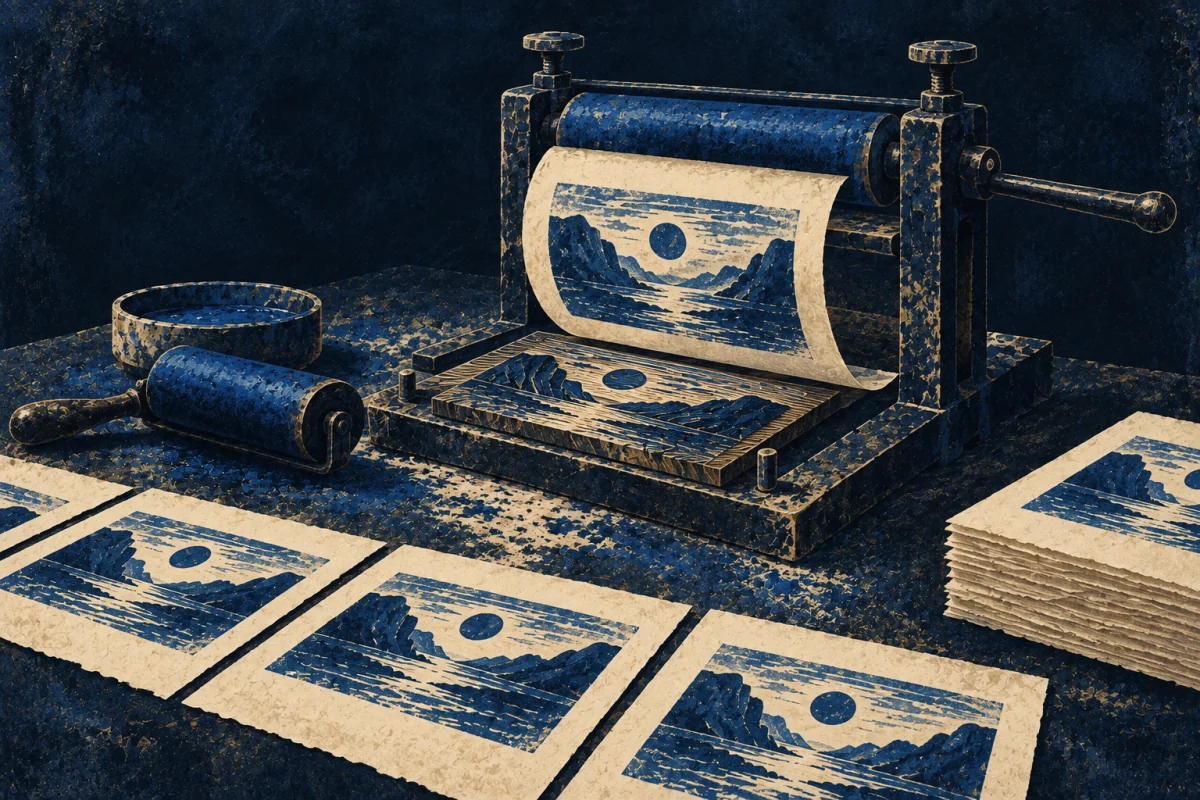
Then the edition, which is the part nobody outside the trade understands. Two hundred prints that are the same. Ink mixed to hold its consistency across a day, pressure unchanged, paper conditioned identically, register hit every time. It is repetitive by design and there is real satisfaction in it: a rhythm develops, and the hand settles into something that produces the same result without deliberation.
And the hands stay small and exact. Everything happens within a few millimetres, and the physical control needed for a clean register is closer to watchmaking than to drawing.
What the Examples Show
It gets read as printmaking, or as an art-and-craft hobby, or as a slow way of making pictures that a copier does faster.
The first element is that the work is committed and irreversible. Every step removes options, so the thinking has to run ahead of the hand, and there is no undoing anything.
The second is diagnostic proofing. What is being read is not whether the print is good but which variable produced the fault, and that reading is what separates somebody who can print from somebody who can make an edition.
The third is tolerance for exact repetition. The same gesture, many times, held to a standard that does not drift, which most people find tedious and a few find genuinely settling. The edition is the product, not any single impression.
Going Deeper
Printmaking was the first technology for reproducing an image reliably, and for four centuries it carried most of what people knew.
Woodblock printing in China and Japan produced both books and pictures, and the Japanese ukiyo-e workshops split the work between designer, cutter and printer, with the printer holding the colour registration across a whole edition. European engraving and etching carried scientific illustration, portraiture and news, and the skill of the plate-maker determined what the public could see. Lithography industrialised the whole thing in the nineteenth century and put cheap colour images into ordinary houses for the first time. In each case an image mattered only if somebody could produce it identically hundreds of times, and that person was almost never the one credited with it. The designer is remembered; the printer who held the register across an edition of two thousand is not.
What happened next is familiar, and it lands on the people still doing it. Photographic and then digital reproduction took the function away completely, leaving the craft as an art practice supported by a small market. Studio access is the main barrier now: presses, ventilation and space are expensive, so the trade depends on shared workshops, and those keep closing as rents rise. The materials have real hazards, and generations of printmakers worked with acids and solvents whose effects arrived decades later. And the editioning that defines the craft is exactly the part collectors discount, since scarcity sells and this work is built to be multiple.
The Image
The register.
Two colours laid down on separate blocks, meeting exactly, with no white line and no overlap.
There is nothing clever about it and it cannot be faked. Either the paper went down in precisely the same place two hundred times or it did not, and every print in the edition says which. It is the plainest possible test of whether somebody's hands do what they intend.
Where It Stops
Being able to draw is not this, and neither is liking prints. The work is reverse-planning, diagnosis and exact repetition, and the image is only part of it.
It goes wrong as technique without a reason. A printmaker can spend years perfecting a process and producing editions of something that did not need making, and the craft is absorbing enough to hide that for a long time.
It also fails where speed or change is wanted. Anything that needs to be revised, iterated or produced quickly is the wrong job for a method whose whole discipline is commitment, and a digital file will beat it every time.
Take the plainer explanation first. Anybody trained in printmaking proofs and editions, because the course requires it. The test is whether the same attention appears where nothing is being printed — a stamp, a stencil, a repeated mark on anything that had to line up.
Where It Pays
Inside a job. Fine art printmaking and master printing for other artists, studio and workshop management, print conservation, letterpress and book-arts work, textile and wallpaper printing, packaging and specialist production printing, and teaching in all of these. Also currency, security and stamp printing, where controlled registration is the entire point.
What is being bought is fidelity across a run. Anybody can produce one good impression; producing four hundred that a buyer cannot tell apart, on paper that moves with humidity, with ink that changes through the day, is a distinct and rare competence, and master printers are sought by name for exactly that.
Where it pays badly is throughout the art side, where a studio costs more than the prints earn and editions are priced against a market that rewards uniqueness. It pays badly in teaching, which is where most printmakers actually earn, and in any commercial operation where digital output is close enough for the client.
Outside one. Community print studios, artists' books, posters for causes and the long history of printmaking as the cheapest way to put an image into many hands. The cost worth naming is that it takes a room: this is one of the few practices that simply cannot be done at a kitchen table, so it lives or dies on access to a press.
Try This
Make something repeatable by hand. A simple stamp cut into a potato, an eraser or a lino offcut will do.
Print it twenty times on the same sheet, in a grid, trying to make every impression identical.
They will not be. Look at the twenty and, for each bad one, say out loud which variable caused it: too much ink, too little pressure, paper shifted, block not clean.
That naming is the whole craft, and twenty prints is enough to start seeing it.
Exact repetition is a tool, not a self. Pick it up where many copies have to carry the same line. Put it down where the thing still needs changing, because a method built on commitment is a poor way to find out what you meant.
If This Isn't You
Most people press print, take what comes out, and get on with the work, which is what the machine is for. Not caring whether the two hundredth matches the first is an answer, not a carelessness.
Where To Go Next
Its near-twin — Pattern-Etcher. Both cut into a surface with great precision. Pattern-Etcher is making the marked object itself, which is the finished thing. This one is making a matrix, and the object only matters through what it prints.
Its shadow — Image-Maker. Image-Maker is after the single image and will change it until it is right. This one commits early, cannot revise, and spends most of the time making copies of a decision already taken.
Most often confused with — Scribe-Hand. Both reproduce by hand to an exacting standard. Scribe-Hand makes each copy individually, so every one is a fresh act. This one makes the thing that makes the copies, and then the copies are mechanical.