In Plain Sight
A person with this pattern makes a messy set of clues clear by checking them more than once. They do not trust a guess because it feels right, but test it by marking the same kind of clue again. You'd spot this in the person who rewrites the seating chart five times, then sees two names that should not sit together.
The Pattern at Work
A seating plan for a hundred and forty people, redone five times. The first version was built from the guest list, the second from who arrived with whom, the third by table and the fourth by family line. None of those was wrong and none of them showed anything. The fifth is arranged by who has not spoken to whom since a particular year, which is not a category anybody supplied — it emerged from having drawn the same set of people four times and noticed which two names kept ending up near each other by accident. The wedding goes fine. Nobody will ever know that it was arranged around a single adjacency that took four attempts to become visible.
A support team with forty tickets and no obvious theme. Somebody writes them out by product, then by customer, then by time of day, then by the exact wording of the first sentence. The fourth pass shows eleven tickets that begin with a variation of the same phrase, which turns out to be one confusing button.
A ward's falls over six months, tabulated by patient, by time, by ward and finally by the member of staff on shift — not to blame anyone, but because it was the one cut nobody had drawn. It shows nothing about staff. It shows that the falls cluster in the forty minutes around handover, whoever is on.
What links them is that nothing was searched for. The same material was re-laid four times and the structure fell out of the redrawing.
What the Examples Show
Thoroughness is the usual verdict, and it misses the mechanism entirely.
Thoroughness means covering everything once. What happens here is that the same material is represented repeatedly, in different arrangements, and the finding appears in what survives across them. A pattern that shows up under one ordering is probably an artefact of that ordering. A pattern that keeps appearing whichever way the material is laid out is a property of the material.
Which is why the discarded versions are not waste. They are the control. Four drawings that showed nothing are precisely what makes the fifth credible, and a person who produced the fifth directly would have no reason to believe it.
And it explains the refusal to accept a strong hunch. A hunch arrives from one arrangement, usually the first, and feeling right is exactly what an artefact of the first arrangement feels like.
Going Deeper
John Snow had a list of cholera deaths in Soho and a theory nobody accepted. What changed the argument was not the list but the map: the deaths drawn onto the streets, then drawn again by distance to each pump, until the cluster around the Broad Street handle was something no one could look past. He paid for it in the ordinary way — the removal of the pump handle was allowed, the theory was not accepted for years, and the general board of health published a report rejecting it.
Florence Nightingale did the same thing with mortality in the Crimea, redrawing the figures until the shape showed that most of the deaths were preventable disease rather than wounds. She understood exactly why the redrawing mattered: she was not adding information, she was arranging it until it could not be dismissed by people who had every reason to dismiss it, which is work that reads afterwards as decoration.
The epidemiologist's line list. The cartographer's successive fair copies. The tailor's pattern pieces, cut in cheap cloth first and thrown away.
Three costs, consistent across all of them.
The redrawing looks like indecision, and in any organisation with a schedule it is the first thing offered up when time is short.
The finding, once seen, looks obvious, and the four failed versions are invisible. Credit accrues to whoever says the sentence, not to whoever made the sentence sayable.
And there is a trap inside the method: the drawing is pleasant, and can quietly become the work, so that a person produces eleven beautiful arrangements of a thing and no conclusion at all.
The Image
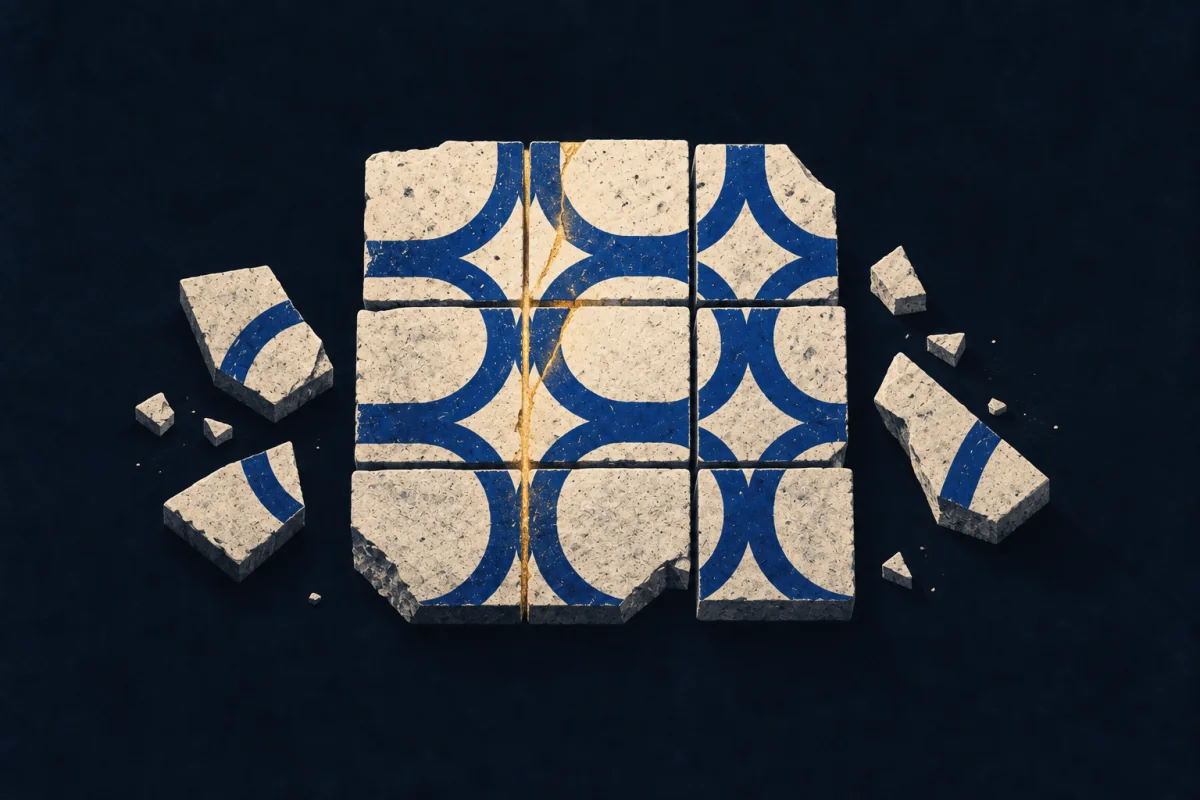
The fourth drawing.
The first three showed nothing, and they are the entire reason the fourth can be believed. A structure that survives being laid out four different ways is a property of the material. One that appears in a single version was a property of the layout, and it will feel exactly as convincing.
Carry that one into any set of facts that has a story attached to it already.
Where It Stops
Neatness is a red herring. Several people who do this work in appalling handwriting on the backs of things, and plenty of immaculate record keepers never redraw anything.
It goes wrong as never stopping. There is always another cut available, and the point at which the arrangements stop yielding is a judgement rather than a signal. A person who cannot make that call will keep redrawing past the moment the answer was in front of them.
It also fails where the data will not bear the weight. Four arrangements of eleven data points produce four different compelling pictures, and the method gives each of them the same air of having been tested. Small numbers plus repeated re-cutting is a machine for manufacturing confidence.
Take the plainer explanation first. Anyone who has been wrong once about a particular kind of pattern will check that kind twice forever afterwards, which is a scar rather than a method. The test is whether the redrawing happens on material where nothing has gone wrong before.
Where It Pays
The contribution is that a group stops acting on the first arrangement of its own information, which is where a startling proportion of expensive decisions come from. Data arrives already organised — by department, by date, by whoever built the report — and that organisation is invisible and is doing an enormous amount of work on what people conclude. Someone who will re-cut it three more times before anybody decides anything is not being careful. They are removing an error that nobody in the room can see, because it is built into the shape of the page they are looking at. This is worth most in epidemiology and public health, safety and incident analysis, quality engineering, audit, intelligence work, and any investigation where the material is complete and the meaning is not. It pays badly wherever the answer is wanted this afternoon, and badly again in a culture that treats a second version of anything as evidence the first was botched.
Outside work it turns up in family histories, allotment records, household accounts, and any long amateur inquiry. The cost worth naming is that the four discarded versions are never seen by anyone, so this person spends most of their effort on work that, by design, leaves no trace — and is then described as somebody who spotted something.
Try This
Take a set of facts you already have a view about and write it out again in a different order.
Not a better order — a different one. By time if it was by person, by size if it was by time, alphabetically if nothing else offers. Do it three times, quickly and untidily, without trying to find anything.
Then look at what appears in all four versions and what appears in only one. What survives every arrangement is worth acting on. What appeared once was probably made by the way you first wrote it down.
The fourth drawing is a tool, not a self. Pick it up where the material is complete and the meaning is not. Put it down where there are eleven data points and any picture at all would be flattering.
If This Isn't You
Most people read a table once and form a view, and that view is right often enough for ordinary life to proceed. Trusting the first arrangement is not laziness; it is what the first arrangement is for.
Where To Go Next
Its near-twin — Hidden Pattern Finder. Both bring out structure nobody pointed at. Hidden Pattern Finder sees it, often immediately, and then has to explain it. This one cannot see it at all until the material has been laid out four ways, and then does not have to explain anything.
Its shadow — Speed-Chaser. Speed-Chaser gets to a usable answer in ninety seconds by cutting the field down. This one gets to a trustworthy answer in four days by laying the field out again, and neither can afford the other's method on the other's problem.
Most often confused with — Track-Counter. Track-Counter verifies: everything gets counted, and the anomaly appears against a complete tally. This one does not count anything. It rearranges, and the finding appears in what refuses to move.