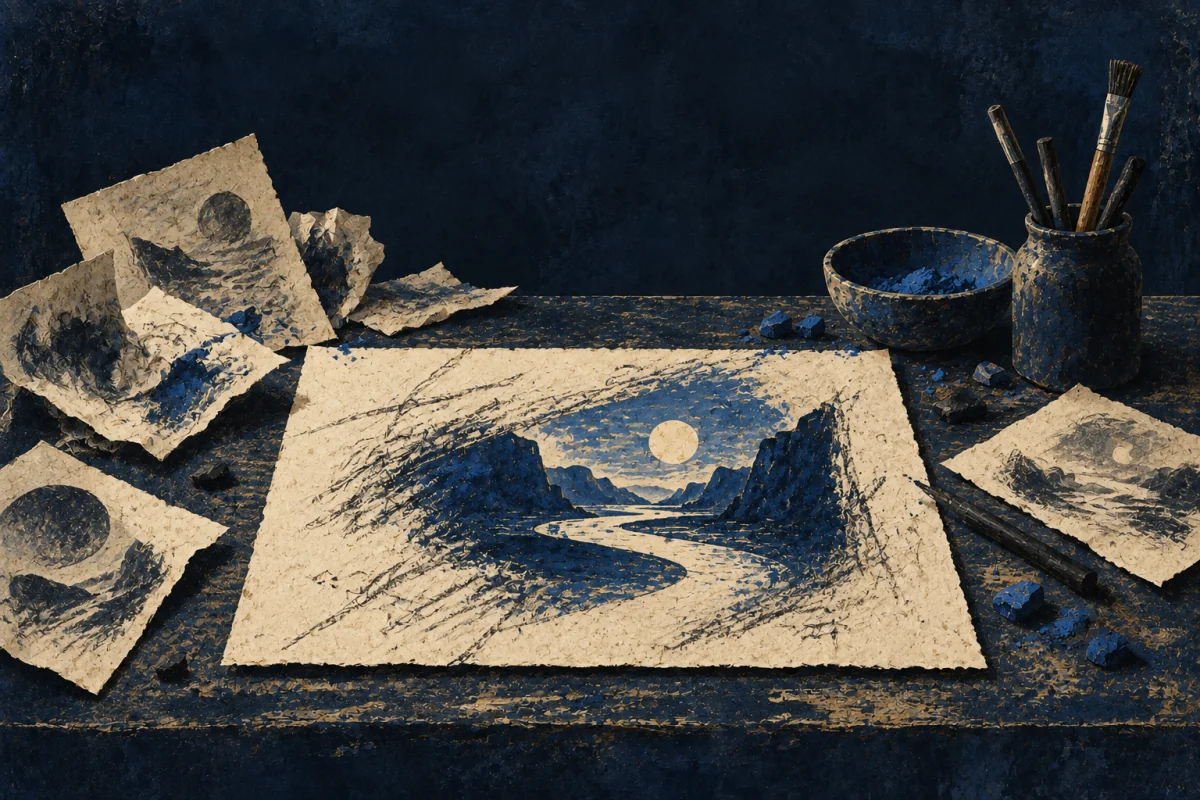
In Plain Sight
This person carries a picture in the head and works until the paper matches it. They are not copying what is in front of them. The hand keeps adjusting, for hours, against something only they can see. You'd find this in the neighbor who fills the margin of every page and still sharpens pencils at the kitchen table.
The Pattern at Work
She has drawn the same corner of the same room forty-one times. It is not an interesting corner: a chair, part of a window, the edge of a radiator. What she is after is one quality of light that occurs there in February at about four o'clock, and the first thirty attempts were not failures of drawing. They were failures of noticing — each one revealed something she had been putting in because she knew it was there rather than because she could see it. The radiator has fewer lines in it every time. The version that works has almost nothing in it at all.
A man carves birds and works from no reference. There are photographs in the workshop and he does not use them, because a photograph flattens the thing he is chasing, which is not what a jackdaw looks like but how it holds its weight. He has watched them for thirty years. The carving goes wrong at the shoulder every time, gets cut back, and goes wrong again slightly differently, and the difference between the eleventh bird and the fortieth is invisible to everybody except him and entirely the point to him.
A woman illustrating a children's book redraws one page nine times for a publisher who was happy with the second. She cannot explain what is wrong with the second, except that it is not the thing. The ninth is the thing. The publisher cannot see the difference, and says so, and is not being unkind.
What the Examples Show
The obvious reading is perfectionism, and it is the wrong frame. A perfectionist is measuring against a standard. All three of these are measuring against a picture nobody else can see, which is a different problem and has no ceiling in it.
What is running is translation. There is an image in the head that is complete, detailed and not made of marks, and the work is getting it onto a surface that can only hold lines and pigment. Every attempt loses something. The forty-one drawings are not repetitions; each is a different set of decisions about what to sacrifice.
The second half is the fight with knowledge. Most drawing failures are not failures of hand but of memory — a person draws the radiator they know rather than the one they can see, and the corrections all run in the direction of removing things. That is why the good version has less in it than the early ones, which is counter-intuitive to everybody watching and obvious to anybody who has done it.
Going Deeper
The problem has been recognised for as long as anybody has drawn. Dürer produced study after study of hands, hares and grass — work nobody commissioned and which existed only to get closer to something he could already see. Hokusai wrote at seventy-three that nothing he had made before seventy was of any consequence, and that by a hundred and ten every dot would be alive — not modesty, but a man describing a gap that had not closed in sixty years.
Photography changed the terms and did not remove the problem. Representation stopped being the job, and what was left was the part this pattern was always doing.
The teaching tradition arrived at the same diagnosis from the other side. Every drawing course spends its first weeks trying to interrupt what the student knows: draw the negative space, draw it upside down, draw without looking at the paper. All of those exercises exist to stop the symbol taking over from the sight.
The costs are unusual in that nobody else can see the target. A miss cannot be explained, which is why the ninth version of the page has no justification the publisher will accept and the artist cannot supply one. The hours are solitary and largely invisible, and there is no external measure of progress — only a private sense that the thirty-first is closer than the thirtieth. And the gap does not close. Every account from inside this work says the same thing: the finished piece is much further from the picture than anybody looking at it imagines.
The Image
What is behind the eye.
Two things are going on whenever somebody draws. One is the surface, which everybody can see and discuss. The other is the picture in the head, which nobody else has access to and against which the surface is being constantly judged.
Almost every argument about somebody's work is a conversation about the first thing with a person who is looking at the second.
Where It Stops
Being good at drawing is not this. Plenty of extremely skilled draughtsmen work happily from references and have no interior picture they are chasing at all, which makes them faster, more employable and frequently better company.
It goes wrong as a gap that eats everything. The ninth version for a publisher who liked the second is not always integrity; sometimes it is a person who cannot stop, and the difference is whether anything ever gets delivered.
It goes wrong again as contempt for the finished thing. A maker who can only see the loss becomes unable to accept praise, which is wearing for everybody around them and eventually for them.
It also fails where the job is accuracy. Technical illustration, court drawing and surveying all want the radiator with all its lines in, and an interior picture is an obstacle in that work.
Take the plainer explanation first. Anyone trained in art school has been taught to work this way. The test is whether it happens in a margin, at a kitchen table, with nothing commissioned.
Where It Pays
Inside a job. Illustration and concept art, animation, printmaking, carving and modelmaking, design where an image has to be invented rather than assembled, tattooing, and the parts of film and game production where somebody has to draw a thing that does not exist yet. The contribution is that an image arrives which was not available to be photographed, and no amount of reference-gathering substitutes for it. Whole industries now run on people who can draw the thing nobody has photographed. It pays badly on a deadline that does not care, and badly again in work that is measured in revisions, because this pattern's natural revision count is high and its reasons cannot be written into a brief, which is how a brilliant illustrator acquires a reputation for being difficult.
Outside one. Sketchbooks, margins, carving, model-making, and the long private practice of drawing that a great many people keep up for decades without showing anybody. The cost worth naming is that the work cannot be discussed. Nobody can see what it is being measured against, so praise lands as though aimed at someone else and criticism lands as though it missed. The second is the hours, which are solitary by necessity and which a household experiences simply as absence.
Try This
Draw something in front of you for ten minutes — badly is fine, this is not about skill.
Then draw it again with one rule: put in only what you can actually see from where you are sitting. Not the four legs you know the chair has. Not the full circle of the cup's rim. Only what reaches your eye.
The second drawing will have less in it and look more like the thing. That gap is the whole subject of this card, and observing it needs no talent — only a willingness to notice how much you were drawing from memory.
The interior picture is a tool, not a self. Pick it up where an image has to be made rather than recorded. Put it down where somebody needs an accurate drawing of a radiator.
If This Isn't You
Most people take a photograph, which is quicker, more accurate and entirely sufficient for what they wanted. Feeling no pull toward the forty-first attempt at the same corner is an answer, not a gap.
Where To Go Next
Its near-twin — Symbol Maker. Both reduce until only what matters is left. The Symbol Maker compresses a whole idea into a mark that must read instantly to strangers. This one compresses nothing, and is trying to carry across as much as it can of something it already sees.
Its shadow — Audience-Singer. The Audience-Singer's work exists in the exchange with a room and is not finished until somebody is watching. This one's work is finished, or not, in an empty room, and an audience changes nothing about whether the light in the corner came out right.
Most often confused with — Wheel-Potter. Both do long solitary handwork and both judge by something they cannot articulate. The Wheel-Potter's standard is in the fingertips and in what the material will do. This one's is a picture, and the material is only ever in the way.