In Plain Sight
This person moves to the front when others need cover. Power is not the point; they lead because someone has to notice risk and make the first steady move. Recognizable in the teammate who sees a new member getting blamed, asks one clear question, and shifts the whole group back toward fairness.
The Pattern at Work
A ferry has lost power and the announcements have stopped. Two hundred people in a lounge are doing the thing crowds do, which is watching each other for what to feel. A member of crew walks through the middle at walking pace, not fast, and says three things: what has happened, what is being done, when she will come back. She does not say it will be fine. She comes back when she said she would, which is the part that actually works, and the second time nobody in the lounge stands up.
A team meeting where one person is being quietly buried. Nobody has been unkind, exactly; the account has just drifted so that a new starter is carrying something that belonged to a process. One person asks a single question — what would have had to happen for her to have known about the deadline — and the room answers it honestly because it is a fair question. The blame does not so much get lifted as dissolve, and nobody has been accused of anything.
A walking group in weather that has turned, two hours from the car, with one person underdressed and starting to shiver. The decision is to turn back, and it is made out loud, immediately, by somebody who then gives three specific instructions: the spare layer goes on her now, the two strongest walk at the front, everyone stops every ten minutes. None of it is complicated. All of it is a relief.
What those have in common is not authority. In two of them the person has none.
What the Examples Show
This gets called natural leadership, or being good under pressure, and both suggest something a person is rather than something they do.
The first move is inward. A frightened group is reading bodies, not words, and an unsteady voice propagates faster than any instruction lands. So the work begins with the leader's own state, and everything after that is downstream of it — which is why calm here is a discipline rather than a temperament, and why people who feel it strongly can still do this while people who feel nothing sometimes cannot.
The second move is reducing choice. Under threat, groups do not need information; they need to know what to do next. Three specific instructions beat an accurate briefing, and the accuracy costs lives in the settings where this originally mattered.
And it explains the retreat afterwards. This pattern goes to the front because somebody must, not because being there is pleasant, and it usually steps back the moment the danger passes — which is why it is so often missed by anybody looking for leaders.
Going Deeper
Anywhere a group has been in danger, somebody has had to be the one whose voice does not shake.
Battlefield command is the oldest version and the most written about, but the same figure is a ship's captain in a storm, holding a crew through hours when the honest answer is that nobody knows yet. It is the fire-ground incident commander standing outside a building, taking reports and giving three orders. It is the charge nurse who walks into an emergency department at its worst moment and starts by slowing everything down. It is the evacuation marshal in a stairwell saying the same sentence four hundred times. It is the trip leader on a mountain deciding to turn a group around against their wishes.
None of those roles are about courage in the ordinary sense, and the literature on all of them says the same thing: the decisive variable is whether the person in front can regulate themselves while frightened. Everything else — the plan, the training, the equipment — works only downstream of that.
What it takes has been constant. The role is held alone and cannot be shared in the moment, because a group can follow one voice and not two. The decisions are made on thin information and reviewed later by people with better information, and that asymmetry never resolves. And the person who held it is expected to be fine afterwards, since they were the calm one, so the reckoning happens privately or not at all — which is why the ones who do this repeatedly tend to be quiet about it and tend to know each other.
The Image
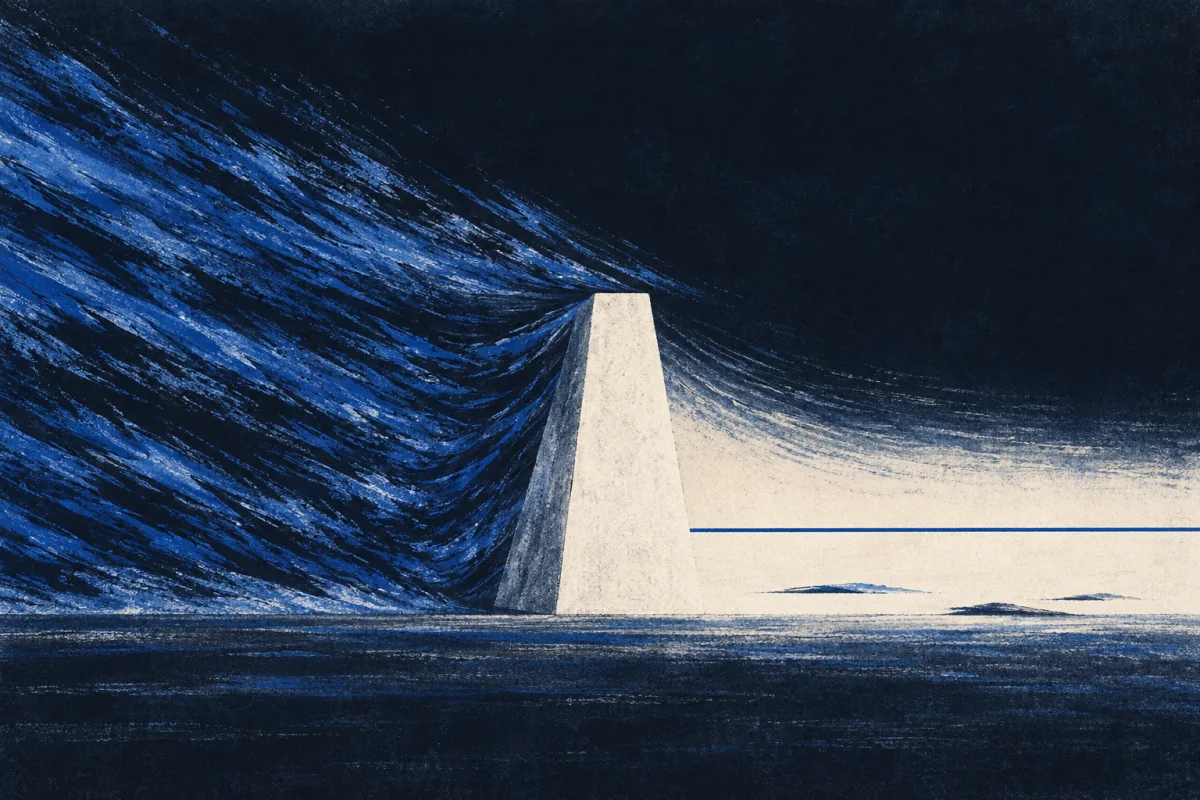
The first steady move.
Not the plan. The first visible action taken at ordinary speed while everybody else is deciding whether to panic. Groups take their reading from it, and it is mostly what they remember afterwards.
Carry that one into any room that has just been given bad news. The question is not what to say. It is what the first thing you do looks like to somebody watching you decide.
Where It Stops
Confidence is not this, and loud is not this. Some of the most assured people in a room go rigid when it actually turns, and some who do this well are visibly frightened and do it anyway.
It goes wrong as taking the front where nobody needed covering. Not every difficulty is a danger, and a group that is merely working things out does not want three instructions. The pull to step forward does not check whether there is a threat.
There is a failure that reads as strength: staying in front after the emergency has ended. The same moves that settle a frightened group infantilise a calm one, and the handover back is a separate skill that does not come with the pattern.
And take the plainer explanation first. Anyone trained in incident command, aviation or emergency medicine will produce all of this inside their role, because the training exists to install it. The test is whether it appears with no authority at all — in a meeting, a street, a family, where nobody has to listen.
Where It Pays
Inside a job. Anywhere people work near real consequence: emergency services, clinical settings, marine and aviation, site safety, security, outdoor instruction. Also the entire unglamorous middle of ordinary organisations — restructures, failures, the week after something went badly wrong — where the need is identical and nobody calls it an emergency. The real contribution is not decisions. It is that a group stays a group. Frightened people fragment, act individually, and make the situation worse in a dozen small uncoordinated ways, and the single largest determinant of whether that happens is whether one person moved early and visibly.
Outside one. Families in crisis, accidents at the roadside, community emergencies, and the more common version — being the one who speaks when something unfair is happening in a room and everybody can see it. It pays badly where the work is sustained and calm, because the pattern is built for the moment things turn and can look like somebody waiting for weather. It pays badly again in cultures that reward visible authority, since this tends to hand the group back and go quiet. The cost worth naming plainly is that being the steady one gets assigned, permanently, by people who were not steady and do not remember choosing. Nobody asks afterwards what it took.
Try This
Next time a group you are in gets bad news, watch the first thirty seconds and do nothing in them.
Notice where people look. They look at one or two faces before anybody speaks, and those faces set what happens next.
Then, if nobody has moved, do one small visible thing at ordinary speed. Sit down. Put the kettle on. Say what is known and what is not.
Watch whether the room's speed changes. That is the evidence, not whether anybody thanked you.
The first steady move is a tool, not a self. Use it when a group is about to scatter. Put it down the moment it has not, because a calm room does not need managing.
If This Isn't You
Plenty of capable people wait to be told what to do in an emergency and then do it extremely well, which is most of what any group needs. Not wanting the front is not a smallness.
Where To Go Next
Its near-twin — Triage-Mind. Both act when things go wrong. Triage-Mind is deciding what gets attention and in what order. This one is holding the group together so that the order can be carried out at all.
Its shadow — Grief-Holder. The Grief-Holder stays still and asks nothing of anybody. This one moves first and gives instructions. Both are right, and the wrong one at the wrong moment does real damage.
Most often confused with — Protective Watcher. Both put themselves between people and harm. The Watcher works alone and early, before anything has happened. This one works in front of a group after it has, and needs an audience to function at all.