In Plain Sight
Some people treat writing as a thing made rather than typed. They are not being decorative. Ink, line and spacing carry part of the meaning, and the hand slows until the shape of a letter matters as much as the word. You'd notice this in the one whose ledgers still read well forty years on.
The Pattern at Work
The register is a working document and has been kept by the same hand since 1981. It is not calligraphy and nobody has ever called it beautiful. What it is, is legible — every entry at the same size, the columns holding, the numerals unambiguous in a way that matters because a seven read as a one is a real event, and the corrections done as a single ruled line with the original still readable underneath. Four decades on it can be read by a stranger at speed, without hesitation, on a bad photocopy. The registers either side of it, kept by people in a hurry, cannot be, and the difference has cost somebody several afternoons.
A letter that has to say something difficult is written by hand, slowly, and the slowness is not ceremony. Writing at the speed of a hand changes what gets written: sentences get shorter, the second thought arrives before the first is finished, and a good deal of what would have been typed is simply never started at all.
A label on a jar, a name on a gate, a card with six words on it. Each one gets laid out before anything is written, in pencil or in the head, because the spacing is the decision and the writing is the easy part. Most bad lettering in the world is not badly written.
It is badly spaced, by somebody who started at the left and found out at the right that there was not enough room.
What the Examples Show
It gets read as nice handwriting, or as nostalgia, or as a slow way of doing something that a keyboard does better.
Three things are running. The first is that the mark carries information beyond the word: size, weight, spacing and consistency all tell a reader how to take what they are reading, and a page where those are controlled is readable at a glance in a way that a uniform one is not.
The second is the speed. The hand is slower than thought, which is usually described as a disadvantage and is the reason the writing is better. Slowing to the hand forces a kind of selection that typing removes.
And the third is durability, which is the one nobody thinks about until later. A page made carefully remains usable for decades by people who never met the writer, which is an act performed entirely on behalf of strangers.
Going Deeper
Writing was a physical craft for most of its history and the people who did it were valued for the hand rather than for the words.
Monastic scriptoria developed scripts, Carolingian minuscule among them, specifically to solve a legibility problem across a continent, and what they produced can still be read today by anybody who has spent an afternoon learning the letterforms. Islamic calligraphic traditions treat the letter as the central art form and train hands for decades. Chinese and Japanese calligraphy hold that the stroke records the state of the person making it. Clerks, engrossers and copperplate writers were an ordinary profession well into the twentieth century, and the ledgers they left behind are the reason a great deal of ordinary history — who was born, what was owed, who was buried — can be reconstructed at all.
All of that was removed within about two generations.
The typewriter and then the screen solved the legibility problem completely and removed the craft along with it, which was a reasonable trade and had costs nobody counted: writing is now produced at the speed of thought, in uniform letterforms, with no physical record of who made it or how carefully. The people who still hold the skill are mostly doing something that is classified as an art or a hobby, and the practical version — the well-kept register, the legible label — has quietly disappeared from places that still need it. And the work is invisible while it succeeds, since a page that can simply be read produces no comment at all.
The Image
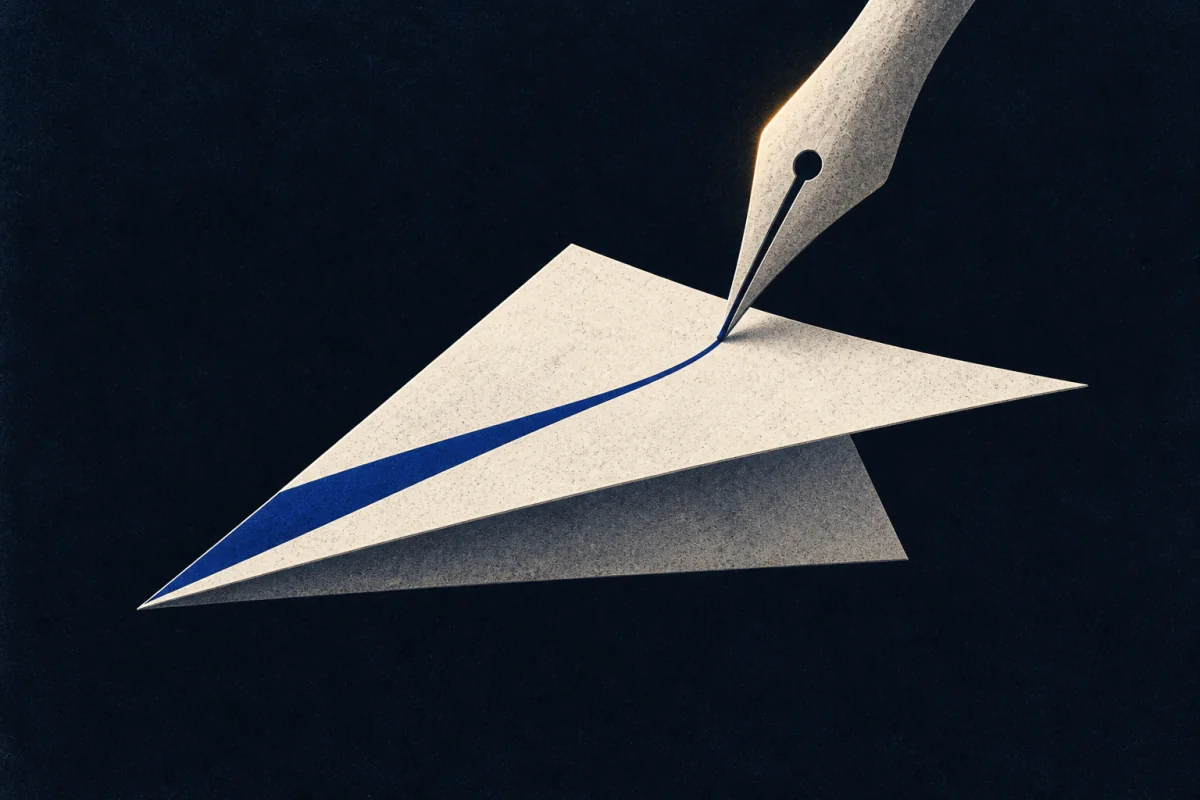
Readable by a stranger in forty years.
Not beautiful, and not fast. Made at the speed of a hand, with the spacing decided before the writing, by somebody thinking about a reader who has not been born yet.
Anything written down that will outlast the writer can be tested this way. Almost nothing produced now would pass it, and almost nobody producing it has considered the question.
Where It Stops
Neat handwriting is not this, and neither is calligraphy, which is a performance art with different aims. The specific thing is treating a working document as an object that has to serve a stranger later.
It goes wrong as slowing everything down. Most writing is disposable and should be: notes, drafts, messages. A mind that letters a shopping list has mistaken the practice for a virtue.
It also fails where the content is what matters and the form is a distraction. A difficult message, beautifully written, can read as composed rather than meant, and the recipient will notice the care and mistrust it.
Take the plainer explanation first. Anyone trained before about 1990 writes legibly because school insisted. The test is whether somebody lays out before writing, and whether they think about the reader in forty years.
Where It Pays
Inside a job. Archival and records work, conservation, legal and estate documents, cartographic lettering, signage and hand-lettering, book and invitation work, museum and exhibition labelling, and any register or log that has to be read long after everybody involved in keeping it has gone. Also the teaching of handwriting, which has quietly become a specialism rather than something every teacher does.
There is a second, less obvious market: anywhere a hand-made object still carries weight. Invitations, certificates, memorial books, presentation volumes and the front of a building are all places where a printed version says something the client did not intend to say.
What is being bought is retrievability. Organisations produce enormous quantities of record and lose most of it not to destruction but to illegibility and inconsistency — entries that cannot be resolved, corrections that obliterate the original, columns that drift. One person who keeps a register properly saves somebody, decades later, a week of work that will never be attributed to anything.
Where it pays badly is anywhere speed is the measure, anywhere the output is digital by default, and in any organisation that treats a record as a compliance artefact rather than as something a person will read.
Try This
Take something you would normally type and write it by hand instead — a letter, a list of what you actually think about a decision, a page of notes.
Before you start, decide where the margins are and how big the writing will be. Deciding that first is the whole exercise.
Then write at the speed of your hand and correct nothing. Cross out with one line and leave the original readable.
Look at it the next day. The content is usually different from what you would have typed, which is the point and has nothing to do with the handwriting.
Readable by a stranger in forty years is a tool, not a self. Pick it up where the page will outlast you. Put it down for anything disposable, because there it is only a way of taking longer.
If This Isn't You
Most people type, and it is faster, clearer to everybody and entirely adequate, which is why the world moved. Feeling nothing about the shape of a letter is an answer, not a coarseness.
Where To Go Next
Its near-twin — Music Mark Designer. Both make a page that somebody will work from. Music Mark Designer is designing for a reader acting at speed under pressure. This one is designing for a reader who may arrive in forty years and has all the time they need.
Its shadow — Word-Smith. Word-Smith works the words themselves and is indifferent to how they appear. This one will accept ordinary words and cares entirely about the object they arrive as.
Most often confused with — Symbol Maker. Both work on marks. Symbol Maker reduces toward one form that stands for an idea. This one is making a page of ordinary language that behaves well for somebody reading it in a hurry, later.