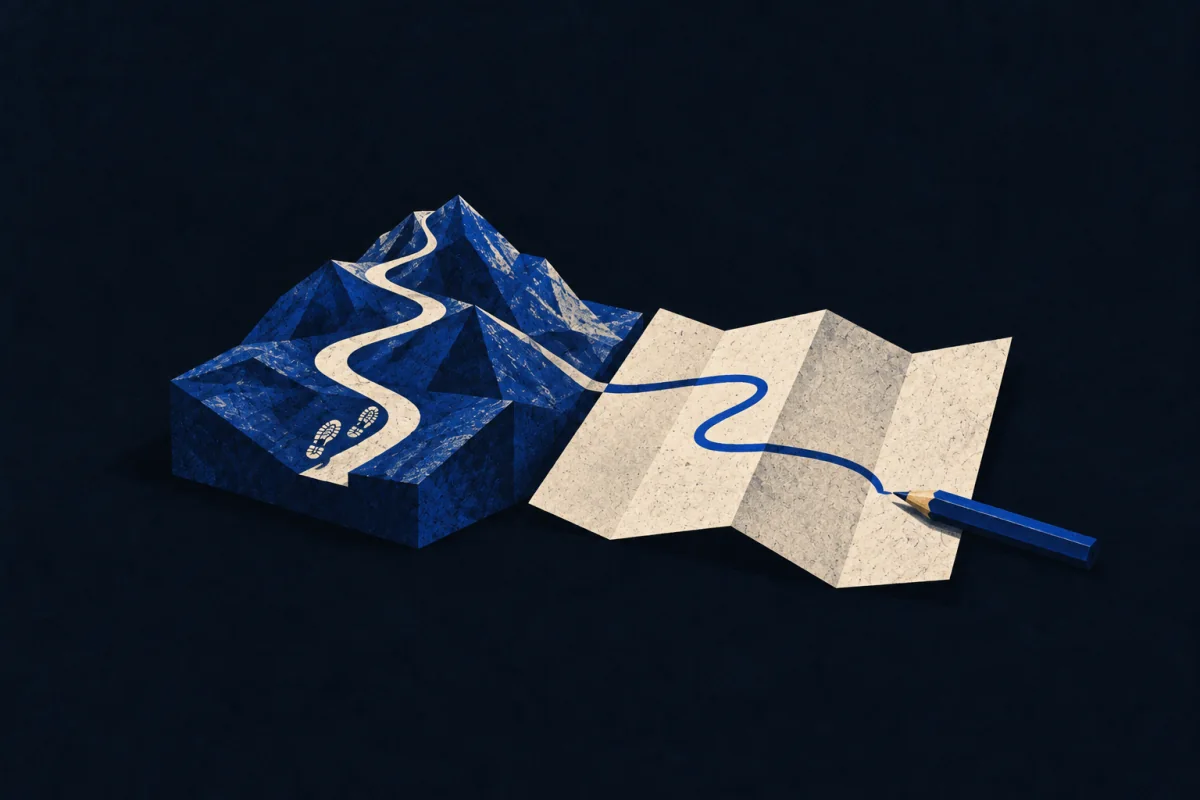
In Plain Sight
Some people walk a route and notice only the places where somebody would go wrong. A junction with nothing on it, a turn hidden by summer growth, a sign facing the wrong way. Then a mark goes up, small and in the right spot, and people stop getting lost. You'd notice this in the one who walks the path backwards to check it.
The Pattern at Work
Marking a route is not decorating it. Every mark is placed at a point where somebody, tired and in poor light, would otherwise have to guess.
Finding those points is done on foot and mostly backwards. A route is obvious to the person who designed it, so the only way to find the confusions is to walk it as a stranger would: from the other end, in the rain, at the end of a long day, with the growth up. The decision points that matter are rarely the junctions on a map. They are the place where a track and a desire line diverge, the gate that looks private, the stretch where the path disappears into a field.
Then the mark itself has to survive and has to be read at the right moment. Too early and it is forgotten before the turn, too late and the walker has already committed. It has to be visible in both directions if the route runs both ways, legible without stopping, and durable against weather, growth, livestock and whoever takes signs down. Most waymarking fails on maintenance rather than on design, so the good version is planned around being checked and replaced rather than around looking permanent.
Underneath is a restraint that is harder than it sounds. A marked route should carry the least marking that works, because a path studded with signs teaches people not to read them and turns a walk into a corridor. The judgement is which confusions matter and which are part of the experience, and that means deliberately leaving some ground unmarked and accepting that a few people will take the wrong turn there.
What the Examples Show
It gets read as tidiness, or as an interest in signs, or as making the countryside easier.
The first element is that the confusions are found by walking wrong. A route is obvious to whoever designed it, so the points that matter turn up only by going the other way, in bad weather, at the end of a long day.
The second is that the mark has to arrive at the right moment. Too early and it is forgotten, too late and the walker has committed, and most waymarking fails afterwards on maintenance rather than on placement.
The third is restraint. A path with a sign at every step teaches people to stop reading them, so part of the work is deciding which confusions to leave in.
Going Deeper
Waymarking is older than maps and was never mainly for walkers. Cairns, blazes cut into bark, painted flashes on rock and stacked stones at a pass were how a route was handed on in places where nobody carried a chart, and they were built by the people who used them. Pilgrim routes and drove roads were marked the same way, by accumulation, each traveller adding to what was there. The marks were not a system. They were a record of everybody who had come through.
Organised waymarking came with recreational walking and with liability. National trail systems, the painted blaze conventions of long-distance paths and the standardised arrow discs of rights-of-way networks are all recent, and each carries an unspoken promise, which is that following it leads somewhere. That promise makes the maintenance obligatory rather than optional, and a route that is marked badly is more dangerous than one that is not marked at all, because it is trusted.
The costs sit in the upkeep. Marking a route takes a season and keeping it marked takes forever, which is why so many waymarked paths degrade quietly into half-marked ones that people still rely on. Almost all of it is volunteer work, done by ageing groups on land they do not own, negotiating with farmers and councils for permission to put up a disc. Vandalism and removal are constant. And the reward structure is upside down, because the money and the attention go to opening a new route while the paths that already exist go unwalked and unchecked.
The Image
Walking it the other way.
The route is finished and marked, and the person who marked it sets off from the far end, as a stranger, deliberately not remembering.
Almost every mistake turns up in that walk and in no other. Going the way you planned it, you see confirmation. Going backwards, you see a junction with nothing on it and understand exactly what the tired walker at dusk is going to do there.
Where It Stops
Liking the outdoors is not this, and neither is being good with a map. The skill is imagining somebody else's confusion at a specific point on the ground, which map reading does not require.
It goes wrong as over-marking. A route covered in signs is easy to defend and ruins what people came for, and the person who cannot leave a junction alone ends up building a corridor through a landscape.
It also fails where the route should be hard. Wild ground, mountain country and anywhere the navigation is part of the point are damaged by being made easy, and some paths are better left to the people who can find them.
Take the plainer explanation first. Anybody who maintains paths learns where people get lost. The test is whether the route is ever walked in reverse.
Where It Pays
Inside a job. Rights of way and access work for councils and national parks, trail design and maintenance for land trusts and forestry, long-distance route management, and the wayfinding side of estates, campuses, hospitals and transport. The same skill runs indoors, where a building's signage is the same problem with worse consequences, and where somebody late and anxious is the walker in poor light.
What is being bought is people arriving without asking. An organisation measures it in calls to reception, missed appointments and complaints, and a landowner measures it in walkers off the line and in gates left open. Both know the number and both know it moves when somebody competent has been round the route.
Where it pays badly is outdoors, which is where most of it happens. Path work is seasonal, grant-funded, and carried overwhelmingly by volunteers, and the paid posts in access and rights of way have been cut hard almost everywhere. Indoors it is better paid and rarely called the same thing.
Outside one. Walking groups, parish path partnerships, waymarking a village circuit, and putting one sign where a hundred people a year turn the wrong way. The cost worth naming is that every unmarked junction anywhere becomes a small personal grievance.
Try This
Take a route you know well and somebody else does not. A way to your door, a walk near you, the path to a room in your building.
Walk it from the far end, slowly, and stop at every place where you would have to choose. Write each one down. There will be more than you expect.
Now pick the two worst and work out the smallest mark that would fix them, and where exactly it has to be to arrive before the decision rather than after it.
Then leave the rest unmarked on purpose.
Marking the way is a tool, not a self. Pick it up where a stranger has to arrive without help. Set it down where finding it is the point.
If This Isn't You
Plenty of people get lost, work it out and enjoy the walk anyway. Not noticing the missing sign usually means somebody put the right one up.
Where To Go Next
Its near-twin — Path-Carver. Both put a usable route across ground. Path-Carver chooses and cuts the line itself, for water, weight and the next ten years. This one takes a line that already exists and works on the places where a walker has to guess, which is a question about attention rather than about drainage.
Its shadow — Map-Painter. Map-Painter puts the route on paper, in the hand, before anybody sets off. This one leaves the paper alone and puts the information on the ground at the moment it is needed.
Most often confused with — Pathfinder. Both get people through. Pathfinder works it out live, when the way is blocked, and leads. This one is never there, and everything they do has to work for somebody they will never meet.