In Plain Sight
Put this person near a blocked route and they start looking for a way through. They are not guessing for fun. They test the ground before they choose the next step, so others can move without panic. You'd see this in the friend who checks the back gate at a crowded event, then leads everyone out through the quiet side path.
The Pattern at Work
Second day of a walk, and the footbridge is gone; the rain took it out some time in the night. Six people stand on the bank discussing whether the water has peaked. One of them has already gone two hundred metres upstream and is in it to the knee, moving sideways, feeling along the bottom with a boot for the gravel bar. She comes back and says the crossing is up by the bend, that packs go over on a second trip, and that the tallest person goes first. Nobody voted on any of it. The river decided, and somebody went and asked.
A festival, last band, eighteen thousand people heading for one gate. Somebody in a group of six had walked the perimeter that afternoon with no purpose at all, and knows that the service road behind the food stalls rejoins the lane at the far end of the same car park. They leave ten minutes early, take the longer way round in the dark, and are on the motorway while the main gate is still a solid block of people not moving.
A flooded road at night, headlights on brown water, no way to read depth from a driver's seat. The second car stops and someone gets out with a fence stake pulled from the verge, walking the edge, watching where the surface combs and where it goes glassy and quick. Back at the window: the dip is at the far end, the water is running harder than it looks, and there is a farm track half a mile behind that comes out above the flood. Four cars turn round.
What the Examples Show
Read quickly, all three look like an appetite for risk. The words that get used are bold, adventurous, a little reckless — and in two of the three the person was the only one who ended up wet or cold.
The appetite is not for risk. It is for information. Every one of those moves turned something unknown into something measured, and did it before the group committed to anything. A boot in the water is a depth reading. A walk round a perimeter with nothing particular in mind is a map being made early. A stake from a hedge is a gauge that happened to be lying nearby.
Which is why the person goes first, and it is not about leading. The reading cannot be taken from the bank, and the people waiting there cannot use a guess.
Going Deeper
For most of the time people have been moving across ground, the question of whether there was a way through had no authority to answer it. Either there was no map, or the map stopped at the edge of what somebody had already walked. The route was not looked up. It was found, by a person who went ahead and came back, and whose standing in the group rested on a single number: how often the ones behind arrived.
The drover knew which ford stayed passable after a week of rain and took cattle over it four times a year. The Alpine guide, before guiding was a profession, was a local with goats who had been on that face in bad weather. The river pilot came aboard at the bar and took a ship he had never seen over sand he had known since he was nine. The passeurs who moved people across the Pyrenees in 1941 worked from an ordinary smuggler's knowledge of one valley, turned to a different cargo. The point man walks ahead of the patrol. The Sherpa fixes the rope before anybody climbs it.
What all of them shared was that being right erased them. A crossing that works becomes a road, and a road has no author; the second person over remembers nothing but the water. They were blamed for weather, and for ground that moved under them. They spent their working lives a little ahead of the people they were with, which is a particular kind of alone — close enough to hear the group, far enough that nobody is checking the same thing at the same moment. And the arithmetic of other people's safety was never once seen being done.
The Image
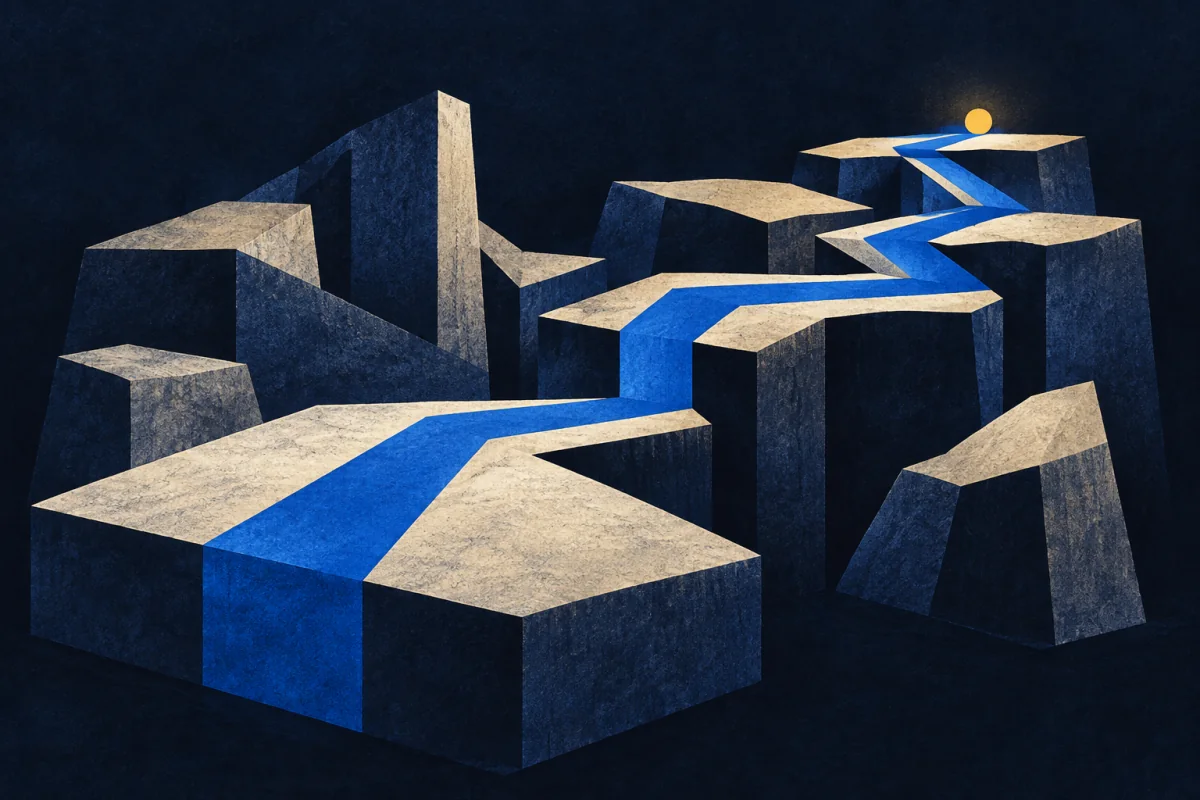
The ford.
A river is not crossed where it looks narrowest. It is crossed where the bottom comes up, which is usually where the water is widest and least impressive, and nearly always a short way from wherever everyone has gathered to look. Finding it means getting wet before anybody else does.
Take that into anything blocked. The way through is rarely at the point where the blockage is most obvious.
Where It Stops
Enjoying rough country is not this, and neither is knowing an area well. A person who has lived somewhere for thirty years knows its ways through, and that is memory rather than reading.
It goes wrong as an inability to accept that a road is shut. Some obstacles are simply obstacles, and a day spent finding an elegant way round a two-hour delay is a day spent badly. It goes wrong in the other direction as moving before the group can follow — the route gets tested by one body and then offered to six, and sometimes the six cannot do what the one just did.
It also fails where the obstacle is not made of ground. Bureaucracies, contracts and families are blocked in ways that no amount of walking the perimeter will read.
Take the plainer explanation first. Anyone who works outdoors for a living does a version of this daily, because the job requires it. The test is whether it appears on unfamiliar ground, off duty, with nothing riding on it.
Where It Pays
Inside a job. Logistics and last-mile delivery, line work and utilities, field survey, wildland fire, expedition and location work, disaster response, marine pilotage, rural health outreach — anywhere the route is not given and the ground changes between one week and the next. The real contribution is not speed. It is that a team stops treating an obstruction as a stop and starts treating it as a question with an answer somewhere nearby. It pays badly where routes are fixed by licence or by law and the whole value is compliance, and badly again anywhere nobody may move without a signature, because the reading gets taken and then waits in an inbox until it is out of date.
Outside one. Family journeys, evacuations, getting a frail relative through a hospital built in four goes, crowds, unfamiliar cities, the school run on the morning the bridge is closed. The cost worth naming is that this becomes the job: every stuck journey in a family routes to one person, and the request tends to arrive after the wrong turn rather than before it. There is a second one, quieter — the habit of always knowing a second way out does not switch off, and in some rooms that reads as an inability to settle.
Try This
The next time something is blocked, do not start by asking what to do about the blockage.
Go and look at its edge. Walk the perimeter, physically, with no plan — the car park, the building, the riverbank, the queue. Give it ten minutes and come back with one measurement: how deep, how wide, how fast, how long the line actually is.
Then decide. And write down before you go what you expect to find, so the ten minutes can be judged on whether the guess was any good rather than on whether the walk was enjoyable.
The ford is a tool, not a self. Pick it up when the ground is unknown. Put it down when somebody has already walked it and written it down.
If This Isn't You
Plenty of people cross when the bridge is there and wait when it is not, and the world moves along perfectly well on that. Feeling no pull toward the edge of a flooded road is an answer, not a gap.
Where To Go Next
Its near-twin — Sea-Sky Wayfinder. Both get people across ground nobody has marked. The Wayfinder holds a course for weeks with almost nothing to look at, working from things that do not change. This one works the fifty metres directly ahead, on ground that changed last night.
Its shadow — Long-Walker. The Long-Walker's return is in the going, and arriving can even be a small loss. This one cares only about the far bank, and would take a dull road over a fine one without a second thought.
Most often confused with — Map-Maker. The Map-Maker records ground so that nobody has to go first again. This one goes first because no record exists, and leaves nothing behind but a group on the other side.