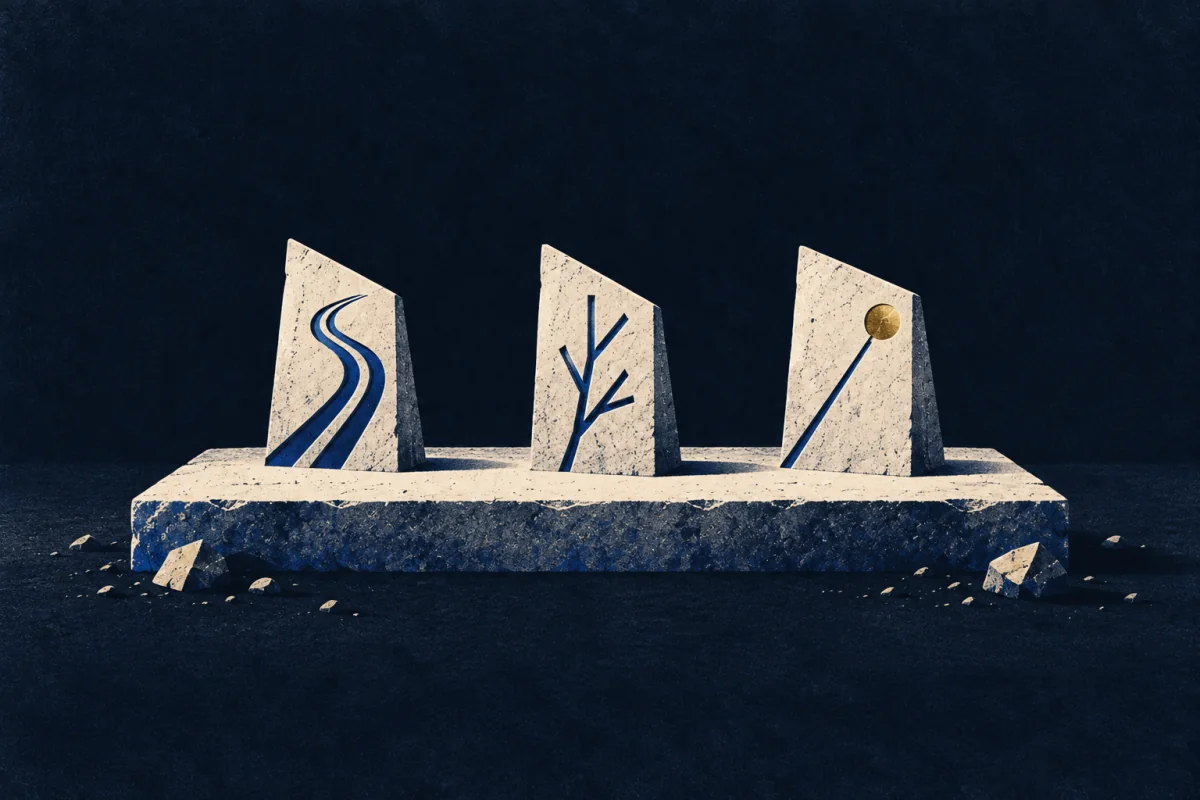
In Plain Sight
Some people read the ground as a record of what has passed. They are not tracking by luck. A bent stem, a scuff and a change in the wind get put together into a map that keeps moving. You'd notice this in the walker who points at a ridge and says the deer will be on the far side of it.
The Pattern at Work
A walker has been missing for nineteen hours and the search is covering ground by grid. One member of the team is not in the grid. He is at the last confirmed point, working out what the man did next: the path splits, one branch is obvious and one is not, and there is a single flattened patch of bracken eight metres down the wrong branch that could be a deer or could be a person sitting. He takes the wrong branch. Half a mile on there is a boot scuff on wet rock pointing downhill, which is the wrong direction for the route and the right direction for somebody who has decided to get off the hill fast. The man is found in a gully, off every planned search line, four hours before the grid would have reached it.
A farmer loses lambs and assumes dogs. The neighbour who comes to look does not examine the carcasses first. He walks the fence line, finds where the wire is pushed rather than jumped, reads the width of the gap and the hair caught on it, and then follows the line of flattened grass uphill to a gate that has been open for a week. It was not dogs.
None of that is a checklist. It is a moving picture assembled out of things that are individually almost nothing.
The stalker knows before the light is good enough to see anything that the deer moved off this face in the night, because the grass where they lay is cold and the droppings are not fresh, and he is already walking to the corrie where they will be instead.
What the Examples Show
It gets called an eye for it, or a countryman's instinct.
The unusual part is not seeing the sign. Most signs can be pointed out and anybody will see them. The unusual part is the jump: from a broken twig and a wind direction to a claim about where something is at this moment, in country nobody present can see.
That jump runs on a model of the thing being followed — what a frightened sheep does, how a man decides when he is cold and scared, where deer go when the wind swings. The signs are inputs. The model produces the prediction, and the prediction is the valuable part, because a sign reports the past and only a prediction closes the distance.
Which is also why this pattern moves. It does not stay and study the print. It reads enough, commits, and goes to where the answer should be, accepting that it will sometimes be wrong and that being wrong quickly is cheaper than being certain slowly.
Going Deeper
Following something across ground is older than farming, and the interesting thing about it is how much of it is inference rather than observation.
San trackers in the Kalahari have been studied repeatedly and what keeps coming out is that the expert work is hypothetical: not this print, but what kind of animal, in what state, would have left this print here and gone where. Australian Aboriginal tracking was used in police searches through the twentieth century precisely because it produced locations rather than descriptions. Mountain rescue teams now formalise the same reasoning as lost-person behaviour models, with statistics attached. Professional stalkers and hunting guides in every upland country hold the identical skill under a dozen different names, and none of them can hand it over in a season.
All of it has the same standing problem, which is that the method cannot justify itself before it works.
A tracker's decision to leave the obvious path is, at the moment it is made, indistinguishable from a guess, and it is made in front of people who are doing something systematic and defensible. If it comes off, it looks like luck. If it does not, it looks like the reason the search was delayed. The knowledge is also almost impossible to hand on at the speed institutions want, because the inputs are thousands of hours of ground. And it decays: a year away from the hill and the model goes stale, which is why this is the skill that disappears first when a way of life ends.
The Image
Three ridges over.
The sign is here, under your feet, and it is already old. The thing that left it is somewhere you cannot see.
The whole discipline is the willingness to stop looking at the evidence and go to where the evidence says the answer has got to by now.
It applies well beyond ground. Most evidence anybody examines is a record of something that has since moved.
Where It Stops
Knowing the countryside is not this. A great many people who can identify every print in the mud have no interest in where the animal is, and are doing natural history rather than tracking.
It goes wrong as committing too early. The whole method runs on a jump, and a jump made on two signs instead of five is a confident march in the wrong direction, taking a search team with it.
It also fails where nothing left a trace, or where the trace is being made on purpose. Ground does not deceive; people sometimes do, and the same reasoning applied to a person who wants to be followed will follow them exactly as intended.
Take the plainer explanation first. Anyone who has stalked, hunted or worked stock reads ground because the work requires it. The test is unfamiliar country, an unfamiliar quarry, or a city — a lost child in a shopping centre pulls the same reasoning out of somebody who has it.
Where It Pays
Inside a job. Search and rescue, stalking and guiding, wildlife survey and anti-poaching work, stock management on open ground, and the field end of ecology where animals have to be found rather than counted. Also military and border work, where the same reasoning is trained deliberately.
What is being bought is a shorter search. Systematic methods are reliable and slow, and in the situations that matter most the difference between finding somebody in five hours and eleven is the difference between two outcomes. One person who can predict rather than cover changes where the effort goes, and changes it early enough to matter.
It pays badly in any organisation that requires a defensible method in advance, and badly again where a wrong call is punished more heavily than a slow one — which is most institutions, and is why this skill usually sits alongside a formal search rather than inside it.
Outside one. Walking, stalking, dog work, and finding things and people that have gone missing locally. The cost worth naming is that the reasoning is not admissible: being right repeatedly without being able to show the working makes people uneasy, and it is tiring to be doubted about something you are sure of.
Try This
Next time you are somewhere with soft ground — a path, a beach, snow, a muddy gateway — find one track that is not yours.
Do not identify it. Instead, answer three questions: which way, how long ago, and in what state. Hurried or browsing. Alone or not.
Then make one prediction about where that animal or person is now, and say it out loud before you go and look.
Do it five times and keep score. The score is the only thing that improves this, and most people find the first four humbling.
Three ridges over is a tool, not a self. Pick it up where something has moved and left a record. Put it down where the trail was laid for you to follow.
If This Isn't You
Most people walk past a great deal of information on the ground and arrive perfectly well at where they were going, which is what paths are for. Feeling no urge to work out where the deer went is an answer, not a dullness.
Where To Go Next
Its near-twin — Field-Naturalist. Both read the outdoors from fragments. Field-Naturalist is asking what is happening here and will stay and test it against the weather. This one is asking where something is now and will leave the evidence behind to go and find out.
Its shadow — Stillness-Holder. Stillness-Holder waits and lets the thing come to it, on the grounds that moving is what spoils the seeing. This one closes the distance, and accepts being wrong as the price of arriving.
Most often confused with — Map-Edge Walker. Both cover hard ground alone and hold direction without a map. Map-Edge Walker is going somewhere for its own sake. This one is following something, and has no interest in the country except as the place the answer is.