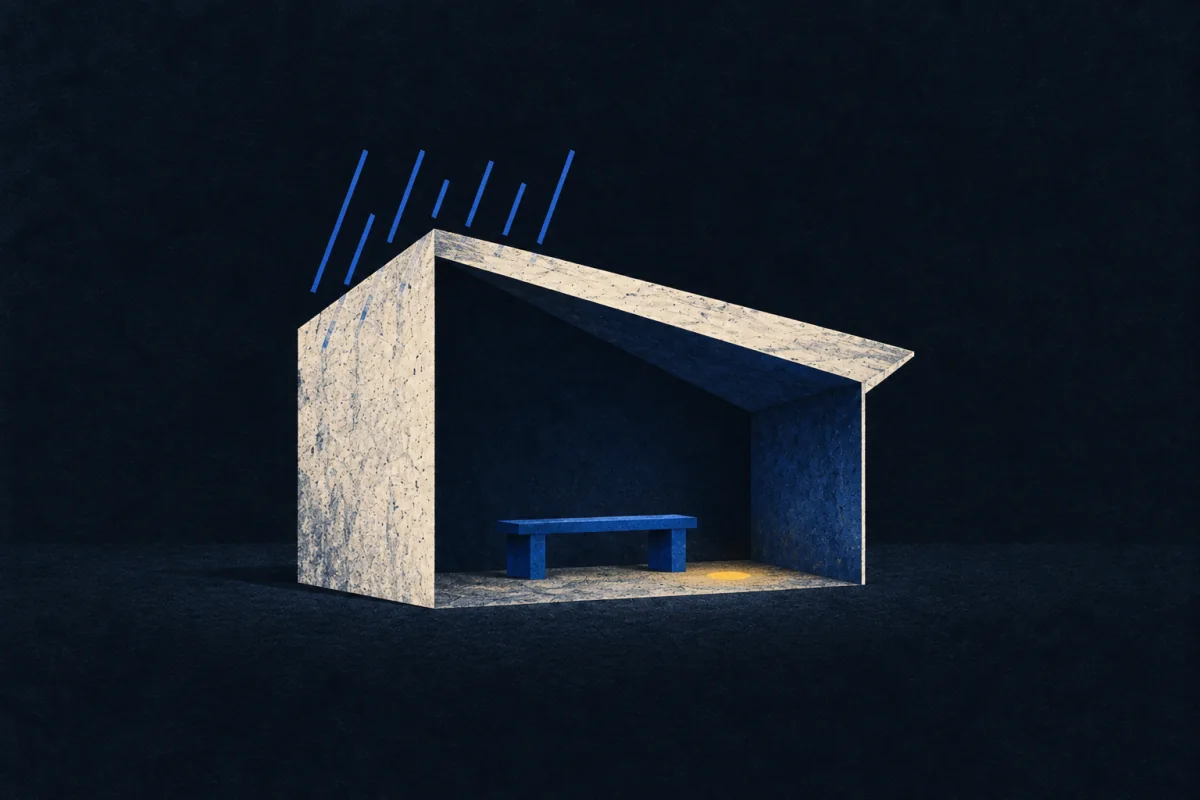
In Plain Sight
Some people look at a space and think first about whether a body could rest in it. Not how it looks. Where the cold comes in, where the water goes, whether there is anywhere to be unobserved, whether it can be put up by the people who will live in it. You'd notice this in the one who rearranges a spare room around where the draught is.
The Pattern at Work
The design starts from what will go wrong rather than from what it should look like. Cold at night, heat in the afternoon, rain finding the one joint that was not thought about, smoke with nowhere to go, and a family with no way to be out of sight of each other. Each of those is a separate failure with a separate fix, and the fixes fight one another.
Ventilation against warmth is the clearest of those fights. A shelter sealed against cold fills with damp and with smoke from whatever is being burned inside it, and people die of that rather than of the cold. So the answer is never the tightest envelope but the one that moves air without losing heat, which is harder, and which almost nobody gets right on the first attempt.
Then comes what can actually arrive. A design that needs a truck, a crane or a trained crew is not a design for an emergency; it is a drawing. What travels flat, what can be carried by two people, what can be put up without instructions in a language nobody reads, what can be repaired with what is already on the site: these constraints are as binding as the structural ones and they eliminate most good ideas.
And underneath all of it sits dignity, which is not decoration. A door that closes, a place to wash unseen, somewhere to put a possession, a shape that does not announce to everybody outside that the people in it are being kept. Designers who leave this out produce shelters that are technically sound and that people abandon or rebuild, and the rebuilding is the evidence.
What the Examples Show
It gets read as architecture, or as practicality, or as a humanitarian impulse looking for an outlet.
The first element is that the design starts from failures. Cold, damp, smoke, water and exposure are each worked at separately, and the fixes contradict each other, so the work is mostly trade-offs rather than solutions.
The second is that deliverability is part of the design. Anything that cannot travel flat, be carried by two people and be put up without instructions is not a shelter design, whatever it looks like on paper.
The third is that dignity is structural. A door that closes and somewhere to wash unseen decide whether people stay, and a shelter that people rebuild or abandon has failed however well it performs.
Going Deeper
Emergency shelter became a design discipline only after it became clear that most camps are not temporary.
The average displacement now lasts years rather than months, which turns a tent problem into a housing problem, and most of the standard responses were designed for the wrong duration. The work since has moved away from shipping a finished unit and towards supplying what cannot be found locally, meaning fixings, a waterproof membrane and a frame, then letting households build the rest with materials and methods they already know. That shift came from watching people modify or discard what was delivered, which is the only honest evaluation the field has ever had. Minimum standards now exist for floor area, water access and separation between shelters, written after outbreaks traced directly to crowding, and fire spread between shelters is the other reason spacing rules exist.
The costs are not mainly technical. Decisions are made by agencies and governments under political pressure, so a design can be rejected for looking too permanent, which is a policy about whether people are expected to stay rather than a judgement about the shelter. Funding arrives for the emergency and stops long before the situation does. The designer is rarely present when the thing is built and almost never when it is lived in, so the feedback that would improve it does not come back. And the work carries a weight that does not lift, because every compromise is a compromise about somebody's winter, and the people making it will never meet them.
The Image
The door that closes.
Not a flap. A door, with something to fasten it, on a structure that cost very little.
It changes what the space is. A family that can shut a door can leave things inside it, can change clothes, can have an argument nobody hears. Everything else in the design is about weather, and this one thing is about whether the place is somewhere to live or somewhere to be kept.
Where It Stops
Caring about people in trouble is not this. The feeling is common and the design work is specific, and plenty of committed people produce shelters that leak, cook or cannot be delivered.
It goes wrong as a clever object. Emergency shelter attracts designers who want to solve it with one elegant unit, and the history of the field is full of prototypes that won prizes and were never built twice, because the problem was never the shelter but the supply chain, the site and the people already there.
It also fails where permanence is what is needed. A design built around being quick and light is the wrong instinct for housing that should last, and the habit of treating everything as temporary keeps people in it for years.
Take the plainer explanation first. Anybody who works in relief learns some of this. The test is whether the design changes according to what can be carried in.
Where It Pays
Inside a job. Humanitarian shelter and settlement work for aid agencies and the larger relief organisations, disaster housing and reconstruction programmes, refugee camp planning, and the shelter side of civil contingency and military engineering. Also social and supported housing where the brief is people in crisis rather than a market, and the design of temporary accommodation, field hospitals and remote workers' camps.
What is being bought is a place people stay in. A programme is judged on whether the shelters are occupied, intact and unmodified a year later, and that outcome is decided almost entirely at the design stage. Agencies that get it wrong pay twice, once for the delivery and again for the replacement.
Where it pays badly is the insecurity. The work is project-funded, posted abroad on short contracts, and the technical roles are thin compared with the size of the operations around them. Many people leave for conventional practice, where the hours are ordinary and the brief is a client rather than a crisis.
Outside one. Local disaster response, self-build and land projects, and working out how a spare room becomes somewhere somebody can actually live. The cost worth naming is that once the eye is trained, ordinary buildings look careless.
Try This
Take a room you know that somebody sleeps in: yours, a spare room, a child's.
Work out three things in order. Where does the cold or the heat get in. Where would water go if it got in. Where in the room can a person be unobserved.
Now change one thing for each answer, using only what is already in the house.
Sleep there, or get somebody to, and see which of the three you got wrong.
Designing for the body is a tool, not a self. Pick it up where somebody has to rest, recover or wait in a space. Set it down when the room is fine and the only thing wrong with it is that you have started looking.
If This Isn't You
Plenty of people walk into a room, sit down and are comfortable without ever asking why. Not seeing the draught is not a failure of attention; it means somebody already solved it.
Where To Go Next
Its near-twin — Settlement-Planner. Both arrange space so that people can live in it. Settlement-Planner works at the scale of the whole site, deciding where the water, the road and the buildings go. This one works at the scale of the single dwelling and what happens to one body inside it.
Its shadow — Under-Load Builder. Under-Load Builder is concerned with whether a structure stands up under weight, over decades. This one accepts a much shorter life and spends its attention on damp, smoke, privacy and delivery, which a load path says nothing about.
Most often confused with — Hearth-Defender. Both make a space somebody can rest in. Hearth-Defender arranges a room that already exists, for the person in front of them. This one designs the thing itself, for people they will never meet.