In Plain Sight
Put this person on empty ground and they start deciding where things should go. They read the water and the slope before they read the view. Then they set the first lines: the well here, the road bending there. You'd see this in the one who can still point to which ridge the road should have followed.
The Pattern at Work
Week one of a camp that will hold nine thousand people, on a plain that held nobody a fortnight ago. Most of the argument in the coordination tent is about tents. One of the site staff spends two days walking the ground with a hand level and returns with different questions: where the water goes when it rains hard, which means where the latrines cannot be, which means where the road has to run. The layout she proposes puts the water points further from the entrance than anybody wants, because the alternative puts them downhill of the sanitation. Six months on, the camp has not had the outbreak the neighbouring one had, and nobody connects the two facts.
A family buys eleven acres of rough ground with an old track through it. One of them will not let anyone site the house for a fortnight. She watches where the frost sits, walks the track after rain to see where it turns to soup, and works out that the obvious spot — flat, with the view — is the bottom of a bowl that cold air pours into every clear night. The house goes thirty metres up and back, loses half the view, and is warm, dry and reachable in February.
A small development of forty houses gets signed off with a road that bends for no apparent reason, at the insistence of one person on the committee. The bend cost money and was argued about twice. It exists because straight roads through housing carry traffic at forty, and the school path crosses there.
What the Examples Show
The obvious reading is planning, in the dull municipal sense, or an eye for land. Neither accounts for the fortnight of walking before anybody could put a peg in.
What runs underneath is reading several systems at once and finding where they conflict. Water, slope, wind and route are each simple on their own. The site is where they interfere, and almost every decision above is one system overruling another: sanitation beats convenience, cold air beats the view, safety beats the cost of a bend. A person who reads only one produces a layout that is excellent in one dimension and unliveable.
The second half is the horizon. All three are deciding things that cannot be undone. A camp road becomes a permanent street, and a bend argued over once will still be slowing cars when everyone at that meeting is dead. That is why the pace is odd at the start: the decisions with the longest lives get made in the first week, by whoever is standing there.
Going Deeper
Hippodamus laid out Miletus on a grid in the fifth century BC and is remembered as the first to treat a city as designed rather than accumulated. The Romans industrialised it: every castrum to the same plan, two main streets crossing, the same gates in the same places, so a soldier arriving in the dark in Britain or Syria knew where he was. Their surveyors ruled the farmland into squares with a chain, and in parts of the Po valley the field boundaries still follow those lines.
The Spanish crown wrote it into law in 1573. The Laws of the Indies specified plaza dimensions, street widths, which way the grid should turn against the prevailing wind, and where the slaughterhouse went — which is why several hundred towns from California to Argentina share a shape. New England put a common in the middle instead. The United States ruled a grid across a continent from a survey line, and the consequence is visible from an aircraft window today. Chandigarh and Brasília are the modern limit case, whole capitals from one hand, instructive because what they got wrong is permanent too.
Set against that is the awkward truth that unplanned settlements often work better in the ways that matter to the people living in them, because they were laid out slowly by everybody rather than quickly by one person.
The work carries a burden that little else does. Every choice is irreversible on any human timescale, and is made with the least information anybody will ever have about the place, since nobody has lived there yet. Being right produces a town that feels as though it simply grew. Being wrong produces a bowl of cold air that four generations complain about without knowing whose afternoon it was.
The Image
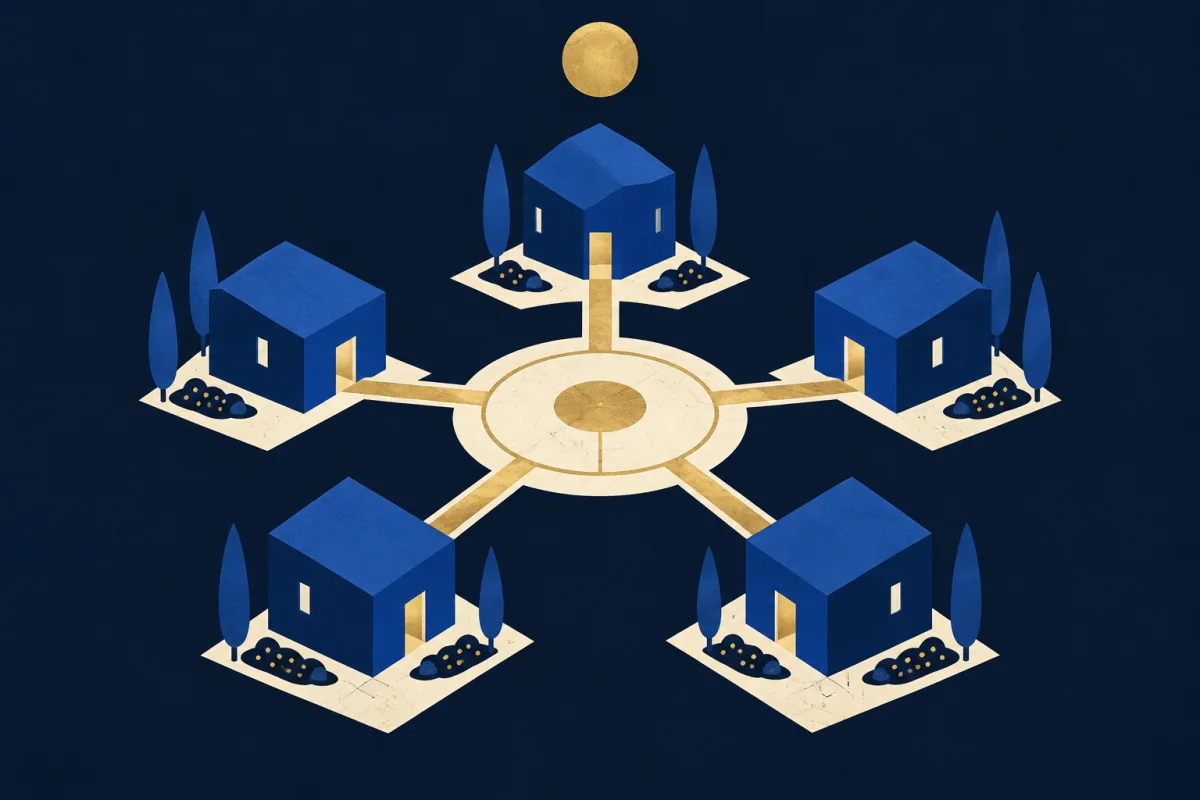
The first line.
Before there is a village there is one mark: a well dug here, a track that went round that way, a wall on this side of the stream. Everything afterwards arranges itself around it, and within two generations it looks inevitable rather than chosen.
Look for it wherever you are standing. Somebody drew the first line, and most of what is annoying or excellent about the place follows from it.
Where It Stops
Liking maps is not this, and neither is being good at layouts on paper. The fortnight of walking is the work; a plan produced without it is a drawing rather than a siting.
It goes wrong as the belief that a place can be fully designed. People use ground in ways nobody anticipates, and the desire paths worn across every planned lawn are a permanent argument with this pattern. The good version leaves room to be wrong.
It goes wrong again as deciding for people who are not there yet and could be asked. A camp laid out by somebody who has never lived in one has its mistakes named immediately by anybody who has.
It also fails on ground that is already built. Most work is not empty land, and an instinct trained to draw first lines suits it badly.
Take the plainer explanation first. A surveyor does this because the job is this. The test is whether it appears on a family's eleven acres, with no fee.
Where It Pays
Inside a job. Site planning and civil engineering, humanitarian shelter and camp design, land management, forestry and estate work, agricultural and smallholding layout, utilities routing, and the early weeks of any development where the ground is still open. The contribution is that the expensive mistakes get made on paper instead of in concrete, and the expensive ones are always the same family: water where it should not be, routes that invite the wrong speed, buildings sited for the day they were visited rather than the year they will stand.
It pays badly wherever the layout is already fixed and the task is to decorate it.
Outside one. Houses, plots, gardens, allotments, campsites, and the long decisions about where things go on any piece of land a family holds. The cost worth naming is that this person is slow at exactly the moment everybody wants speed — the fortnight of walking arrives when the diggers are booked, and the argument for it cannot be made with anything visible. The second is that being right takes decades to show, by which time the decision has stopped having an author, and the person who was overruled remembers the bowl of cold air rather better than anybody else does.
Try This
Go and stand somewhere you know well — a street, a campsite, a school yard, your own plot.
Before anything else, find where the water goes. Then find where people actually walk, as distinct from where the path is. Then work out which came first, the route or the buildings.
Write down one decision somebody clearly made and one they did not. Doing this in three or four familiar places is oddly transformative: layouts you accepted as natural turn out to be a few choices, some careless, all still in force.
The first line is a tool, not a self. Pick it up where ground is open and the decisions are about to become permanent. Put it down where people already live, and ask them instead.
If This Isn't You
Most people arrive somewhere, find the layout as it is, and get on with living in it, which is what places are for. Feeling no urge to work out where the well should have gone is an answer, not a gap.
Where To Go Next
Its near-twin — Map-Maker. Both hold a piece of ground whole in the mind. The Map-Maker records what is there so people can find their way through it. This one decides what will be there, which is a commitment rather than a record.
Its shadow — Pathfinder. The Pathfinder solves the fifty metres in front of the group and leaves nothing behind. This one leaves lines that outlast everybody and cannot be revised when the ground changes.
Most often confused with — From-Nothing Starter. Both begin things that do not exist and both see the whole before it is there. The From-Nothing Starter is starting a venture, and can pivot it next month. This one is starting a place, which cannot be pivoted at all.