In Plain Sight
Some makers build things that have to carry weight. They are not working to a drawing they were handed. They feel the grain and the seam, then decide where the load will run, because a mistake here does not show until something is standing on it. You'd notice this in the builder whose old work is still holding after forty years.
The Pattern at Work
Three jobs, three materials, one habit: deciding where the weight will travel before anything is cut.
The boat is being built from a half-model and a set of offsets, and the builder spends a morning sorting planks that arrived as one delivery. He is not looking for defects; he is looking for where the grain runs out, because a plank with the grain running off at the wrong angle will be fine for years and then split at the one place it is holding the hull's shape. The good ones go where the curve is hardest. The ordinary ones go where the load is low. None of that appears in the plans, and none of it could.
A timber frame is being cut for a barn. The apprentice has laid out all the joints to the same dimension, which is what the drawing says. The framer changes four of them. Two are carrying a roof load that is about to be doubled by a slate that was specified last month, one is in a post that will be in the weather, and one is at a place where the frame will be racked when the building is lifted — a load that only exists for eleven minutes, on one afternoon, and would have broken it.
A wheelwright dishes a cartwheel, building it deliberately not-flat, so that it goes into compression when the cart leans into a rut. Every part of that is counter-intuitive and none of it is visible in a finished wheel.
What the Examples Show
The reading is craftsmanship, or care, or being old-fashioned about it.
Underneath it is a specific kind of imagination, and it is the whole thing: running the forces through an object that does not exist yet. Not where the parts go, but where the weight will travel once they are there, including the loads that are temporary — the lift, the gale, the fully laden day that happens twice a decade.
That thinking has to be done from the material outward rather than from the drawing inward, because the material is where the uncertainty lives. Two planks of the same dimension are not the same plank. A drawing cannot know which one is going where.
And the feedback is slow to the point of being absent. Everything holds on the first day. The information about whether the judgement was right arrives ten or forty years later, which means the standard cannot be learned from a maker's own results in any useful time and has to be taken on trust from a tradition.
Going Deeper
For most of history, anything that bore weight was made by somebody with no way to calculate it, and a surprising amount of it is still standing.
Gothic cathedral masons worked by proportion, precedent and the visible behaviour of the last building, and when they got it wrong the vault came down — Beauvais did, twice. Shipwrights carried hull shapes in half-models rather than in numbers, and those models encoded generations of hulls that had not broken. Japanese temple carpenters built joints that move under load, so that a building flexes rather than resists, and some of them have been flexing for a thousand years. Cartwrights across Europe arrived independently at the dished wheel.
None of them could prove anything in advance, and all of them knew exactly how the failures happened, because the failures were the curriculum.
That is the shape of the cost. The work is judged on a timescale longer than a career, so a maker never finds out about most of their own decisions, and the ones who are wrong are often long gone before anybody learns it. Being conservative is the only rational response, which makes this pattern look slow and expensive next to somebody who will do it cheaper and be right nearly always. And a failure is not a defect; it is a collapse, sometimes with somebody underneath. That possibility sits permanently in the background of the work and changes how the person is, which is why so many of these trades are quiet and slightly humourless about specification.
The Image
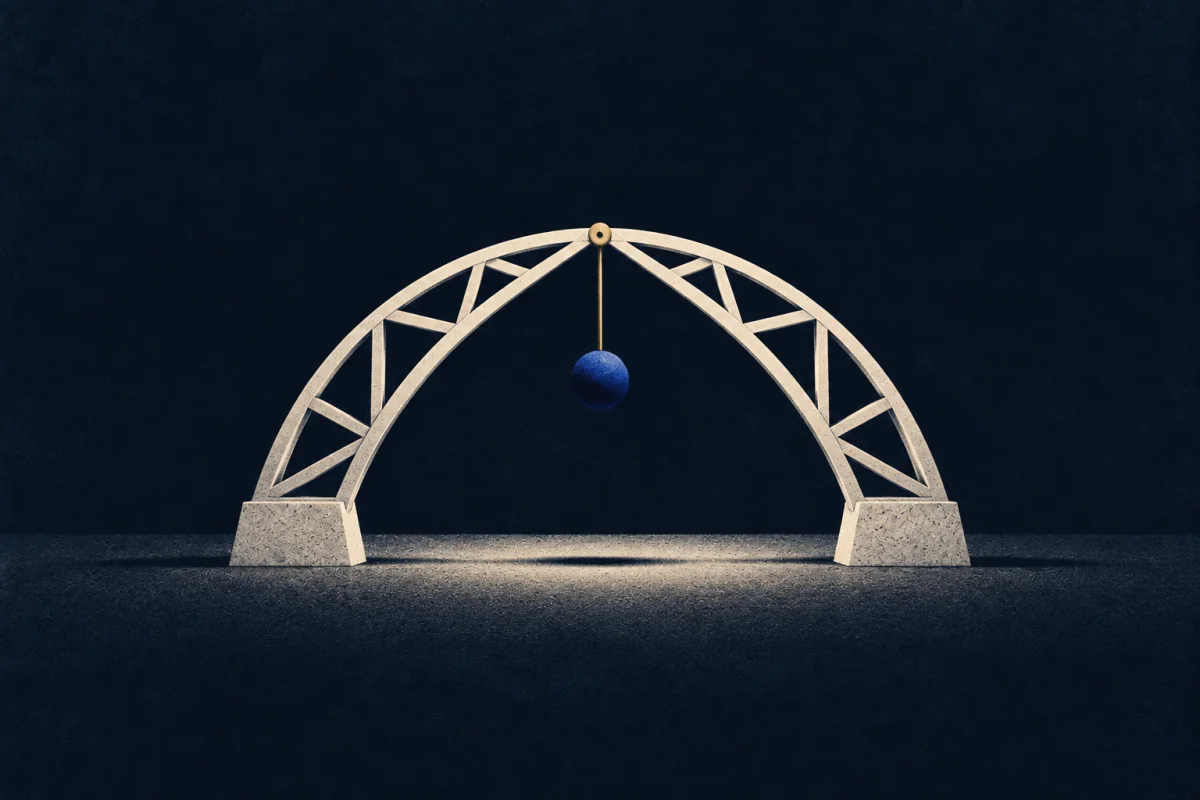
The load path.
Put a finger on any part of a structure and ask where the weight arriving there goes next, and next after that, until it reaches the ground.
Every object that holds something up has one. Most failures are a place where the path has a gap in it, and the gap was there from the first day and simply had not been asked a hard enough question yet.
Where It Stops
Building things is not this. A great many competent builders work to specification and produce entirely sound work, because somebody else did the load thinking and wrote it down.
It goes wrong as overbuilding everything. When the feedback is forty years away, more material always feels safer, and the result is work that is heavy, slow, expensive and sometimes worse — a frame too stiff to move will break rather than flex.
It also fails where nothing is at stake. Applied to a shelf for three books or a set for a school play, the same reasoning produces a considered answer to a question nobody asked, at four times the cost.
Take the plainer explanation first. Anyone trained in a structural trade thinks in loads because the training is loads. The test is whether it happens untrained and uninvited: a hired ladder, a friend's decking, a shelf bracket in somebody else's kitchen.
Where It Pays
Inside a job. Boatbuilding, timber framing, furniture that takes weight, structural carpentry and steelwork, wheelwrighting, rigging, scaffolding, staging, and the practical end of structural engineering where a drawing has to survive contact with actual material.
The contribution is the failure that never happens, which means it is never counted. Most structural work is specified for the loads somebody remembered to list, and the ones that break things are the loads nobody listed: the lift, the snow, the day the building was used for something else. One person who thinks in paths rather than parts catches those before anything is cut, at a cost of one morning.
It pays badly wherever price per unit decides, badly against a fast programme, and badly in any organisation that treats a raised structural doubt as an obstruction rather than as the service being bought.
Outside one. Sheds, decking, boats, anything in a garden that people will stand on. The cost worth naming is that it cannot be switched off around other people's work, and pointing at somebody's new balcony is not a welcome contribution, however correct. The second is that the thinking takes a morning and looks, to everybody watching, like a morning in which nothing at all was done.
Try This
Find something in your house that holds weight and that you have never thought about — a shelf, a stair, a table, a bracket.
Put a hand on the loaded part and trace where the weight goes: into what, then into what, all the way down to the floor.
Somewhere in that path there is one member or one fixing doing more than its share. There nearly always is, and it takes two minutes to find once you are looking at a path rather than at an object.
Do it in three places.
The load path is a tool, not a self. Pick it up where something will be stood on, sat in or hung from. Put it down where nothing is carrying anything, because there it is only a way of making a small job large.
If This Isn't You
Most people put up the shelf, load it, and find out that way, which works almost always and costs almost nothing when it does not. Feeling no urge to trace the weight to the floor is an answer, not a recklessness.
Where To Go Next
Its near-twin — Steel-Smith. Both think in stress and failure. Steel-Smith arrives at objects that already exist and finds where they are about to give way. This one is deciding, before anything is cut, where the weight will be allowed to travel.
Its shadow — Tool and Toy Crafter. Tool and Toy Crafter learns by letting versions fail, cheaply and fast. This one cannot use that method at all, because here the first failure is the last one and somebody may be standing underneath.
Most often confused with — Hand Shaper. Both work material by feel. Hand Shaper is answering to the form and stops when the object goes quiet. This one is answering to a weight that has not arrived yet, and will accept an unlovely object that will still be there in forty years.