In Plain Sight
Some people start from the worst thing that will happen to a build rather than the day it is finished. Where will the load concentrate, what flexes, what fails first if this is used hard. They add material there and nowhere else. You'd notice this in the one who checks the trolley wheels before the event and tapes the loose one twice.
The Pattern at Work
The first question is always about forces rather than about form. A hull is not a shape that happens to float; it is a structure being pushed on from several directions at once, by water that is not level, by a rig trying to lever the mast out through the bottom, by the shock of coming off a wave. Somebody with this pattern is thinking about where all that goes and how it gets spread, and the shape follows from that. Which is why their drawings start with frames and floors and the places where two loads meet, not with the profile anybody will photograph.
Then comes an unusual kind of accounting, because strength that is not needed is a defect. Extra material is weight, and weight is paid for in speed, load and fuel across the whole working life of the thing, so the discipline is to be strong exactly where the load arrives and no heavier anywhere else. That is a harder problem than building everything solidly, and it produces a person who will argue for an hour about one bracket while waving through a section somebody else is fretting about.
And the material is never uniform. Timber has grain, moves with moisture and has to be selected so that its strength runs the right way; even modern composites behave differently along different axes.
The fourth element is the long view of maintenance. A vessel will be repaired for decades by people who are not the builder, in places the builder will never see, so whether a fastening can be reached, whether a rotten plank can be replaced without dismantling three others, and whether the bilge can be inspected are all designed in from the start. A boat that cannot be maintained has a short life however well it was built.
What the Examples Show
It gets read as caution, or as over-engineering, or as a preference for the traditional way, which misses the actual calculation entirely.
The first element is designing from load rather than from shape. The structure is worked out by asking where forces arrive and how they travel, and the visible form is a consequence of that rather than the starting point.
The second is that excess strength counts as a fault. Material that is not carrying anything is weight, and weight is paid for on every trip for the whole life of the vessel, so the work is a constant trade rather than a habit of building heavy.
The third is building for the repair. Access, replaceability and inspection are designed in for the benefit of people the builder will never meet, which is a time horizon almost nothing else in ordinary working life uses.
Going Deeper
Boatbuilding is one of the few crafts where the consequence of getting it wrong has always been immediate and fatal, and the trade's habits reflect that.
Traditional methods were worked out over centuries without written calculation. The shell-first clinker technique of northern Europe, where planks are fastened to each other and frames added afterwards, and the frame- first methods of the Mediterranean are two answers to one structural problem, each refined by failures nobody recorded. Shapes were carried as half-models rather than drawings. Polynesian voyaging canoes, built with no metal at all, crossed distances European vessels of the same era could not attempt.
Formal naval architecture arrived late and mostly confirmed, with numbers, what the yards already did. It also opened a gap that has never closed, between the person who calculates the structure, the person who builds it, and the person who has to keep it afloat in twenty years.
The costs are heavy. The wooden trade has been shrinking for a century, displaced by fibreglass and steel, and the surviving yards are small, seasonal and dependent on wealthy owners or heritage funding. The work is physically punishing, with the lifting, the awkward postures inside a hull, and long exposure to resins, dust and solvents. Pay is poor relative to the skill, and the apprenticeship is long. And the defining frustration is that the quality of the work is invisible to the buyer, who sees a finish and a shape, while the decisions that determine whether the vessel survives a bad night are all in places nobody will ever open.
The Image
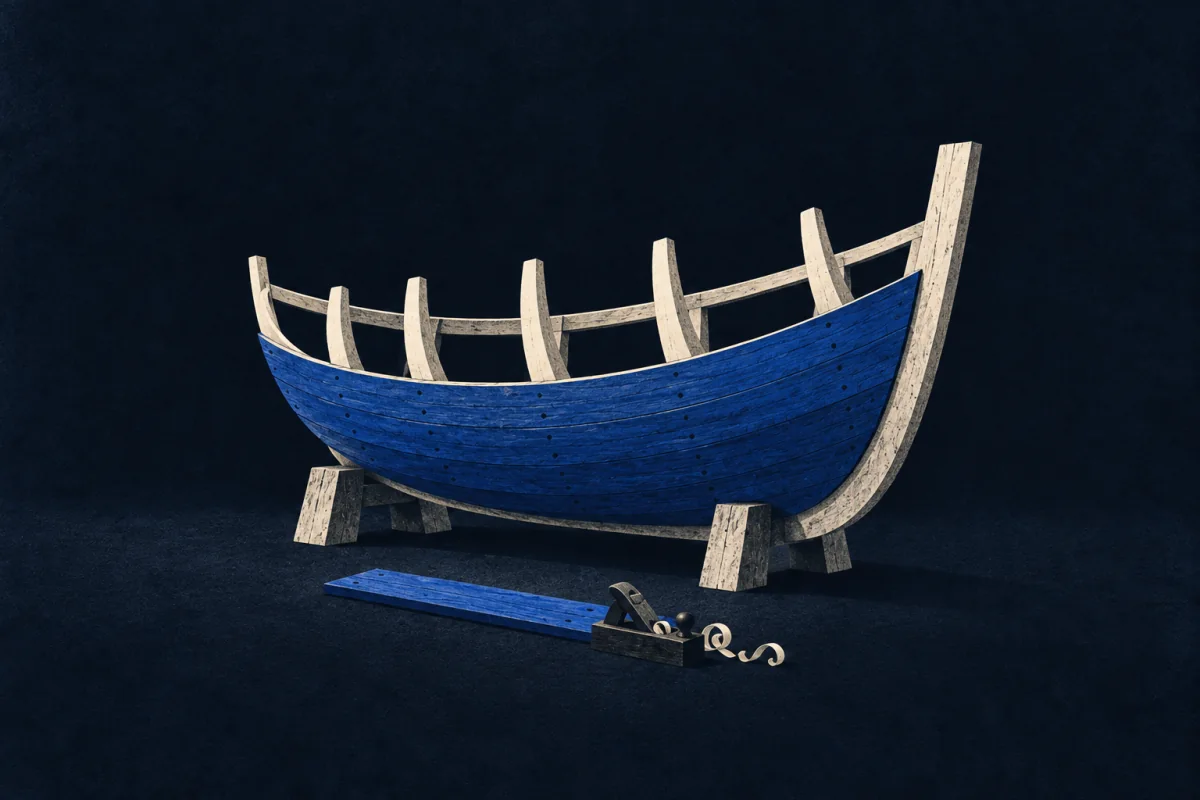
Building for the bad night.
Not the launch, not the photograph. The night it is loaded past sensible and the weather turns.
Everything you do gets judged against that, and the person who is only thinking about the launch will build something that looks better than yours and will not come back. Where you put the extra material is the whole answer, and nobody will ever see it.
Where It Stops
Building things solidly is not this, and neither is a fondness for tradition. The defining move is deciding where strength goes and where it deliberately does not, and simply making everything heavier is the opposite of the skill.
It goes wrong as designing for a disaster that will not happen. Every structure can be made stronger, and somebody who keeps adding for a worse case with no limit produces something too heavy, too expensive and late, which is its own kind of failure.
It also fails as a general disposition. Treating every project, plan or relationship as though it must survive the worst possible conditions makes a person exhausting to work with, and most things in life are not going to sea.
Take the plainer explanation first. Anybody who builds things that carry load learns to think about stress. The test is whether they will argue to take material out of somewhere that does not need it.
Where It Pays
Inside a job. Boat and shipbuilding, naval architecture, structural and civil engineering, bridge and crane work, aerospace structures, scaffolding and rigging, and heavy vehicle or trailer building. Also live events and touring production, where a rig has to be assembled and dismantled repeatedly by different crews and cannot fail over anybody's head.
What is being bought is a structure that survives its worst day and can be maintained on the ones in between. A failure at sea, on a site or above a crowd is not a repair bill, it is an inquiry, and the value of a person who puts the material in the right place is measured in the events that do not occur. Insurers, owners and regulators all price this even when nobody says so out loud.
Where it pays badly is the small custom end, where the work competes with mass-produced alternatives and the buyer cannot see the difference. The decisions that matter are hidden by definition, which makes them almost impossible to sell.
Outside one. Sheds, allotments, village halls, community projects and anybody building a deck or a trailer at home. The cost worth naming is that this person gets asked to check everybody's work, has to choose between saying nothing and being the one who found the problem, and is resented either way.
Try This
Next time you build, rig or arrange anything that has to hold, start at the end.
Ask what the worst realistic day looks like. Not a catastrophe — the loaded, rushed, badly handled version that will actually occur. Who is carrying it, in what weather, in what hurry.
Find the point where the load concentrates. There is usually one, and it is usually a joint. Put your effort there.
Then look for somewhere you have been heavy for no reason and take it out.
Designing for the worst day is a tool, not a self. Pick it up where failure is expensive or dangerous. Put it down for things that can simply be redone, because there building for the storm just makes something slow, costly and never finished.
If This Isn't You
Plenty of people build for the situation in front of them, fix it if it breaks, and go through life without much trouble that way. Handling failure when it comes is a real strategy, and for most things it is the cheaper one.
Where To Go Next
Its near-twin — Form-Realizer. Both hold a whole three-dimensional object in the head and work it into existence. Form-Realizer is aiming at the object itself and judges the result by whether it matches. This one is aiming at what the object will survive, and would accept an uglier answer that holds.
Its shadow — Form-Shaper. Form-Shaper keeps adjusting visible form until it says what it is meant to say. This one has put all its judgement into places that will be sealed up and never looked at again.
Most often confused with — Sea-Hand. Both are at home around vessels and both know what the sea does. Sea-Hand reads conditions and works the boat that exists. This one decided, years earlier and on land, what that boat would be able to take.