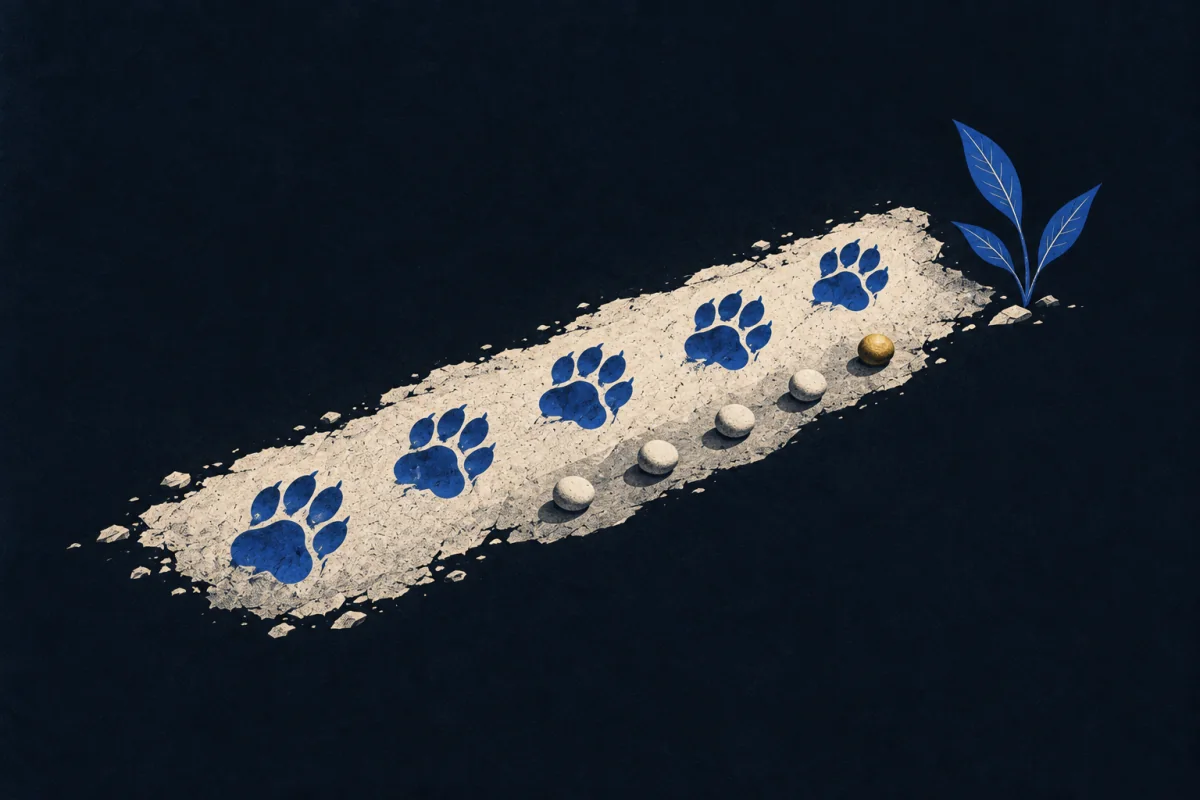
In Plain Sight
A person with this pattern notices marks that others walk past. They count because guesses stay loose until each track or repeat has been checked. This is not fussing over details; counting turns loose signs into proof. You'd see this in the classmate who checks every printed ballot after a vote and catches the one folded twice.
The Pattern at Work
Everyone in the room already suspects something. Suspicion is free, and it is worth nothing.
A society election, two hundred and eleven ballots, a result that surprised people. Rather than argue about it, one person counts — not the votes, which have been counted twice, but the papers: how many were issued, how many came back, how many show the same fold. Two hundred and eleven returned against two hundred and seven issued, and one paper folded twice when every other was folded once. The anomaly is not clever. It exists only because everything ordinary was counted first, and against a complete tally a single odd thing has nowhere to hide.
A stock room where things have been going missing, in the way things always are, with a general sense of who. Somebody counts instead: every item, by line, against deliveries, over six weeks. What emerges is not a person at all. It is that one line is consistently short by exactly the case quantity, never by ones and twos, which points at a delivery process rather than a thief, and saves the job of somebody nobody had quite accused of anything.
A transect across a heath, walked on the same line four times a year for eleven years, every individual plant of one species counted. The numbers are dull to collect and duller to read, and they are the reason a planning objection succeeds eleven years later, because an objection with a decade of counts behind it is a wholly different object from an objection with a conviction behind it.
What the Examples Show
It looks like distrust, and that reading is why the work is so often resented.
Distrust is a posture toward people. What is happening here is a conversion: an impression becomes a number, and a number can be handed to somebody who was not there and does not share the impression. Almost nothing else performs that conversion. A strong feeling about a stock room persuades nobody and never will, however correct it turns out to be.
Which is why completeness matters more than accuracy. A count of most of the ballots is not a slightly weaker count — it is not a count, because the whole value lies in there being nothing outside it for the anomaly to have been hiding in.
And it explains why the finding is usually not what anybody expected. A complete tally is indifferent. It is as likely to clear the suspected person as to convict them, and the people who wanted the count are often the people it disappoints.
Going Deeper
The English Exchequer ran on split hazel sticks for six centuries. A debt was notched across a stick and the stick was split lengthwise, each party keeping half, and the two halves had to match on the grain as well as the notches. It is a counting device designed on the assumption that everyone involved might lie, and it worked because the physical record could not be adjusted afterwards by either side.
William's commissioners produced Domesday in 1086 and then sent a second set of commissioners over the same ground, to different men, to check the first. That is the whole discipline in one administrative decision: the count is not the count until it has been done again by somebody with no stake in the first answer.
The election scrutineer. The dockside tally clerk marking every crate off a ship. The bird counter on a transect. The stocktaker.
None of these roles is loved, and that is the first cost rather than an incidental fact about them. The counter is present because somebody might be wrong or lying, and everybody being counted knows it, and no amount of courtesy removes it.
The other costs follow.
The work is only ever vindicated by failure. A count that finds nothing was, to everyone watching, several days spent confirming what they already said.
It cannot be done partly. Half a count has no evidential value at all, which means the work is undroppable once begun and impossible to scale down when time runs short.
And it is monotonous in a way that is genuinely difficult, since the attention has to stay level across hours during which nothing whatever happens, and the one thing that matters will arrive without warning at item one hundred and ninety.
The Image
The one folded twice.
It carries no signal by itself. It becomes evidence only because everything else was looked at and everything else was folded once. The anomaly is manufactured by the completeness of the tally rather than discovered in spite of it, which is why a partial count finds nothing and a full one finds everything.
Carry that one anywhere a conviction needs to become something another person can act on.
Where It Stops
Pedantry is the charge, and it lands often enough to be worth answering. The difference is what the counting is for: a count aimed at a question ends when the question is answered, and pedantry has no such stopping point.
It goes wrong as counting the available thing rather than the relevant one. Some things are easy to count and mean very little, and a complete tally of the wrong quantity carries all the authority of a real one. That is the most expensive failure available here, because it is unfalsifiable from outside.
It also fails where the population cannot be bounded. Counting needs edges — this shelf, these ballots, this transect. Applied to something with no boundary, the method produces a number that looks solid and rests on an arbitrary decision about where to stop.
Take the plainer explanation first. Anybody whose job requires a reconciliation does one, monthly, because the job says so. The test is whether it appears unprompted, on something nobody has asked to have counted.
Where It Pays
The contribution is that a disagreement stops being about who is more convincing. Most organisational disputes are fought between two people's impressions, and they are settled by seniority, confidence or fatigue, and they resurface six months later unchanged because nothing was ever established. A complete count ends that permanently — not by being clever but by being checkable, so that the person who disagrees has somewhere to go other than into the argument again. It is worth most in audit and assurance, elections and governance, stock and inventory control, ecological survey, clinical incident review, and any regulated activity where a record has to survive somebody hostile reading it. It pays badly wherever decisions are made on judgement and speed and nobody will ever be asked to justify one, and badly again where the culture reads a request to count as an accusation, which many do.
Outside work it turns up in committees, clubs, allotment societies and residents' associations, and the cost worth naming is social rather than practical. The person who counts is doing the group an unambiguous service and will be experienced as a difficulty, and the people most irritated are usually the ones who were right — because being right on impression and having it confirmed by arithmetic feels, oddly, like having been doubted.
Try This
Take something you are fairly sure about and count it properly once.
Pick the boundary first and write it down — this drawer, this month, these files — because deciding the edge after you start is how counts go wrong. Then count everything inside it, including the obvious parts.
The obvious parts are the work. The anomaly, if there is one, only means anything against them.
Afterwards, note whether the count confirmed you, contradicted you, or found something unrelated. The third outcome is the commonest and it is the one that makes the method worth having.
The complete tally is a tool, not a self. Pick it up where an impression has to become evidence. Put it down where nobody is going to be asked to justify anything.
If This Isn't You
Most people act on a reasonable impression and are right often enough to get through a week, and counting everything would stop the week happening. Trusting a sense of it is not sloppiness; it is what makes ordinary decisions possible.
Where To Go Next
Its near-twin — Order-Keeper. Both maintain a record other people rely on. Order-Keeper keeps the system straight so that it goes on working. This one counts in order to settle a specific question, and stops when it is settled.
Its shadow — Case-Maker. Case-Maker begins with a conclusion and assembles what supports it. This one refuses to hold a conclusion until the tally is complete, and is regularly disappointed by it.
Most often confused with — Pattern-Etcher. Pattern-Etcher rearranges the same material until a structure appears. This one rearranges nothing and counts everything, and the finding is whatever fails to match.