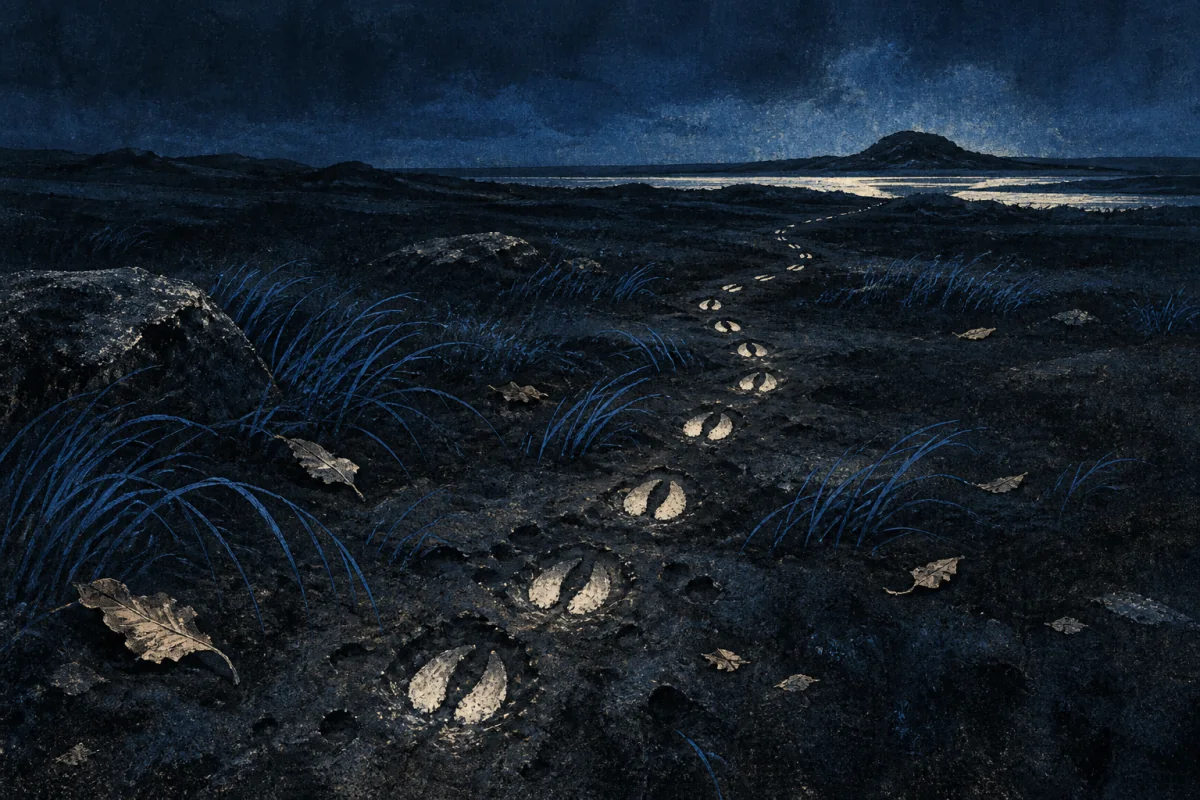
In Plain Sight
Faint marks in the dirt pull this person to a stop. They read the prints and the way the mud has dried around them, until scattered signs come together as one thing that happened. You'd see this on a wet trail in the morning, when one person crouches and can say what came through, which way it went, and roughly how long ago.
The Pattern at Work
It is nearly dark on the hillside and the line of volunteers is about to sweep the next field. One of them stops and crouches at the edge of the bracken. The grass here is bent the wrong way. Not trodden flat by the search line, which came from the other side — pushed over by something moving downhill, and still springing back, which means recently. The search turns ninety degrees on the word of one person reading a few broken stems.
In a garage, someone runs a hand around the inside edge of a front tyre and knows the car has been driven hard into left turns for months, on roads with a camber, by a driver who brakes late and turns in early. The owner said none of this. Nobody described a single journey. The rubber did all of it.
A parent comes home to a quiet kitchen. The kettle is warm but not hot, which puts it at about twenty minutes. There are two mugs by the sink and one of them is unused. A chair has been pulled around to face the back door, and the bread bag is open but the knife is clean. Nobody has told them anything, and they already know that someone came, sat where they could watch the garden, stayed twenty minutes, did not eat, and left the way they came in.
None of these three would call it the same skill. The volunteer would call it fieldcraft. The mechanic would call it experience. The parent would say they just know their own house.
What the Examples Show
The obvious reading is sharp eyes. A good observer, someone who notices more than the rest of us. That reading is wrong, and getting it wrong is why this pattern goes unrecognised in the people who have it.
Sharp eyes gather signs. This gathers signs and then holds several competing accounts of them at once, refusing to settle on the first one that fits. A bent stem could be twenty things. The read only works if all twenty stay live long enough for the mud, the light, the hour and the direction of travel to knock nineteen of them out.
Which is why patience here is not a virtue attached to the pattern. It is load-bearing. Rush the read and it still produces an answer — just a story instead of an event, and it will feel exactly as convincing.
Going Deeper
This is one of the oldest jobs a person has ever had, and for most of human history it was the one a group's survival actually ran through.
The San of the Kalahari, whose trackers can follow a wounded animal across ground a visitor would call blank. Aboriginal Australian trackers whose readings were accurate enough that colonial police forces who despised them still could not work without them. Sami herders who know where the reindeer went by what the snow has done since.
The work has never really changed, only the ground. A search-and-rescue tracker on a wet hillside and a forensic investigator standing in a room are doing the Kalahari hunter's job under different light. So is the wildlife biologist aging a print to the hour.
What that figure has always cost is worth knowing, because it still costs it.
The tracker works alone and slightly apart. The read cannot be done by committee and it cannot be hurried by frightened people, so the tracker is usually the one moving slowly while everyone else needs to move fast. The skill stays invisible until the moment it is needed, and then it is expected to be right immediately.
And it carries a particular loneliness. Being certain of something nobody else can see, that nobody can check — and sometimes being certain and wrong. The old figure was never the one at the centre of the camp. It was the one who came back and said what was out there.
The Image
Cold ground at first light.
Everything that happened here has already happened. Nothing is going to move to help you. No one is going to explain. The answer is lying still in front of you and it will keep — it does not get truer if you hurry, and the only thing that spoils it is your own impatience to be finished.
Carry that one. It is worth having in a meeting, an argument, a diagnosis, a room full of people who have already decided.
Where It Stops
This is not a love of the outdoors. Plenty of people who carry this pattern have no interest in nature at all; the ground they read is a spreadsheet, a codebase, a house.
It tends to go quiet where there is no record to read. In a fast live argument, in a room where everything is happening now and nothing has been left behind, this pattern has nothing to work on and can leave the person looking slow.
It misfires in one specific way. The machinery that assembles four real signs into an event will assemble three coincidences into one, and from the inside the two feel identical. Confidence is not the check here.
And there is a plainer explanation to rule out first. Deep experience in one domain looks a great deal like this and isn't. A mechanic of thirty years reads tyres; that may be the trade rather than the pattern. The test is whether it happens in places where the person was never trained.
Where It Pays
Inside a job. Anywhere the question is what actually happened here. The post-incident review. The bug nobody can reproduce. The audit, the due diligence, the account that stopped renewing and nobody knows why. Work that arrives as a finished state with its history missing.
The real contribution is usually not the answer. It is being the one person who stops the room acting on the first story that fits — and the one who can say what the evidence actually supports versus what everyone has quietly started assuming. Teams under pressure converge fast and early. This is the brake.
It pays badly in roles built on speed, live response, or constant meetings. It pays very well where being wrong is expensive and there is time to be right.
Outside one. The same move runs on a house, a family, a body, a set of accounts — working out what has been going on with someone from what they leave behind rather than what they say. Reconstructing a family history nobody wrote down. Knowing a place by what it has been through rather than by what it looks like now.
Worth naming: it can cost you socially. People notice being read, and not everyone wants their kitchen reconstructed. Knowing when to put it down is part of carrying it.
Try This
Once this week, when you find yourself certain about something that happened somewhere you weren't, stop and write down the actual marks you read — the specific things, not the conclusion. Then write one other story that would have produced the same marks.
Then find out what really happened, if you can.
Do that three or four times and you will learn something more useful than whether this card fits. You will learn your own hit rate, and which kinds of ground you read well and which you only think you do.
The cold ground is a tool, not a self. Pick it up where it earns its keep and put it down in the rooms that need you fast and warm.
If This Isn't You
Feeling nothing here is an answer, not a failure to understand it. The page can be left exactly where it is.
Where To Go Next
Its near-twin — Field-Naturalist. Same patience, same ground, opposite question. The Field-Naturalist asks what is here and builds a record of it. The Tracker asks what was here and builds an event. If both sound right, the difference is whether the pull is to collect or to reconstruct.
Its shadow — Triage-Mind. Everything here needs a scene that has stopped moving. Triage-Mind works where nothing has stopped and there is no time to run anything backwards. The two rarely sit comfortably in one person, and which one someone reaches for under pressure is informative.
Most often confused with — Hidden Pattern Finder. Both find structure where others see noise. Hidden Pattern Finder finds it in abstraction, across data and ideas. The Tracker needs physical ground and a thing that actually happened. Many people read one of these cards and belong to the other.