In Plain Sight
This person reads a body with the hands and answers in the same movement. They are not guessing at what hurts. They feel heat and held tension, and then the relief arrives without much needing to be said. You'd recognize this in the one whose hands get called for when something has gone wrong inside somebody.
The Pattern at Work
A man comes in with a shoulder that has been bad for five months and a scan that shows nothing much. The practitioner spends about ninety seconds on the shoulder and the rest of the session on the opposite hip, which he has not mentioned and does not think is relevant. It is stiffer than it should be, has been since a fall two years ago that he has forgotten about, and the shoulder has been doing extra work ever since. He is not told any of this at the time, because the explanation would arrive as a theory and he has had four of those already. He is told to come back in a week, and the shoulder is better in three.
A baby has been crying for two hours and everybody in the house has tried everything. The grandmother takes him, and what she does is not rocking. Her hand goes flat on his back, she finds where he is rigid, and she stays there with a slight pressure and no movement at all until something lets go. Forty seconds. She could not tell anybody what she felt, and if pressed would say he was holding himself funny, which is both true and useless as instruction.
A horse will not take the left rein and three people have opinions about schooling. The farrier runs a hand down the neck and along the back without being asked and says, mildly, that it is the feet, and it has been the feet for a while. Nobody argues, because he has not made a case. He has put a hand on an animal that cannot say anything, and the animal has told him.
What the Examples Show
The quick reading is a gift, and that word does damage, because it makes the thing sound unlearnable and stops anybody asking what is happening.
What is running is palpation — reading a body by touch for heat, tension, texture and asymmetry — and it is a trained sense with an enormous amount of accumulated reference behind it. The reason the hip was found is that thousands of hips have been felt, so this one registered as wrong against a very large background. That is experience rather than intuition, and it arrives faster than thought, which is what makes it feel like neither.
The second half is that the finding and the treatment are one movement. There is no diagnosis and then a plan. The hand locates the problem and answers it in the same contact, which is why explanations are poor and come afterwards if at all — and why the pattern works on a baby and a horse.
Going Deeper
Every settled society has had bonesetters, and they were usually the person the doctors disliked most: unqualified, frequently effective, and impossible to examine. English villages had them into the twentieth century, families passing the work down. Hugh Owen Thomas came from exactly that line and then qualified, and produced the splint that saved a very large number of legs in the First World War — a fair illustration of how much real knowledge sat in that tradition.
Andrew Taylor Still founded osteopathy in 1874 after losing three children to meningitis and concluding that medicine as practised was not working. Thai and Ayurvedic massage traditions codified pressure and sequence centuries earlier. The midwife's hands did the same work on a different problem, reading a position through an abdomen with nothing else available.
The awkward fact running through it is that palpation thinned out as imaging improved, for understandable reasons, and something was lost in the trade that is hard to argue for because it cannot be shown on a screen.
The bill is paid in credibility. A finding arrived at by hand cannot be demonstrated to anybody who was not holding the hand, which makes this knowledge structurally hard to defend, and its practitioners have been regulated, mocked and occasionally prosecuted for as long as the work has existed. Some of that was earned: the same unprovability shelters people who cannot do it at all. And the ones who can are asked at parties, at weddings and across dinner tables, permanently, by people holding out a wrist.
The Image
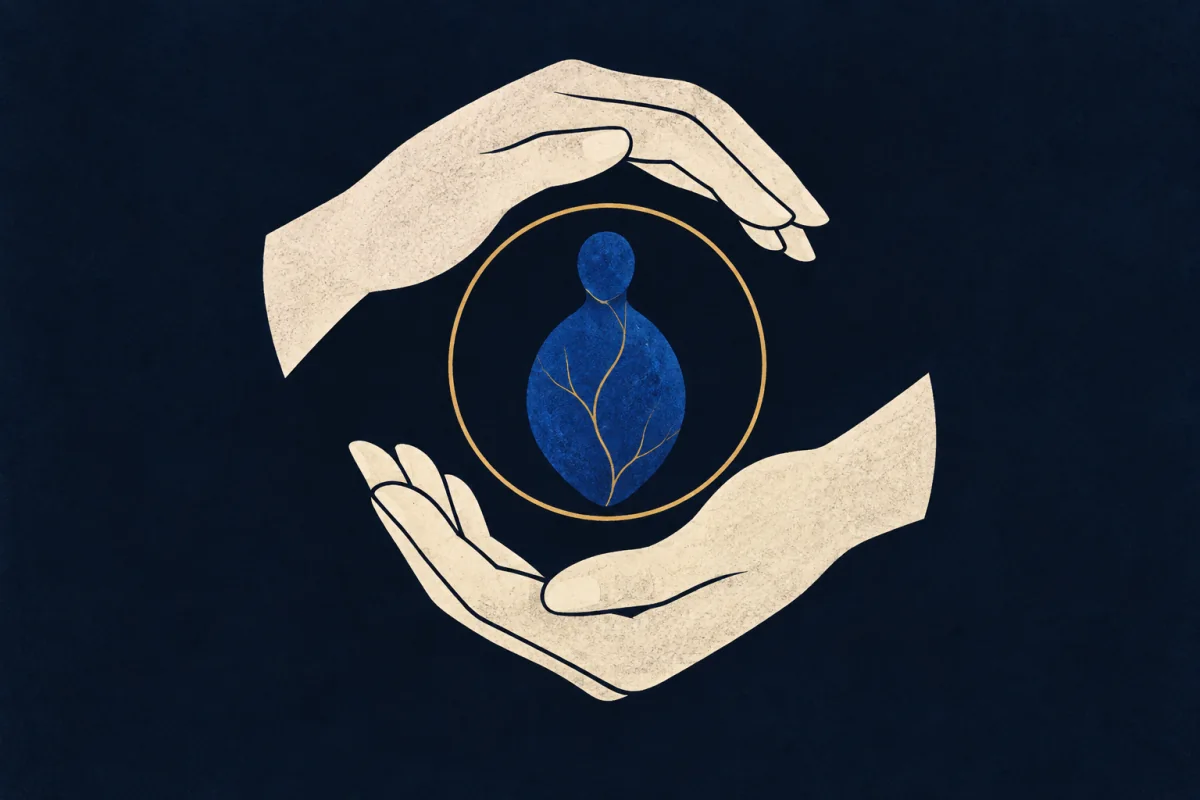
What the hands find first.
Put a flat hand on a shoulder and most people are already receiving information: warmth, where the muscle is hard, whether the breath moves under it. The information was always available. What separates this pattern is a very large number of previous shoulders, which is what turns a sensation into a reading.
It is worth noticing how much of this you are already getting and discarding.
Where It Stops
Being comforting is not this. A hand on a shoulder is a kind thing and is not a diagnosis, and the two get confused constantly, usually by people describing the work rather than doing it.
It goes wrong as confidence beyond the evidence. A hand can find a stiff hip. It cannot find a tumour, and the history of this territory includes people who thought otherwise and delayed somebody's treatment by six months.
It goes wrong again as never explaining. There are patients who need to understand what is happening to their own body, and silence, however skilled, leaves them dependent on returning.
It also fails where touch is unwelcome or unsafe. That is not a small category, and a practitioner who reads consent as poorly as they read tissue is dangerous regardless of what their hands can find.
Take the plainer explanation first. Any physiotherapist or osteopath does this because the training builds it. The test is whether it happens with a crying baby, an animal, or a friend's back, with nothing riding on it.
Where It Pays
Inside a job. Physiotherapy, osteopathy and chiropractic, massage and soft-tissue work, midwifery, nursing, veterinary practice and farriery, sports medicine, and the hands-on end of palliative care. The contribution is speed to the actual site: a great deal of pain is referred, meaning the place that hurts is not the place that is wrong, and a reading by hand crosses that gap in a session where investigation takes months. Vets and farriers rely on it entirely, since their patients say nothing.
It pays badly in any system that requires the reasoning to be written down before the treatment is given, and badly again where contact is billed in six-minute units.
Outside one. Children, elderly parents, animals, sports injuries in a family, and the ordinary business of being the person whose hands are asked for. The cost worth naming is the demand: this is one of the few patterns that gets requested directly and physically, and the requests have no natural limit. The second is the strain of unprovability. A person who can feel what is wrong and cannot evidence it spends a lot of their life being either overtrusted or dismissed, and both are uncomfortable in their own way.
Try This
Put a flat hand on your own shoulder, or a willing person's, and do nothing for thirty seconds. No rubbing.
Then note three things in words: where it is warmer, where it is harder, and whether the breath reaches under your hand. Most people have never consciously read any of the three.
Do it on several different people over a few weeks. The finding is not that you can diagnose anything — you cannot — but how quickly a background builds, and how obvious an unusual one then becomes.
The reading hand is a tool, not a self. Pick it up where a body cannot say what is wrong. Put it down where what is wanted is an ear rather than a hand.
If This Isn't You
Most people offer a hand on a shoulder because it is kind, not because it tells them anything, and the kindness is the whole point and does real work. Feeling no urge to read a body through your palms is an answer, not a gap.
Where To Go Next
Its near-twin — Mind-Healer. Both relieve something a person cannot relieve alone. The Mind-Healer works through language, over months, and the understanding is part of the cure. This one works in one contact, on a patient who may be a baby or an animal, and the explanation is optional.
Its shadow — Evidence Mapper. Both find what happened from physical traces. The Evidence Mapper works slowly, records everything, and stakes a claim anybody can check from the file. This one arrives in seconds and can show nobody anything, which is the strength and the difficulty.
Most often confused with — Grief-Holder. Both are present with distress and neither says much. The Grief-Holder does nothing at all with their hands and is not trying to change anything. This one is working, and the stillness is a reading rather than company.