In Plain Sight
Some people cannot walk anywhere without reading what is growing. The names come, but so does the reason: this one here, on this soil, at this height, with that one beside it. A notebook fills up with dates and locations that look like nothing to anybody else. You'd notice this in the walker who stops at a verge and says the ground must be limestone.
The Pattern at Work
The identification is never of the plant alone. It is of the plant and where it is standing, and the two are read together.
Field botany runs on a key, which is a chain of either-or questions about the specimen in hand. Leaves opposite or alternate. Hairs on the stem or not. The flower parts in fours or fives. Each answer closes off half of what remains, and a wrong answer early sends the whole chain somewhere useless. Somebody good at this notices when the key stops fitting and goes back up rather than forcing the specimen into the nearest option.
Underneath the key sits the habitat. Species have preferences in soil chemistry, drainage, shade and exposure, and an experienced eye uses the place to shorten the list before opening a key at all. Standing on chalk downland rules out most of the flora of an acid bog. It also runs backwards: an unexpected plant says something about the ground it is on, and a patch that has no business being there usually means the soil or the water has changed.
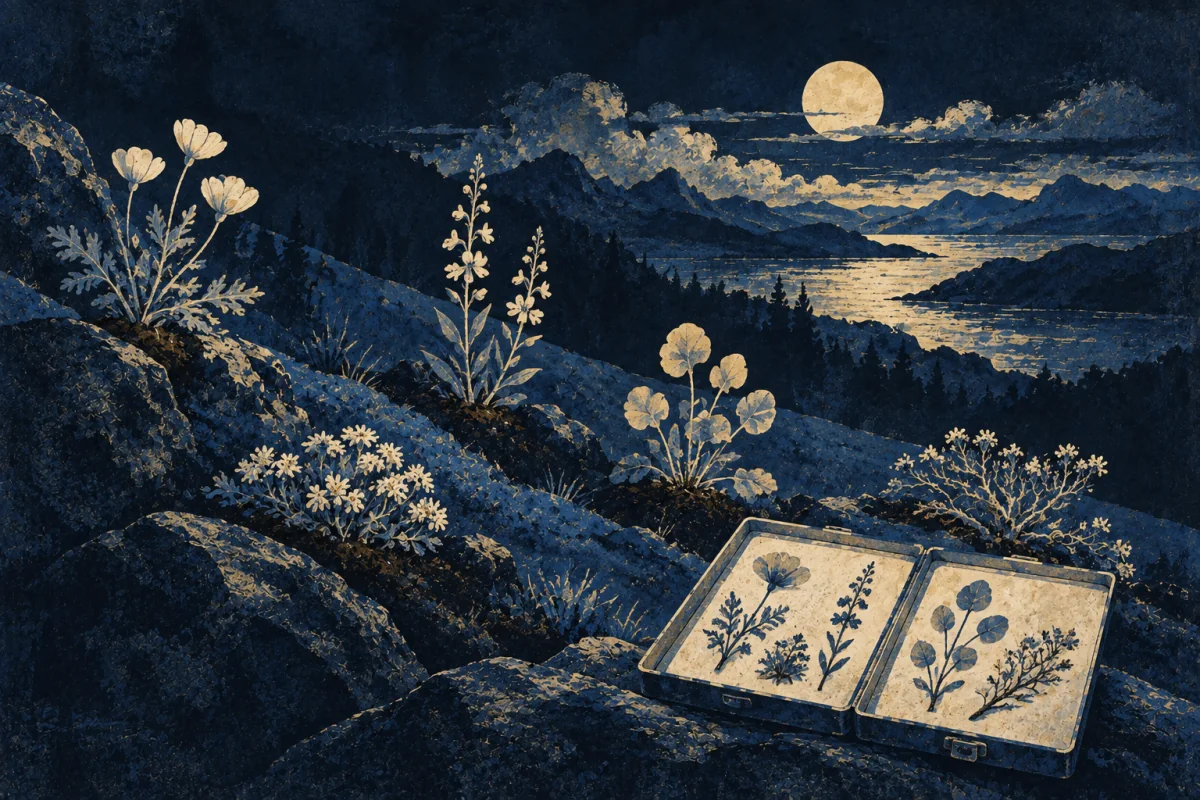
And the whole of it gets written down. A record without a date, a location and a name attached to it is worth nothing to anybody later, so the recording is not tidiness but the actual product. The same discipline covers the specimen itself: pressed properly, labelled at the time rather than from memory, and never collected where the population is too small to take from. The notebook outlives the walk, and it is the only part that does.
What the Examples Show
It gets read as a hobby, or as a good memory for names, or as a general love of the countryside.
The first element is that the plant and the place are one observation. Where something grows narrows what it can be, and an unexpected plant is information about the ground rather than a curiosity.
The second is the key: a disciplined chain of either-or decisions where an early error is invisible and fatal, and the skill lies in noticing when the chain has stopped fitting.
The third is that the record is the output. Date, location, name, condition, written at the time. A walk with no notebook produced nothing, however much was seen, because the record is what the next person works from.
Going Deeper
Botanical recording is one of the very few sciences still largely carried by unpaid people, and it has been for two hundred years.
The Linnaean system gave amateurs a way in: a plant could be keyed out by anybody with a good eye and a book, without a laboratory. Local floras were compiled by clergymen, doctors and schoolteachers through the nineteenth century, and the county recorder system that grew out of that still runs. The distribution maps that conservation policy rests on are built from records submitted by volunteers, many of whom have walked the same square for decades. Herbaria in universities hold specimens collected by people who never drew a salary for it. Professional botany moved on to genetics and physiology, which left identification in the field to people doing it for nothing.
The costs are real. Naming plants is treated as a pastime, so the people who do it best often hold no position and no pay, and their knowledge leaves with them. It takes years to become reliable, and there is no shortcut: a key can be followed by anybody, but knowing which species are plausible here takes a long apprenticeship to a particular landscape. The recorder community is elderly almost everywhere and has not replaced itself. And the work is solitary and slow in a way that does not photograph well, being hours on a verge with a hand lens, producing one line in a database that nobody will read until someone needs to know what used to grow there.
The Image
Kneeling on the verge.
Down at the level of the plant, hand lens out, counting something on a flower head that is smaller than a fingernail.
Everybody walking past sees a person crouched at the roadside. What is actually happening is a decision between two species that look identical standing up, made on a detail that can only be seen from here, and the answer changes what the record says about this piece of ground.
Where It Stops
Loving gardens is not this. Gardening is about growing chosen plants well; this is about identifying what arrived on its own, which is a different skill and often held by people whose own gardens are a mess.
It goes wrong as certainty. A confident name attached to a hard species, recorded and submitted, puts a wrong dot on a map that other people then rely on, and nobody catches it. The discipline is in writing down the uncertainty rather than resolving it for tidiness.
It also fails when the place changes. Somebody who has learned one landscape deeply can be lost in another, because the shortcut that makes them fast is local knowledge and it does not travel.
Take the plainer explanation first. Anybody who walks the same ground for years picks up names. The test is whether the habitat is read alongside the plant.
Where It Pays
Inside a job. Ecological consultancy and survey work, which is where most of the paid demand sits: habitat classification, protected species surveys, and the botanical side of environmental impact assessment. Also nature reserve and national park staff, countryside stewardship advice, herbarium and seed bank work, and the identification side of horticulture, forestry and agronomy. Museums and universities employ a small number of people to curate collections.
What is being bought is a defensible answer about what is on a site. A development, a grazing agreement or a designation turns on whether a particular species is present, and the record has to hold up when somebody with an interest in the opposite answer looks at it. Consultancies compete on whether their surveyors can be trusted.
Where it pays badly is in the rest of it. Survey work is seasonal, contract- based and often poorly paid for the qualification it needs, and many surveyors spend winter out of work entirely. The recording tradition that supplies the underlying data is unpaid by design.
Outside one. County recording, local wildlife trusts, national plant monitoring schemes, and the long private project of knowing one patch properly. The cost worth naming is that the expertise is enormous, freely given, and almost invisible until it disappears.
Try This
Pick one patch of ground you pass often: a verge, a wall, a corner of a park.
Go to it and name three things growing there. Not from memory. Use a key or an app, and follow it properly rather than guessing from the picture.
Then ask why those three and not others. What is the soil like? How wet? How much light? Whether the answer comes or not, you will look at the next patch differently.
Write down the date and the place. That is the part that turns a walk into a record.
Reading the ground is a tool, not a self. Pick it up where what grows tells you something. Put it down when somebody wants the garden to look nice.
If This Isn't You
Plenty of people enjoy being outdoors without wanting to know what anything is called, and lose nothing by it. A walk does not have to be a survey.
Where To Go Next
Its near-twin — Plant-Hand. Both live close to plants and read them quickly. Plant-Hand works with growing them, judging by feel what a living thing needs next. This one is identifying and recording what is already there, and often never touches it.
Its shadow — Plant-Healer. Plant-Healer knows plants for what they do to a body, carried as use rather than as taxonomy. This one holds the names, the places and the records, and has no interest in whether anything is useful.
Most often confused with — Plant-Doctor. Both diagnose from a plant's appearance. Plant-Doctor is working out what is wrong with a specimen somebody cares about. This one is working out what the specimen is, and healthy or sick barely matters.