In Plain Sight
Some people keep the count where the work happens. They are not doing accounts. Flocks at dusk, the weight on the dock, bushels coming off the field are tallied on the spot, tied to the weather and the animals. You'd notice this in the one whose ledgers outlast the herd they recorded.
The Pattern at Work
The sheep come through the gate at dusk and there are two hundred and eleven, and the number is written in the book before anybody goes in for the evening. Not approximately, not tomorrow. Two hundred and eleven, the date, and one line about the weather and where they had been, because a count without conditions attached is a number that cannot be compared with any other number.
Everything about that discipline is unglamorous and it is why the book works. A count made at the gate is checked against the animals; a count made in the kitchen is checked against a recollection of the gate. The first is evidence. The second feels identical while it is being written and is worth almost nothing, and the person doing it cannot tell the difference.
The haul gets weighed on the dock rather than at the buyer's, which is partly about trust and mostly about the fact that a weight taken at the point of landing, with the time and the sea state noted, becomes a record of what a particular ground produces in particular conditions. After twenty years that is the most valuable thing the boat owns and it was never the point of writing it down.
The tally is also public, which is half of why it holds. Everybody at the gate sees the number go into the book, and anybody who thinks it is wrong can say so while the animals are still there rather than three weeks later when it has become somebody's word against somebody else's.
What the Examples Show
It gets read as being meticulous, or as a suspicious nature, or as somebody who likes numbers.
What is actually running is a refusal to let measurement separate from the thing measured. The numbers stay tied to weather, animals, ground and season, which means they can answer questions years later that nobody thought to ask at the time — and the moment they float free of those conditions they become an abstraction that cannot be checked or compared.
The second element is immediacy. Everything here turns on the count being made at the point of contact, with the thing present, because human memory produces confident numbers that are wrong by a few per cent and no amount of care afterwards recovers it.
And it is a habit of record rather than of calculation. Nothing is being worked out. Something is being written down, in the same form, every time, for decades.
Going Deeper
Counting at the point of production is the origin of writing itself, and it has been done by people with no standing for as long as anybody has kept animals.
The earliest clay tablets in Mesopotamia are tallies of grain and livestock, and the script came out of the counting rather than the other way round. English manorial reeves counted stock and rendered account annually to a lord who did not trust them, and a great many of the rolls survive and can still be read. Tally sticks were used as receipts in the Exchequer into the nineteenth century because a split stick cannot be altered by either party. Fishery landing records, shepherds' counts in dialect numerals across northern England, and the account books of every farm and mill are the same practice.
What it costs is that it is boring, and boring work is the first thing dropped and the last thing credited.
The value of a run of records is entirely in its continuity, so a gap of three years destroys far more than three years of value, and the gaps happen whenever the person doing it is ill, busy or dies. It is also unpaid and invisible: nobody has ever been thanked for a well-kept tally, while the absence of one becomes apparent only in a dispute or a bad year. And the records are physically fragile, kept in sheds and kitchens, and the usual fate of twenty years of a working life is a skip after a funeral.
The Image
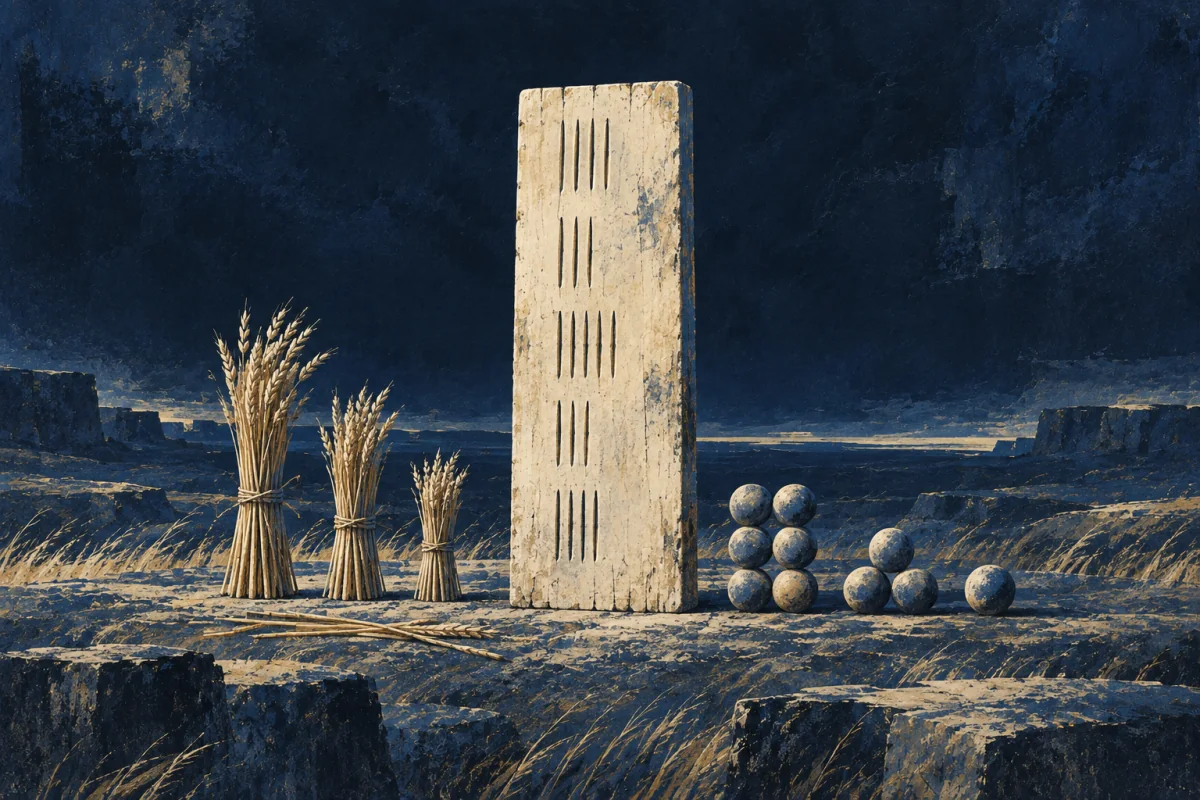
Written at the gate.
Not in the kitchen afterwards, and not approximately. The number put down with the animals still in front of you, the date beside it, and one line about the conditions.
Everything written afterwards is a recollection wearing the clothes of a record, and the person writing it cannot tell the difference. That is the point. It is not a failure of care, it is how memory works, and the only remedy is the gate.
Where It Stops
Liking spreadsheets is not this, and neither is bookkeeping. The distinctive thing is that the count is made at the point of contact and stays attached to the conditions.
It goes wrong as counting instead of looking. A person can produce a perfect tally of a flock and fail to notice that six of them are lame, and the discipline of recording can crowd out the older discipline of watching.
It also fails where the thing is not countable. Applied to work whose value is not in units — teaching, care, most office work — the same instinct produces numbers that are accurate, tied to nothing, and used badly by somebody else.
Take the plainer explanation first. Anybody running stock counts them, because the animals require it. The test is whether the conditions get written down too, and whether the run has gone on long enough to answer a question nobody asked at the start.
Where It Pays
Inside a job. Farming and stock management, fisheries, forestry, warehousing and logistics, field science and ecological monitoring, quality and production recording, and any operation where quantities are generated somewhere other than an office. Also audit and assurance work, where the first question is always whether the number was made where the thing was or somewhere more convenient.
What is being supplied is a run of comparable data that nobody commissioned. Almost every organisation has numbers and almost none has a long consistent series taken the same way in the same conditions, which is the only kind that answers anything. The person who keeps one is usually junior, usually doing it because it seems obviously right, and is holding something the organisation will need in fifteen years and cannot otherwise obtain.
Where it pays badly is anywhere the recording is separated from the doing, anywhere systems change every few years, and in any organisation that treats data as a reporting obligation rather than as an asset. Outside one. Smallholdings, beekeeping, allotments, a rain gauge. The cost worth naming is that it is a daily obligation with no visible return for a decade, and everybody around the person regards it as a harmless eccentricity.
Try This
Pick one thing you could count at the moment it happens — miles, hours, takings, eggs, something growing.
Write it down at the point it occurs, not in the evening, and put two things beside it: the date and one word about the conditions.
Do that for a month without analysing any of it. Resisting the analysis is part of the exercise; the value is in the run, not in any entry.
Then look back at the month. Most people find the conditions column is the part that turned out to matter.
Written at the gate is a tool, not a self. Pick it up where a quantity is produced in the world and will be argued about later. Put it down where the thing that matters cannot be counted, because there a number is a way of avoiding the question.
If This Isn't You
Most people have a reasonable idea of roughly how many, get on with the work, and are right often enough, which is how most of everything has always been run. Feeling no urge to write it at the gate is an answer, not a laxity.
Where To Go Next
Its near-twin — Tally-Hand. Both keep counts that can be trusted. Tally-Hand makes the count into a physical object anybody can verify by hand. This one writes it down at the moment of contact and keeps the conditions with it.
Its shadow — Knowledge-Gatherer. Knowledge-Gatherer collects and organises what others have produced. This one produces the record itself, at the gate, and has no interest in assembling anybody else's.
Most often confused with — Land-Reckoner. Both turn ground into figures. Land-Reckoner fixes positions so a line can be recovered in fifty years. This one counts what the ground produced this evening, and will do it again tomorrow.