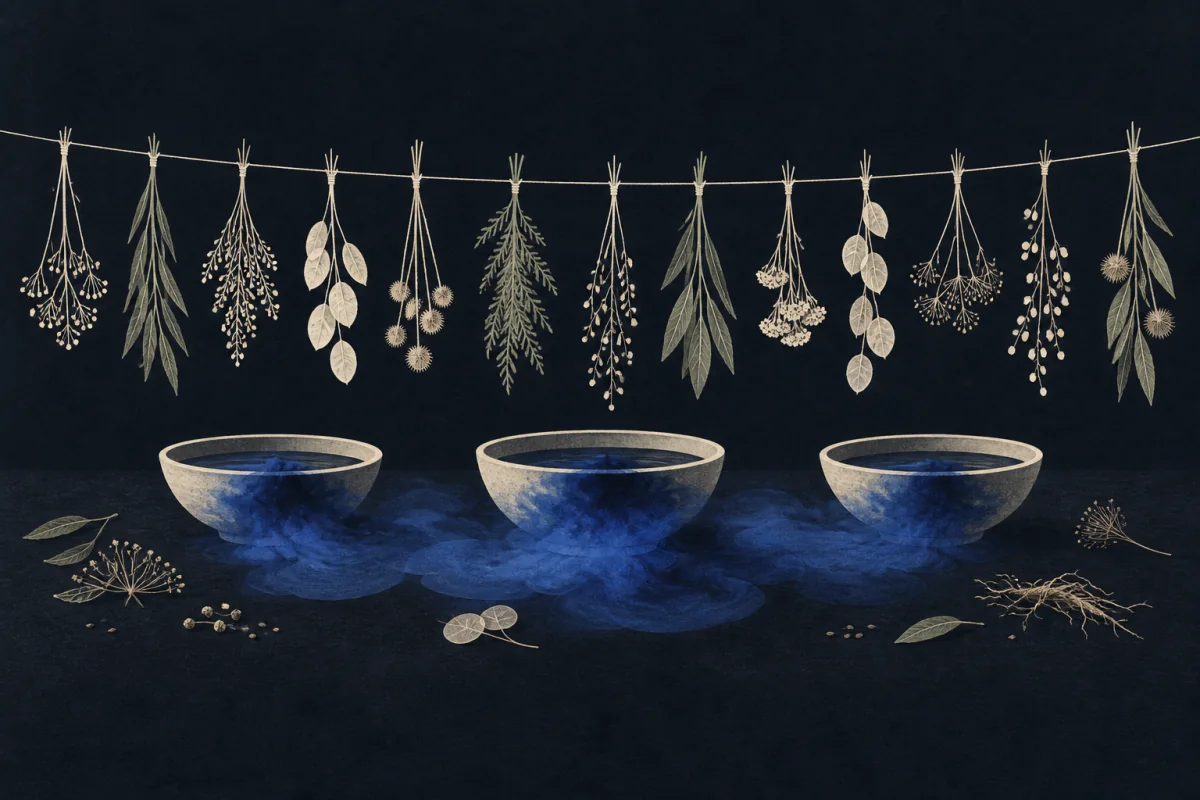
In Plain Sight
Some people treat what ails a body with what grows nearby. They are not selling remedies. Leaves, roots and barks get matched to the person in front of them, and the tending goes on across seasons rather than in a crisis. You'd notice this in the one whose kitchen smells of things drying on string.
The Pattern at Work
A woman has had a cough for six weeks and has been to the surgery twice. The neighbour she eventually mentions it to does not reach for anything immediately. She asks when it is worst, what the house is like at night, whether it started after the flooding in January, and what the woman is actually short of — which turns out to be sleep, more than anything. What she gives her is a syrup that will help a little, an instruction about the bedroom window that will help considerably more, and a standing arrangement to be told in a fortnight. The fortnight is the part that matters. If it has not shifted, the advice is the surgery again, more firmly this time.
A man's hands crack every winter and have done for years, and he has never once mentioned it to a doctor because it is not, in his view, a thing anybody goes to a doctor about. The treatment is unremarkable. The tending is not: a small jar appears each autumn, before the cracking starts rather than after, because the whole arrangement is built around the season rather than around the complaint. He has stopped noticing that it arrives.
An old dog that has gone stiff, a burn on a forearm, a child who will not settle in the evenings. Three things that would not reach a clinic, that nobody would think worth an appointment, and that would otherwise simply be endured for months. All three are dealt with over a garden wall, at no cost, by somebody who will ask about each of them again unprompted in a few weeks.
What the Examples Show
It gets read as folk medicine, or as an alternative to proper treatment, and the argument that follows is usually about whether the plants work.
That argument misses most of what is happening. Two other things are running. The first is continuity: this is somebody who sees the same people over years, in their own houses, and therefore knows what is normal for them and what is new — which is the single most useful piece of clinical information there is and the one a busy surgery has least of.
The second is that the attention is on conditions as much as on symptoms. The damp bedroom, the season, what somebody is not eating, the fact that they are exhausted. The remedy sits inside a picture of a life rather than on top of a complaint.
And the tending is slow and repeated. Nothing here is a single intervention. The arrangement to be told in a fortnight is doing as much work as the syrup.
Going Deeper
Plant medicine is the oldest medicine there is and most of it was practised by people with no standing, usually women, usually unpaid and usually locally.
Monastic physic gardens were laid out to a plan and the knowledge written down, which is the only reason any of it survives in a form anybody can now read. Village herbalists across Europe held the rest orally and were consulted long before anybody else, because they were nearer, cheaper and known. Ayurvedic and Chinese traditions systematised the same material into something teachable. A significant fraction of modern pharmacology came directly from this body of knowledge. Willow bark, foxglove and quinine were all in use long before anybody could say why they worked, and the people who held that knowledge were frequently dismissed in the same breath as the plants were taken from them.
The position has always been awkward, and it has never stopped being awkward.
It sits outside the profession, which means no protection, no standing and no recourse, while carrying real risk: a plant that does something is a plant that can do harm, and the responsibility is entirely personal. It attracts both the genuinely knowledgeable and the confidently ignorant, who are indistinguishable to anybody seeking help. The good practitioners spend a great deal of their energy sending people to the doctor, which earns nothing and is the most important thing they do. And the work is unpaid or barely paid, continuous, and carried out for neighbours who will ask at the door on a Sunday.
The Image
The fortnight.
Not the remedy. The arrangement to be told in two weeks, which converts a guess into something with a check on it and a point at which somebody says this needs a doctor.
Anybody offering help for a body without that arrangement is offering half of it, and the missing half is the half that catches the serious thing.
Where It Stops
Liking gardening is not this, and neither is an interest in natural remedies. The difference is a specific person being followed over a specific period, with a point at which the answer changes.
It goes wrong as not knowing the limit. The same continuity that catches a chest infection early can delay a diagnosis by months if the practitioner cannot say the words that end their own involvement, and that failure is not rare.
It also fails in acute illness. Anything fast, severe or structural belongs elsewhere immediately, and the pattern's instinct to observe across seasons is exactly wrong in a week where hours matter.
Take the plainer explanation first. Anybody who grew up rurally knows some plant remedies, because the knowledge was ordinary. The test is whether somebody is actually following a person — whether there is a fortnight in it.
Where It Pays
Inside a job. Herbal practice and phytotherapy, community and rural health work where formal services are thin, the traditional-medicine side of integrated clinics, veterinary and stock care of the small-scale kind, and anywhere a practitioner sees the same households repeatedly over years. Also the growing and preparation end: physic gardens, medicinal crops, dispensary work.
What is actually being supplied, alongside whatever the plants do, is surveillance of a friendly kind. A great deal of serious illness is found late because nobody was in a position to notice that a person had changed, and this is somebody who is in that position by default. The referrals such a practitioner makes are worth more than any remedy they hand over, and nothing in any system records them.
Where it pays badly is anywhere claims must be evidenced to a clinical standard, anywhere the work is sold as a product rather than carried as a relationship, and in any setting that will not permit a practitioner to say plainly that the thing is beyond them. That last one is not a small matter: a practice that cannot refer is a practice that will eventually do harm, whatever is in the jar.
Try This
Pick one small recurring complaint of your own — dry skin, a winter cough, something that comes back.
Do not treat it. Instead, write down for a month when it is worse and what else is true at those times: the weather, the room, the sleep, the week.
Most people find a pattern within three weeks, and it is usually about conditions rather than the body.
Then change one condition and give it a fortnight, with a date written down for looking again.
The fortnight is a tool, not a self. Pick it up where something is slow, recurring and nobody is watching it. Put it down where something is new, severe or getting worse quickly, and go to a doctor.
If This Isn't You
Most people take the tablet, get better, and give it no further thought, which is efficient and is what the tablet is for. Feeling no urge to hang things from string in the kitchen is an answer, not an ignorance.
Where To Go Next
Its near-twin — Touch-Healer. Both offer relief outside formal medicine and both work by hand. Touch-Healer's instrument is contact and the effect is in the session. This one hands over something material and the effect is measured across seasons.
Its shadow — Body Signal Reader. Body Signal Reader wants a finding and examines to get it. This one rarely examines and relies instead on having known the person for years, which is slower, weaker at diagnosis and better at noticing change.
Most often confused with — Field-Naturalist. Both read plants closely and both work across seasons. Field-Naturalist wants to know what is happening in the place. This one wants to know what will help the person at the door, and will walk past a fascinating question to get it.