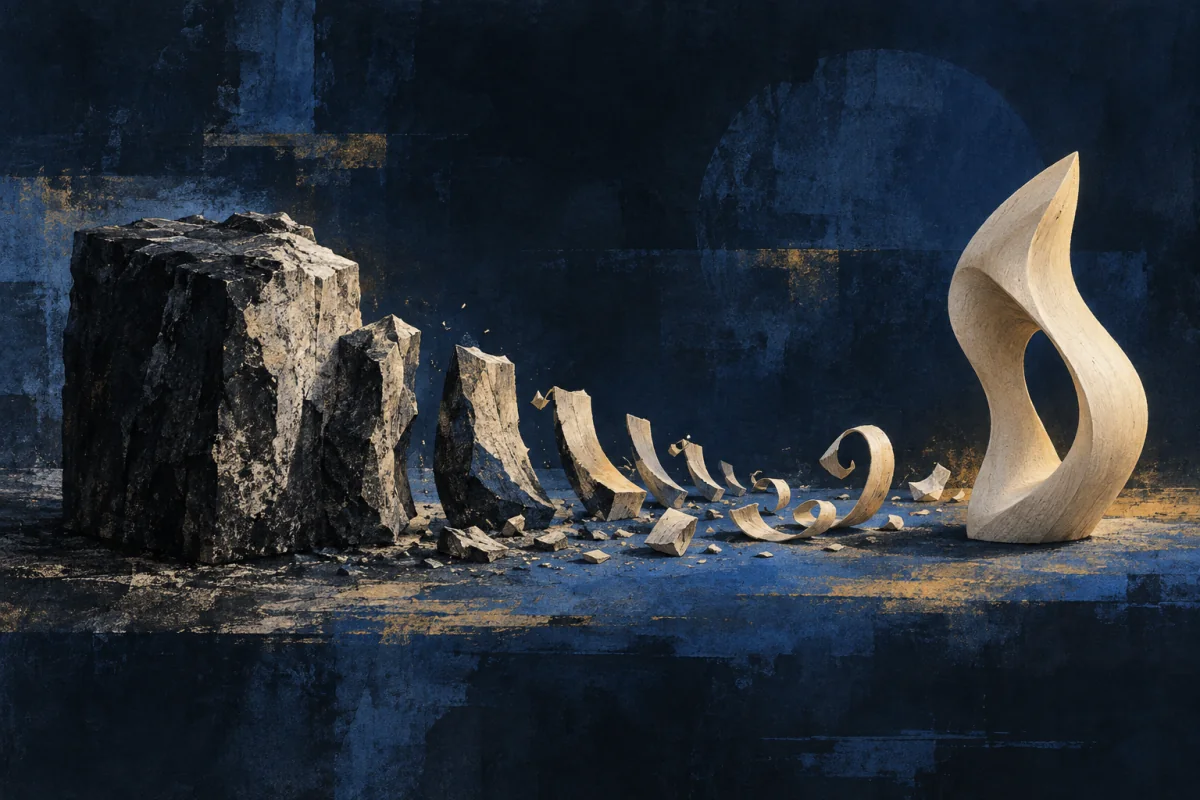
In Plain Sight
People with this pattern can picture a finished object before it exists. They do not just make it look nice; they test with hand and eye until the real piece matches the shape they meant to make. You'd spot this in someone sanding one small wooden part at the kitchen table, stopping often to check its shadow against the wall.
The Pattern at Work
A chair leg has been turned four times and three of them are in the bin. The fourth is not better by any measurement anyone could take — the diameters are within a hair of each other and all four would hold a person. What is different is a curve somewhere below the middle that the maker can see and cannot name, and the test that settles it is holding the leg up against a white wall and looking at the outline rather than the thing.
A violin repairer is asked to replace a bridge. It takes ninety minutes, most of which is not cutting. The blank is fitted to the belly by taking off a shaving, pressing it down, looking at where it marked, taking off another shaving. There is no measurement in this at any point. The wood tells him where it is touching and he removes the places it is not.
A basket-maker working through a winter is doing the same thing on an entirely different clock. The willow is soaked, and it will do what it will do; the shape she is after cannot be forced onto it, so the work is a negotiation in which she proposes and the material answers, over weeks. A stake that fights gets replaced rather than argued with. The finished basket looks like it grew.
None of the three is decoration and none is measurement. All three are somebody comparing what exists against something held internally, and removing the difference.
What the Examples Show
The word offered is craftsmanship, sometimes perfectionism, and both suggest a high standard being met.
A standard is external. This is not — there is an intended form carried internally, and the work is subtraction toward it. That is why the maker cannot say what is wrong with the third chair leg in any language that travels, and why the answer to "is it finished" is never a measurement.
The second half is the material's vote. This pattern reads what the medium will and will not do and adjusts the intention rather than forcing it, which is the difference between craft and struggle. Wood that fights is not a problem to be overcome; it is information about what this piece is going to be.
Which explains the multi-stage patience. Drying, curing, firing, settling — these are not delays between the real work. They are stages during which the material changes its mind, and rushing them produces something that looks right and fails later.
Going Deeper
A Japanese sword-smith folded steel not for decoration but because the material demanded it, and the smith who could feel when the fold had taken was the one whose blades held an edge. Stradivari's instruments have been measured to exhaustion and the measurements do not explain them; what is not reproducible is three hundred small judgements about one piece of spruce. West African bronze-casters worked lost-wax, where the model is destroyed to make the object and there is exactly one attempt. Mesoamerican stone-carvers read a block for its faults before the first strike was made, because a flaw hidden two inches down meant a year of work lost and no way to recover any of it. Native American basket-makers built form and pattern together from material gathered in a specific month.
Every one of those is the same relationship: a person who holds a form, a material with its own opinion, and a long series of small removals.
The costs recur. The work is judged entirely on the last version, and every rejected one is invisible, so the labour and the result cannot be seen at the same time. It is slow in a way that is genuinely uneconomic, which is why these trades have been squeezed everywhere and why the people in them are usually subsidising the work with something else. And the knowledge lives in the hands. It can be shown but barely described, which means each generation is one uninterested apprentice away from losing it — and many have been lost exactly that way.
The Image
The shadow on the wall.
Hold the thing up and look at the outline instead of the object. The eye stops being distracted by grain and finish and colour, and the shape it actually is becomes visible for the first time.
Carry that one into anything being made. When you can no longer tell whether it is right, stop looking at the thing and look at its silhouette — in a document, a room, a plan, that means asking what shape it would have if all the detail were stripped off.
Where It Stops
Being good with tools is not this, and neither is liking nice objects. Plenty of skilled makers execute somebody else's drawing extremely well and have no internal form to compare against, which is a different and entirely respectable trade.
It goes wrong as never releasing. The internal form is always slightly ahead of the object, so there is no natural moment of arrival, and without an external stop — a customer, a deadline, a firing — the subtraction continues past the point where anybody else could detect a change.
There is a failure that reads as integrity: refusing work that does not permit this. Most making is not this kind, and somebody who can only work when the conditions allow full iteration spends a great deal of their life not working.
And take the plainer explanation first. Anyone trained in a craft will produce all of this inside it, because that is what the training builds. The test is whether it appears where no craft applies — a garden bed, a meal, a sentence, a stack of firewood nobody will look at.
Where It Pays
Inside a job. Making trades of every kind: furniture, instruments, ceramics, metalwork, textiles, restoration, prototyping, model-making, and the parts of manufacturing where a first article has to be right before anything is tooled. Less obviously, anywhere a thing has to be brought from rough to finished through stages that cannot be skipped — product development, a building's fit-out, a long piece of writing.
The real contribution is not quality in the abstract. It is that the finished thing behaves as intended in use, months later, because the material was read rather than overpowered. That is a durability property, and it is nearly always attributed to good materials rather than to the person who chose to work with them instead of against them.
It pays badly where the cycle is short and the first pass ships, and badly again where the specification is fixed by somebody else in enough detail that the internal form has nothing to do.
Outside one. Home workshops, gardens, kitchens, instruments, boats, and the long private projects that occupy whole winters. The cost worth naming plainly is time: this takes far more of it than the result explains, and the people nearby experience that as absence rather than as work being done.
Try This
Take one thing you are making or improving this week, at any scale.
Stop halfway and remove it from its context. Photograph it against a plain wall, read the document in a different font, stand the furniture in an empty room. Anything that strips the surroundings away.
Look at the outline, not the detail.
Write one sentence naming what is wrong with the shape. Not the finish — the shape. You will probably find this hard, and the difficulty is the useful part, because a fault you cannot name is one you have been working around rather than fixing.
Then make one removal that answers that sentence, and stop.
The shadow is a tool, not a self. Use it where the form matters. Put it down where the thing only has to work and the shape is nobody's concern.
If This Isn't You
Plenty of people make solid, useful things to a drawing and stop when the drawing is met, which is how nearly everything around you got built. Having no picture in your head to chase is not a lack.
Where To Go Next
Its near-twin — Form-Shaper. Both hold a form nobody else can see. Form-Shaper works on a surface and tests marks until one settles. This one works through material in stages and is negotiating with something that answers back.
Its shadow — Triage-Mind. Triage-Mind accepts a worse outcome to get a result now. This one will lose the afternoon to a curve nobody else can see. Both are correct about different situations and each finds the other faintly mad.
Most often confused with — Steady-Hand Mender. Both work slowly with their hands and read material closely. The Mender is led by a failure that already happened. This one is led by a form that does not exist yet, and has no interest in what broke.