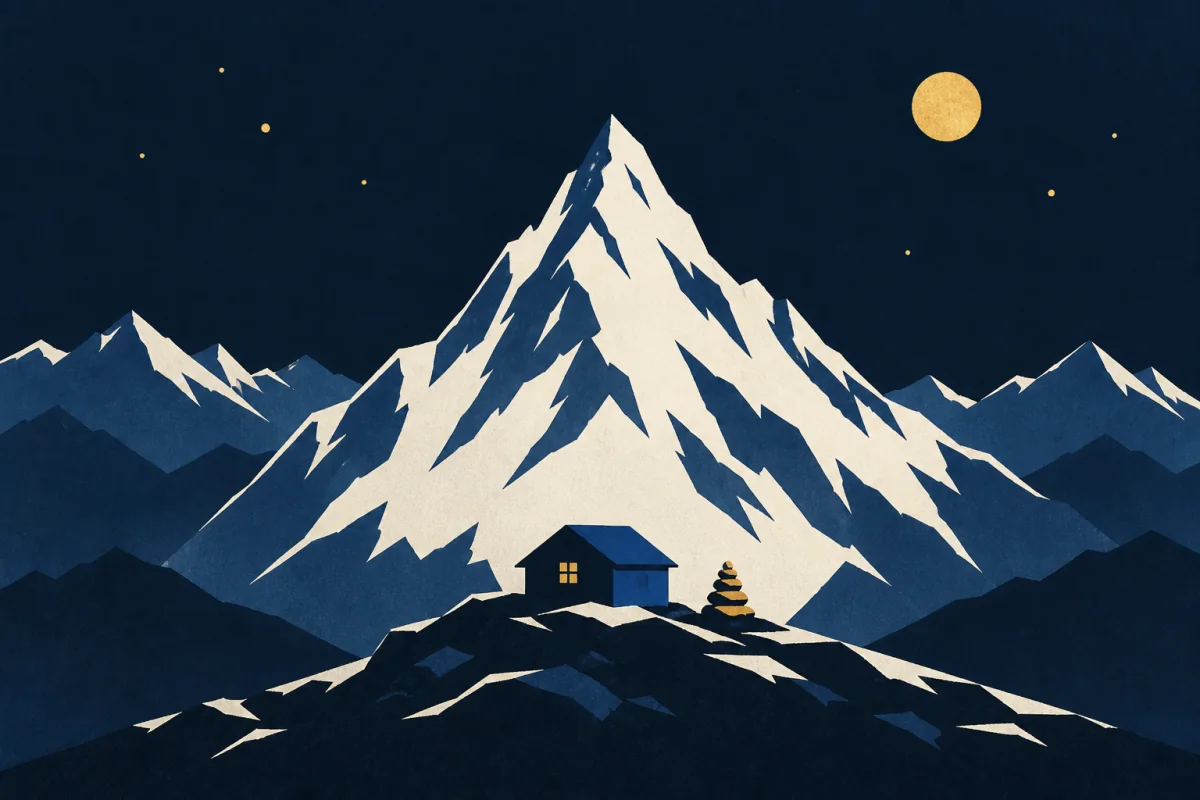
In Plain Sight
Some people belong to thin air and steep ground. Weather, livestock and footing all demanding attention at once, on slopes that exhaust visitors and cost them nothing. A small household is kept running where the supply line stretches thin, and the mountain is company enough. You'd notice this in the one who still walks the upper pasture alone.
The Pattern at Work
The body is adapted and the adaptation is invisible. Ground that has a visitor stopping every hundred metres is crossed at a steady pace that does not change for three hours, because the pace was set decades ago at something sustainable rather than something impressive. Footing is read continuously: where a slope is loose, where it holds after rain, which line across a scree costs half the effort of the obvious one. None of it is deliberate any more.
Weather is read at short range and taken seriously. Mountains make their own conditions, and what is coming over a ridge in twenty minutes bears little relation to any forecast. Cloud shape, wind direction changing, the temperature of the air moving down a valley, and the behaviour of stock, which usually know first. A decision to bring animals down, or to not go up today, is made on that reading and is made early, because the alternative is being wrong in a place that does not forgive it.
The household is the other half and it is all logistics. Everything is carried, driven or fetched from a long way, so the year is planned around stock levels, fuel, the road, the months when it closes. Nothing is bought on the day it is needed. People living this way hold an inventory in their head of what is in the house and what would happen if nothing arrived for three weeks.
And the solitude is not endured. It is the part that is wanted, which is the thing visitors most often fail to understand.
What the Examples Show
It reads as toughness, or as a love of mountains, or as somebody who has chosen an inconvenient life on purpose.
The first element is physical adaptation to steep ground, built over years. It is not fitness in the trained sense; it is a pace and a footing that make altitude ordinary rather than an achievement.
The second is short-range weather reading. The information comes from what is visible and from the animals, at a timescale of half an hour, and it drives decisions that a forecast is too coarse to inform.
The third is that the household is a supply problem. Living well in a place that is hard to reach is mostly planning, and the planning is continuous and unremarkable to the person doing it.
Going Deeper
Mountain people have existed wherever mountains do, and have consistently been described from below.
Alpine communities ran transhumance for centuries, moving stock up in summer and down in autumn, with whole villages organised around that calendar. Himalayan and Andean societies built agriculture in vertical bands, using several climates within a day's walk. Pastoralists across the Caucasus, Anatolia and Central Asia held the high pastures seasonally. In every case the economy, the architecture and the year were shaped by altitude, and in every case lowland states have found these populations difficult to tax, conscript and govern, which has shaped how they were written about. The standard lowland account of mountain people has been the same for two thousand years: hardy, backward, stubborn, and not paying enough. Almost none of it was written by anybody who had wintered there.
The costs are real and mostly structural. Services retreat first from places that are hard to reach, so schools, shops, doctors and transport go, and the population ages and then leaves. The economics of small upland holdings have been poor for a century and are now largely dependent on subsidy, which is politically fragile. The physical risk is ordinary rather than dramatic: a fall, a machine on a slope, weather on the way down. And there is a particular isolation in it that is fine until something goes wrong, at which point the distance that was the attraction becomes the whole problem, and it is usually an ordinary medical event rather than a mountain that proves it.
The Image
The pace.
A walk up a slope that does not change speed and does not stop, for three hours.
Visitors go fast and rest often, and arrive late and wrecked. The pace is slower than a fit stranger wants to go and it does not vary for gradient, which is why it covers ground nobody expects. Almost everything about living high is a version of that: unimpressive, sustainable, and entirely unlike how a visitor would do it.
Where It Stops
Liking mountains is not this, and neither is being fit. The reading is local, built over years, and attached to a particular set of slopes and their weather.
It goes wrong as contempt for visitors. The same competence that makes the ground ordinary can produce a dismissiveness towards people who are genuinely in difficulty, and mountain rescue statistics contain a number of locals who were confident in conditions they had seen before.
It also fails when the conditions change. Glacial retreat, altered snow patterns and new rainfall regimes have made long experience less reliable in exactly the places it was strongest, and the reading is slow to update.
Take the plainer explanation first. Anybody who lives high learns the ground, because the life requires it. The test is whether the pull is to the place rather than to the activity — whether the interest survives a week of cloud with nothing to do.
Where It Pays
Inside a job. Upland farming and shepherding, mountain guiding and instruction, rescue teams, hut and refuge keeping, forestry and avalanche work, ski patrol, hydro and infrastructure maintenance in remote terrain, and field science at altitude. Also tourism and hospitality in mountain areas, which is what most upland economies now actually run on.
What is being bought is competence in conditions that defeat visiting expertise. Anybody can be flown in; very few people can work on that ground every day for thirty years, read its weather at short range, and still be there when something goes wrong at four in the afternoon.
Where it pays badly is in upland agriculture, which loses money nearly everywhere and survives on support payments. It pays badly in seasonal tourism work, which pays for four months and expects people to exist for twelve, and in any arrangement where the local knowledge is used and the decisions are made elsewhere.
Outside one. Small holdings, huts, volunteer rescue and the long business of keeping a road open for the people further up it. The cost worth naming is that the life is chosen by one person and lived by a household, and the ones who did not choose it carry the distance differently.
Try This
Take a steep hill and walk up it twice on different days.
The first time, go at whatever pace feels right, and rest when you need to. Time it.
The second time, pick a pace you are sure is too slow, and do not stop at all, including on the steep part. Time that.
The second is usually faster and always less costly, and discovering that in your own legs explains more about living on steep ground than any description would.
Living high is a tool, not a self. Pick it up where a place asks for constant attention and gives solitude back. Put it down when the distance has started to cost somebody else more than it gives you.
If This Isn't You
Most people love the mountains for a fortnight and are glad to come down, which is an honest and sustainable relationship with them. Not wanting to live up there is an answer, not a softness.
Where To Go Next
Its near-twin — Territory Walker. Both hold large difficult country in the body. Territory Walker is covering ground to see what has changed, and could do it anywhere wild. This one lives there, with stock and a household, and the walking is incidental to the living.
Its shadow — Inn-Keeper. Inn-Keeper keeps a door open for whoever arrives and is made by the traffic. This one has arranged a life where almost nobody arrives, and finds that the better bargain.
Most often confused with — Map-Edge Walker. Both are drawn to hard, empty country. Map-Edge Walker goes to what is unknown and moves on. This one stays in one valley for a lifetime, and the knowledge is entirely local.