In Plain Sight
Some people keep walking to where the path runs out. They are not being reckless about it. Sun, slope and the shape of the ground hold their direction, and being alone for days does not unsettle them. You'd recognize this in the one who came back with a route nobody in the family had walked, and went out again the next spring.
The Pattern at Work
The track on the map stops at a shieling and there is nothing beyond it for eleven miles. She goes anyway, with four days of food, and what she is actually doing for most of the first afternoon is arithmetic she does not think of as arithmetic: how much light is left, how far the ground will let her go in it, where the water is likely to be, what the slope on the far side of that shoulder will do when it rains. Nothing about it is careless. It is simply that the absence of a path is not registering as a reason to turn round, and for most people it is the only reason they need.
Two days later the weather closes and she navigates for four hours without seeing anything beyond thirty metres, holding a line off the fall of the ground and the direction of the wind on her face. She arrives within a hundred yards of where she intended. The skill is real and the more unusual half is that four hours of that produced no particular distress.
A sea kayaker crosses to an island that can be reached on perhaps twelve days of the year, having waited three seasons for one of them. A caver pushes a passage that has been pushed twice before and goes past both previous marks, then spends an hour surveying it so the next person starts further on. Neither is chasing danger, and both would say so with some impatience. They are doing the same thing: going to the place where the information runs out, and finding it habitable rather than frightening.
What the Examples Show
The obvious reading is thrill-seeking, and it is wrong often enough to be worth saying plainly. Much of this is done slowly, carefully and without any adrenaline at all.
Two things are actually running. The first is spatial: a direction held from slope, sun, wind and the shape of ground, updated continuously, which is a real technical skill and can be tested. It is why these people are not usually the ones who get lost.
The second is the unusual one. Most people's tolerance for being beyond contact, beyond a path, and beyond anybody who could help runs out within a few hours, and it runs out as a feeling rather than as a judgement. Here it does not. The company of one's own mind for days is not endured; it is comfortable, and often the point.
Which is why this pattern cannot be produced by training somebody. The navigation can be taught. The comfort cannot.
Going Deeper
There have always been a few people who went past where the information stopped, and every society has had an uneasy relationship with them.
Polynesian navigators held routes across open ocean in memory and star sequences and made crossings nobody could verify. Norse sailors worked latitudes westward until they found Iceland, then Greenland. Ibn Battuta spent twenty-nine years travelling and mostly alone in the sense that mattered. Nineteenth-century surveyors filled maps on foot, and the pundit explorers sent north from India paced entire routes counting steps on a rosary. In every case the community took the benefit afterwards and regarded the person, at the time, as slightly unsound. That is a consistent enough pattern across four continents that it is probably telling us something about communities rather than about walkers.
The reason for the unease is that the behaviour cannot be justified in advance.
Going where nobody has been produces no argument for going, and this pattern is bad at supplying one, because the honest answer is that the map stops there and that is the reason. The costs are borne unevenly: the walker is calm, and the people at home are not, which makes the closest relationships the place where the price is actually paid. The knowledge brought back is real and frequently nobody has any use for it, so it sits in a notebook and gets mentioned at funerals. And the appetite does not decline with age or obligation, so it becomes something negotiated with a family for forty years rather than something outgrown.
The Image
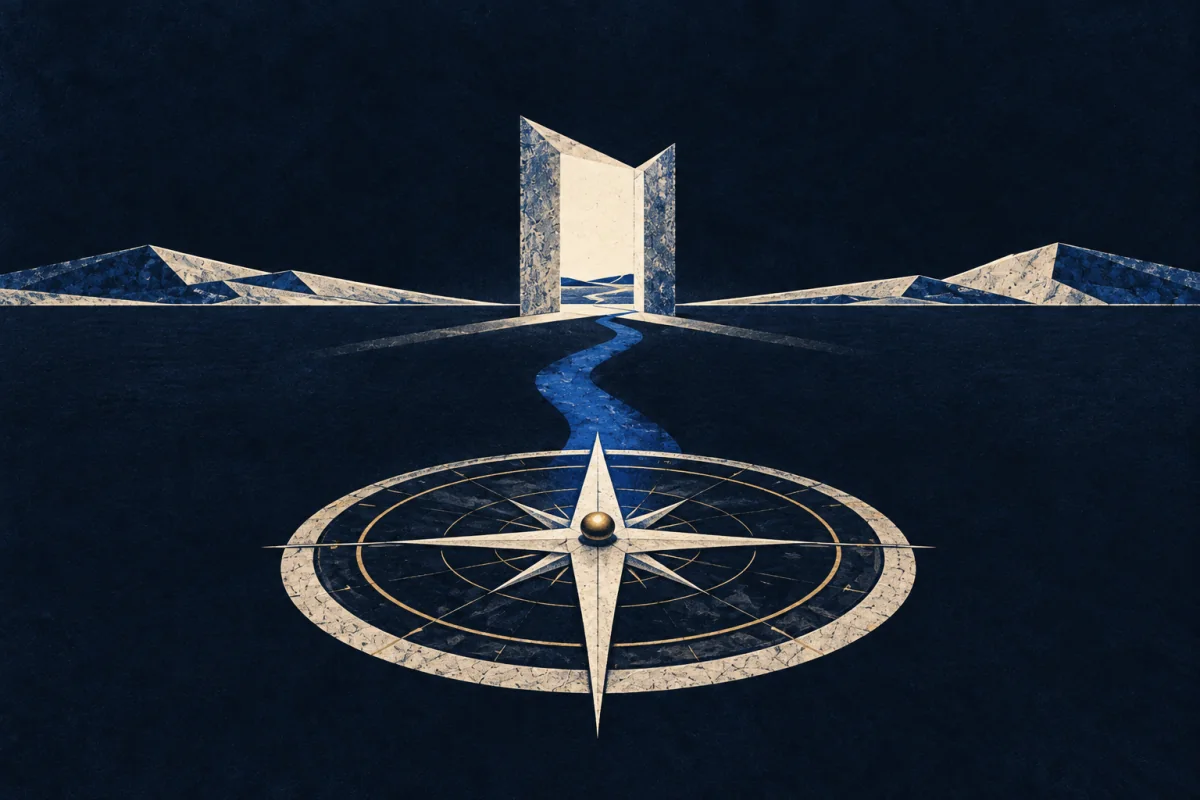
Where the path thins.
Every path does it somewhere. It narrows, then it is a sheep track, then it is a suggestion in the grass, and then there is nothing and the ground is just ground.
That point is a real place and it is the place this pattern is organised around. Most people feel the ending as a stop sign. A few feel it as a door, and the difference is not courage — it is what the absence of information does to them.
Where It Stops
Liking the outdoors is not this, and neither is being fit. Plenty of very capable hill walkers have no appetite at all for ground where nobody has been and no wish to be out of contact.
It goes wrong as being unreachable. Direction-holding and solitude do not protect against a broken ankle eleven miles from a track, and the same temperament that makes the distance comfortable makes leaving word feel like fuss.
It also fails wherever the work is shared. Put this pattern on a team objective with a schedule and other people's risk in it, and the instinct to push past the known becomes somebody else's emergency.
Take the plainer explanation first. Anybody with mountain training navigates in cloud because that is what the training is for. The test is the appetite rather than the skill: whether the map stopping is a reason to turn back or a reason to keep going.
Where It Pays
Inside a job. Survey and field work in remote country, exploration geology, expedition and wilderness guiding, cave and marine survey, conservation work on ground with no access, long-distance delivery and route proving, and the field end of any science that needs somebody to physically go and look.
What is being bought is reach. Nearly all data about remote places is collected within a short walk of a vehicle, which means the picture everybody works from is systematically biased toward the accessible. One person willing and able to spend four days past the road brings back the part nobody has, and it is often the part that changes the conclusion.
It pays badly in any role requiring daily availability, badly under a risk regime written for a car park, and badly wherever the work must be done in pairs, which now covers most of the organisations that would otherwise want it.
Outside one. Walking, paddling, caving, long solo journeys. The cost worth naming is not the risk. It is what the absence does to the people who are not out there, and the fact that reassurance cannot honestly be given, only promised. That promise gets made, and kept, and made again, for decades.
Try This
Take a walk you already know and, at some point, leave the path deliberately for half an hour. Nothing dramatic — a field edge, a bit of moor, the far side of a wood.
Put the phone away and hold your direction off the slope, the sun, and where the wind is coming from. Then check.
Most people are surprised twice: by how far off they were, and by how quickly they wanted the path back. The second is the more interesting number.
Do it three times and watch which of the two improves.
Where the path thins is a tool, not a self. Pick it up where nobody has the information and somebody has to go and get it. Put it down where other people are relying on you being back at six.
If This Isn't You
Most people enjoy the walk, follow the path, and are home for dinner, which is what paths are for and is how nearly everyone sensibly travels. Feeling no pull past the last waymark is an answer, not a smallness.
Where To Go Next
Its near-twin — New Ground Maker. Both are at home where nothing is established. New Ground Maker arrives and starts building what has to exist by winter. This one arrives, looks, and moves on, and would find the second winter unbearable.
Its shadow — Stillness-Holder. Stillness-Holder stays in one place until it opens. This one covers ground on the conviction that what matters is somewhere else, and both are comfortable alone for exactly opposite reasons.
Most often confused with — Trail Sign Mapper. Both hold direction in country with no path. Trail Sign Mapper is following something and the ground is only where the answer is. This one is following nothing, and the ground is the whole of it.