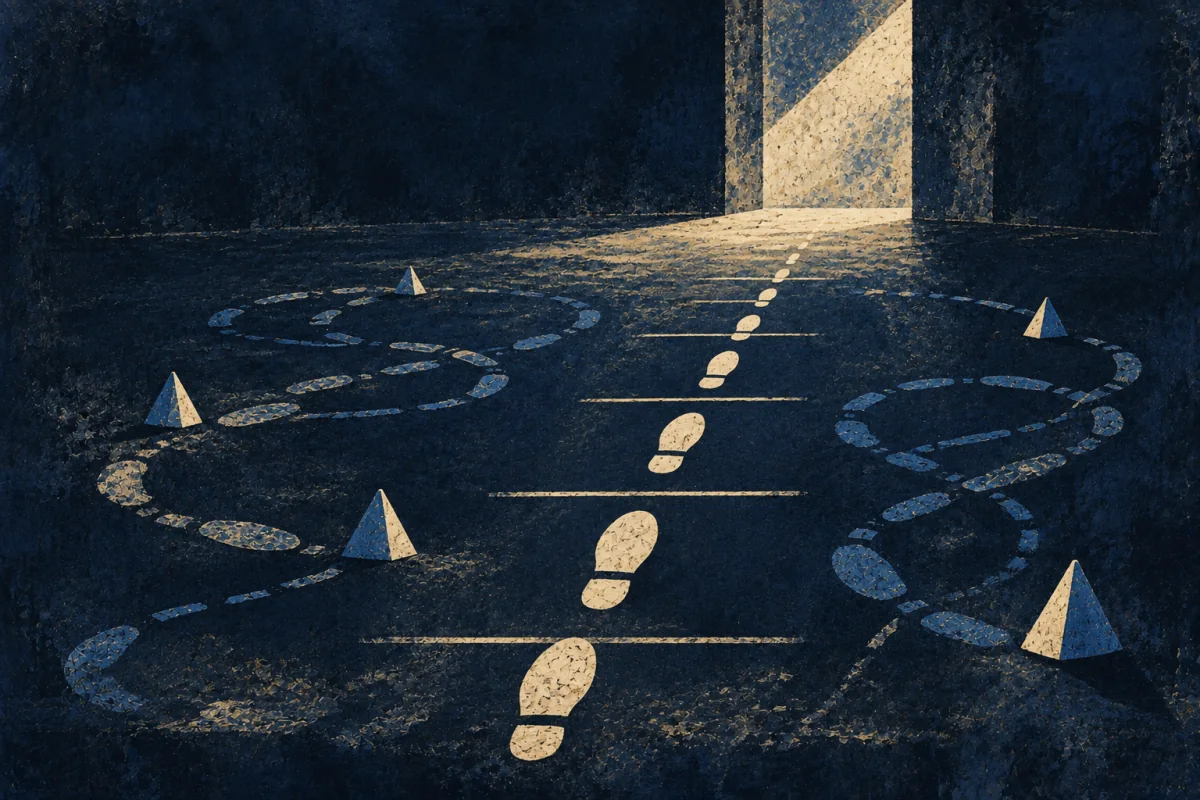
In Plain Sight
Motion helps this person think when a plan is still unclear. They are not moving just to burn off energy. They test distance and timing with their body until the next step makes sense. You'd notice this in the friend who paces while planning the route, then points to the exact corner where everyone should turn.
The Pattern at Work
A small company is staging a crowd scene with eleven people and has spent an hour round a table with a floor plan and coloured counters. Nothing works; the stage keeps emptying at the wrong moment. The director stops the meeting, takes the space alone, and walks it. She goes from the door to the chair at the speed a person actually walks when they are upset, which turns out to be four seconds, not the two the plan assumed, and everything downstream of that was wrong. Then she walks the second entrance, and the third, and finds that two of them cross in a way that will read as an accident from the third row. The solution she arrives at is not on the paper and could not have been: it depends on a body covering a distance in a particular number of seconds, and nothing but a body in that room produces that number.
The village procession is on Sunday and the route was agreed months ago on a map. At five in the morning one of the organisers walks it, alone, at the pace of the slowest person expected, carrying something heavy to make the pace honest. He finds three things nobody found on the map: the band cannot turn into the lane without stopping, there is a forty-metre stretch where the pavement disappears, and the whole thing will arrive at the church nine minutes before the bells. The route changes that morning. On the day it looks effortless, which is what it was designed to look like, and nobody involved ever knows there was a problem.
What the Examples Show
It gets read as restlessness. A person who cannot sit still in a meeting, who paces, who has to be doing something with their hands or feet.
The restlessness is real and it is the symptom rather than the thing. What is running is a way of working that needs the body as an instrument, because the questions being asked are questions about distance, timing and sightline, and those do not have answers that survive being abstracted onto paper. Four seconds is not a number that can be guessed. It has to be covered.
There is a second half that is easy to miss. This is not only how the problem gets solved; it is how the solution gets communicated. Shown rather than described, because a movement demonstrated once lands better than a movement explained three times, and this pattern usually cannot explain it anyway.
Going Deeper
Any event with people moving through it has a shape in time, and the shape is not visible from outside it. A plan of a room shows where things are. It shows nothing about how long it takes to cross, what a person can see while crossing, or what happens when two crossings meet — and those are the only questions that decide whether the thing works.
The Greek chorus rehearsed in the orchestra because the arrangement only existed there. Noh theatre fixed its walking pace so precisely that the timing of a play is measured in steps. Balanchine made ballets on the specific dancers in front of him and changed them when the cast changed. Pina Bausch built work out of what her company did in the room rather than out of anything she had decided beforehand. Prussian drill turned the same insight to a colder purpose: a formation that can be walked can be relied on, and one that has only been drawn cannot.
The cost sits in what this work leaves behind, which is nothing.
A solution arrived at by walking exists in the bodies that walked it. It does not write down, does not survive a change of venue, and has to be rebuilt from scratch each time. The person who found it is often unable to say what they found, which makes them look vague in exactly the meetings where credit is handed out, and the finished event looks so natural that the arranging is invisible. And it is physical work with no status attached to it: hours of covering the same ground at somebody else's pace, mostly alone, mostly before anyone else arrives.
The Image
The rehearsal with nobody in it.
One person in an empty space, walking the thing at the speed it will actually happen, carrying the weight it will actually carry.
Everything wrong with a plan shows up in that walk and almost nowhere else, hours before anybody else could have found it. Do it wherever people will have to move through something you have arranged.
Where It Stops
Energy is not this. Plenty of people pace, fidget and think on their feet without any of this going on, and plenty who have it are physically unremarkable.
It goes wrong as refusing the map. There are problems that genuinely are solved on paper — budgets, permissions, who is bringing what — and a mind that insists on walking everything will burn a week rediscovering things a spreadsheet would have said in an hour.
It also fails where the problem has no bodies in it. Applied to an argument, a policy or a piece of writing, the same instinct produces a lot of movement and no progress, and the person knows it and paces harder.
Take the plainer explanation first. Any dancer, drill instructor or stage manager works this way because the craft requires it. The test is whether it appears off duty — planning a walk, arranging a room, moving furniture for an occasion that has nothing to do with performance.
Where It Pays
Inside a job. Choreography, theatre and live events, processions and ceremonies, sport set-pieces, evacuation and crowd-flow planning, film blocking, and any work where the question is how a number of people get from one state to another without colliding. Also warehouse and kitchen layout, where the same instinct reads as an unusual interest in walking distances.
What an organisation gets is failures found in advance. Crowd problems, timing problems and sightline problems are all cheap to fix a week early and extremely expensive to fix on the day, and the only reliable way to find them early is for somebody to physically do the thing while it is still empty. It pays badly in work that is entirely on paper or on screens, and badly again wherever a plan once signed off cannot be reopened.
Outside one. Weddings, funerals, parties, village events, moving house, getting a large group up a hill. The cost worth naming is that the work is invisible by design: a procession that flows well looks like nothing happened, and the person who walked it at five in the morning has no way to point at what they prevented. The second is that it cannot be delegated, because the answer arrives in the body doing it and in no other.
Try This
Take something you are arranging that involves other people moving — a gathering, a walk, a rearranged room.
Before you finalise anything, do it yourself at the real speed. Walk the route. Carry what will be carried. Go at the pace of whoever will be slowest, not your own.
Write down the three things you learn that were not on the plan. There are always about three, and one of them is usually a timing you had guessed and got wrong by half.
Then change the plan rather than the people, because the people will not speed up.
The rehearsal with nobody in it is a tool, not a self. Pick it up where bodies have to move through time. Put it down where the problem is only an argument, because walking that one out just wears the carpet.
If This Isn't You
Most people make a plan, tell everyone, and sort out the tangles on the day, which works far more often than it should. Feeling no need to walk it first is an answer, not a carelessness.
Where To Go Next
Its near-twin — Ground-Shaker. Both work through the body in front of others. Ground-Shaker is producing an effect on a crowd in the moment. This one is solving a problem of arrangement, and the crowd is supposed to notice nothing.
Its shadow — Inner-Walker. Inner-Walker goes still and inward to find out what is true. This one goes outward and moving, and finds sitting with a question almost physically impossible.
Most often confused with — Body-Trainer. Both work in movement and repetition. Body-Trainer is building a skill into somebody else's body over months. This one is finding the shape of one occasion, and has no interest in who can do it well.