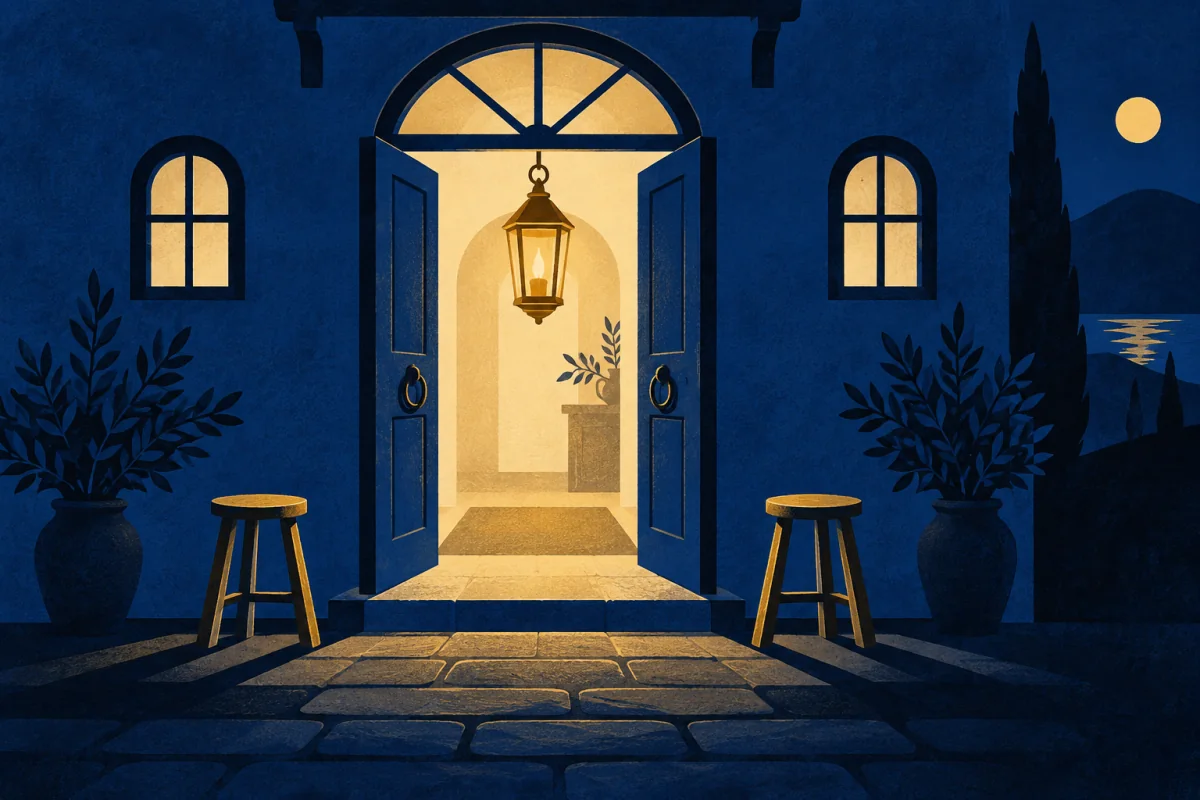
In Plain Sight
Some people keep a door open for strangers. A hearth, a table, a bed for the night, and the small economy that makes it possible. Each arrival gets read quickly, then fed and housed without fuss, while the books are kept and the kettle stays on. You'd notice this in the one whose porch light is still on past midnight.
The Pattern at Work
The reading happens at the door and it is quick. Who is tired, who is frightened, who has been travelling badly, who is going to be a difficulty later. Not judgement about character so much as a working guess about what this person needs in the next hour: food, quiet, somebody to talk to, or to be left entirely alone. Most guests are given the wrong one of those by people trying to be welcoming.
Then it is delivered without ceremony, which is the point. Fuss makes a guest a guest; what a tired traveller wants is to be absorbed into a place that was already running. Food that is already made. A room that is ready. Somebody who does not require them to perform gratitude before they can sit down.
The economy underneath is unforgiving. Rooms empty half the year and full for six weeks, food that goes off, staff who leave, a building that is always needing something. Somebody doing this well is running a business with poor margins and unpredictable demand, and every decision about generosity has a cost attached that the guest will never see.
And the line between hospitality and being taken advantage of has to be held personally. There is always someone who will not pay, who stays too long, who needs more than a night's kindness can give, and the same warmth that makes the place work is what makes those situations difficult to close. Most keepers can name the guest who cost them a fortnight's takings and stayed anyway.
What the Examples Show
It reads as friendliness, or as running a small business, or as a knack for making people feel at home.
The first element is fast assessment at the door. The whole shape of a stay is set in the first minute, on a reading of what this particular person needs, which is often the opposite of what a welcome usually supplies.
The second is that the hospitality and the accounts are the same job. Portions, occupancy, waste and wages are all decisions about how generous the place can afford to be, and somebody who cannot hold both halves loses either the business or the welcome.
The third is that the door is genuinely open. This is not entertaining, where the guests are chosen. It is receiving whoever arrives, which is a different and older thing.
Going Deeper
Housing strangers has been treated as an obligation in almost every society, long before it was a trade.
Monastic and pilgrim hospitality across Europe, the Middle East and Asia took in whoever arrived, on a religious duty rather than a commercial basis. Caravanserais along the trade routes were built and endowed so that travellers and their animals could stop safely for the night. Village inns everywhere combined lodging, drinking, banking, news and the settling of disputes in one room. The guesthouse traditions of Japan, Ireland and the Alps all made a household into a business without ever quite separating the two. What runs through all of it is that the obligation came first and the trade grew out of it, which is why hospitality still carries a moral weight that no other service industry has to carry.
The costs have been constant. The home and the business are the same building, so there is no off duty and no part of the house that is entirely private. The income is seasonal and thin, and a bad summer or a closed road can end a century-old place. The work never stops: someone has to be awake, and the person who answers the door at midnight is also cooking breakfast at seven. It attracts a particular kind of exposure, since a stranger's difficulty becomes the keeper's problem the moment they cross the threshold. And it is hard on families, who grow up in a house where their parents belong to everybody who walks in.
The Image
Already made.
Food on the stove when somebody arrives, rather than an offer to make some.
An offer requires a tired person to have an opinion and to accept a favour. Something already made lets them sit down and eat without owing anybody anything, and the difference between those two experiences is most of what separates real hospitality from the performance of it.
Where It Stops
Being welcoming is not this, and neither is enjoying company. The work is receiving strangers, repeatedly, while running an economy that pays for it.
It goes wrong as never closing the door. Generosity without a limit is not sustainable, and the places that fail usually fail because somebody could not say no to the guest who was always going to be a problem.
It also fails as performance. Hospitality that needs to be noticed puts a weight on the guest, and a house where the welcome is a production is exhausting to stay in.
Take the plainer explanation first. Anybody running a guesthouse greets arrivals, because that is the trade. The test is whether the same reading happens where no money is involved — a spare room, a stranded friend, somebody who turned up unannounced.
Where It Pays
Inside a job. Hotels, inns, guesthouses and bed and breakfast, hostels and refuges, pubs with rooms, campsites and hostel management, hospitality management generally, and front of house in restaurants. Also residential care, shelters and refugee reception, where the same reading is applied to people arriving in far worse conditions.
What is being bought is a stay that people return from and recommend. In hospitality the product is almost entirely the first minute and the small adjustments after it, and the businesses that survive in ordinary locations survive on somebody who can do that reliably at midnight, year after year, with no particular view to speak of.
Where it pays badly is throughout the sector, which runs on long hours, thin margins and a wage floor. It pays badly wherever the building is rented and the seasons are short, and in any operation where a chain has removed the keeper's discretion and left them the hours.
Outside one. Spare rooms, village halls, congregations, and every household known for feeding whoever turns up. The cost worth naming is that the door being open is a standing commitment, and the people who rely on it rarely understand that it has to be paid for in some currency every single day.
Try This
Next time somebody is arriving at your house, do the work before they get there rather than after.
Have the food made. Have the bed done. Have the kettle on before the knock.
Then, when they come in, do not ask what they want. Read them for a few seconds and decide: are they hungry, are they exhausted, or do they need to talk?
Give them that one thing and nothing else for twenty minutes.
Receiving people is a tool, not a self. Pick it up where somebody arrives with nothing arranged. Put it down when the door being open has started costing more than the house can carry, because a place that closes is worse than a place that says no.
If This Isn't You
Plenty of people like their own house to themselves and are honest enough not to pretend otherwise, which spares everybody a strained weekend. Not wanting the door open is an answer, not a coldness.
Where To Go Next
Its near-twin — Gathering Host. Both make people feel at ease in a place. Gathering Host works with people who were invited, for an evening. This one takes whoever arrives, at any hour, and has to make a living from it.
Its shadow — Threshold-Holder. Threshold-Holder stands at the door deciding who comes in. This one opens it first and works out the rest afterwards, and each thinks the other has the balance wrong.
Most often confused with — Provision-Cook. Both feed people at scale from limited supply. Provision-Cook is judged on whether everybody ate. This one is judged on how the place felt, and the food is one part of a longer stay.