In Plain Sight
Some people are pulled towards slow change in jars and crocks. Yeast, salt, vinegar, root and time, doing their work out of sight. Ratios go in a notebook, tastes are taken at intervals, adjustments are made by smell and by the sound of the bubbling, and the verdict is weeks away. You'd notice this in the one whose cellar is a working library of bottles.
The Pattern at Work
The whole craft is arranging conditions and then leaving them alone. Salt at the right percentage, temperature in a narrow band, everything under the brine, air kept out or let in depending on what is wanted. After that the work is done by something else, and the discipline is to stop touching it.
Monitoring is done by the senses rather than by instruments. The smell of a crock at day four is different from day seven in a way that is unmistakable and almost impossible to describe. A good ferment sounds busy. A jar that has gone wrong announces itself before anything is visibly amiss, and the person who has done it two hundred times knows within a second of lifting the lid. Taste is taken at intervals, not to enjoy it but to build the record: this is what week two tastes like, and this is the week-two taste that ends well.
The notebook matters more than anybody expects. Ratios, dates, ambient temperature, what the batch was like at each opening. Fermentation depends on conditions nobody controls — the kitchen in August, the particular cabbage, the water — so the only way to learn is to record enough that the pattern shows itself across years. Somebody serious about this has notes going back a decade and consults them.
Loss is part of it. Batches fail, and a failed batch is six weeks of nothing. People who cannot take that stop within a year. The ones who carry on treat a failure as information, write down what was different about it, and start another the same afternoon.
What the Examples Show
It reads as a food hobby, or as thrift, or as an interest in old-fashioned ways of doing things.
The first element is that the maker is not the agent. Something else does the transformation, and the skill is entirely in setting conditions and then exercising restraint, which is an unusual shape for a craft.
The second is sensory monitoring against a remembered baseline. Smell, sound and taste are read against hundreds of previous batches, and none of it transfers to anybody who has not done the batches.
The third is the timescale. Feedback arrives weeks after the decision, which means learning is slow, mistakes are expensive in time, and the record-keeping is not fussiness but the only available way to improve.
Going Deeper
Controlled rot is one of the oldest technologies there is, and it was household knowledge almost everywhere until very recently.
Korean households built the year around kimchi and jang, with crocks buried and families keeping starter cultures across generations. European farmhouses ran on sauerkraut, cured meat, cider and cheese, all of which made the difference between eating in March and not. Japanese koji underlies miso, soy and sake and supports a trade with unbroken houses centuries old. West African households have long used fermentation to make cassava safe as well as palatable, which is fermentation as food safety rather than flavour. In none of these was it regarded as a craft. It was simply how a household got from one harvest to the next, and the expertise sat with whoever ran the kitchen.
What has happened to it, and what the people who keep it carry, is mostly a matter of displacement. Refrigeration and industrial food removed the necessity, and the knowledge went from universal to niche in about two generations. The remaining practice is unpaid and domestic, so an enormous body of skill sits outside any economy. Regulation sits awkwardly with it: the methods that kept people alive for millennia are difficult to license, and small producers meet rules written for factories. And the knowledge is genuinely local — a house, a climate, a culture that lives in a particular kitchen — which means it cannot simply be published, and a family starter that stops being fed is gone for good.
The Image
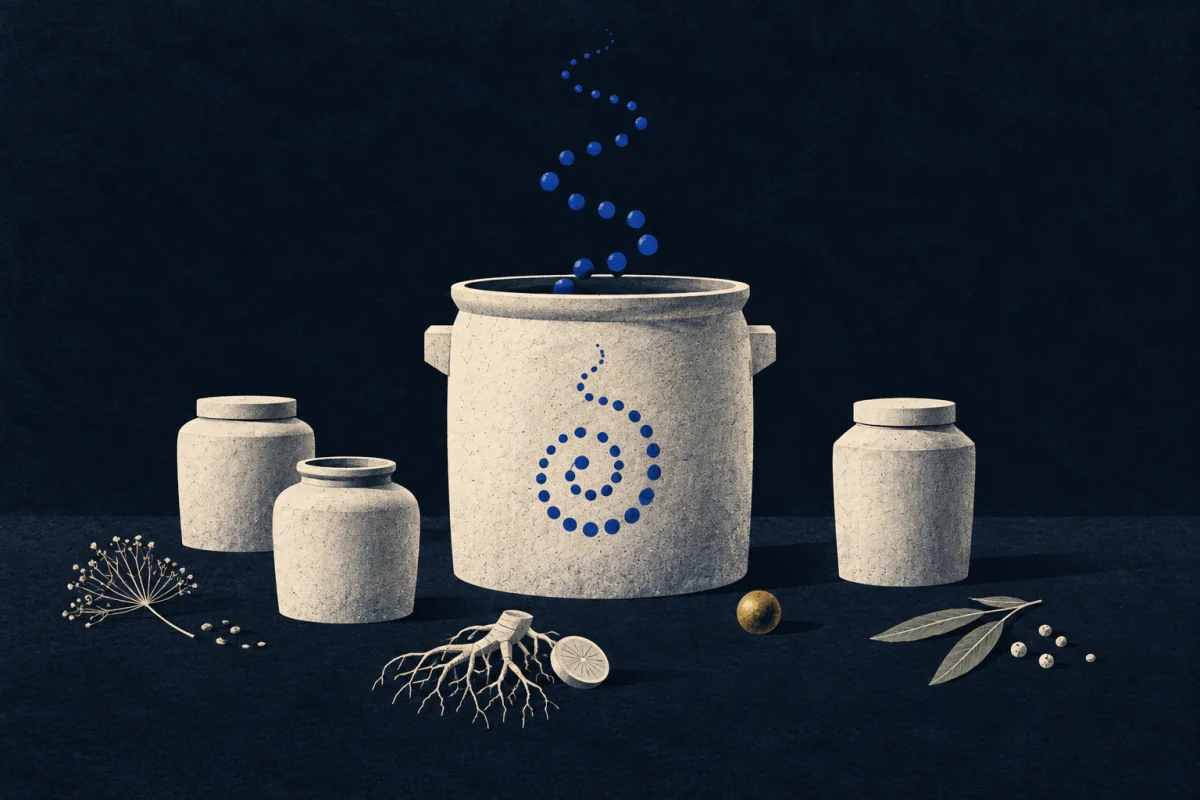
Week two.
The jar opened, tasted, and closed again, with nothing done to it.
There is nothing to adjust and no way to speed anything up. The only purpose of the opening is to learn what week two tastes like, so that in ten batches' time the difference between a week two that will end well and one that will not is obvious from a spoonful.
Where It Stops
Liking sourdough is not this, and neither is following a recipe. The reading is built on many batches and the record, and neither can be shortcut.
It goes wrong as fiddling. The strongest instinct is to intervene, and almost every intervention makes things worse, so the same attentiveness that makes somebody good at this is what ruins batches in their first year.
It also fails where the risk is real and unfamiliar. Most fermentation is remarkably safe and some preserving genuinely is not, and confidence built on vegetables and vinegar does not transfer to low-acid canning or curing meat, where being wrong is serious.
Take the plainer explanation first. Anybody who preserves food keeps notes, because the season demands it. The test is whether the same pull appears where there is no need — a windowsill jar, an experiment with something nobody eats, a starter kept alive for years out of loyalty.
Where It Pays
Inside a job. Brewing, distilling, cider and winemaking, cheesemaking, baking with natural leaven, charcuterie and curing, commercial fermentation of vegetables and sauces, and the production end of food manufacturing. Also food science and quality control, and the increasingly large industry built on cultured ingredients, where the same discipline is applied at scale.
What is being bought is consistency across a process nobody fully controls. Anybody can produce one good batch; producing the same thing in February and August, with different raw material and a different kitchen temperature, is the whole of the trade, and it rests on records and a trained nose.
Where it pays badly is at small scale, where regulation, premises and shelf life make the economics hard, and where the price a customer will pay for a jar has almost no relationship to the six weeks it took. It pays badly wherever the craft is a marketing story attached to a standardised industrial process.
Outside one. Kitchens, cellars, allotments, and the long domestic tradition that keeps most of this alive. The cost worth naming is that it takes space, patience and tolerance from a household, and everybody who lives with somebody like this has an opinion about the smell.
Try This
Start one thing that takes at least three weeks. Sauerkraut is the easiest: cabbage, salt at two per cent by weight, everything under the brine.
Open it at day three, day seven, day fourteen and day twenty-one. Taste a little each time and write one line: smell, sound, taste, anything unexpected.
Change nothing at any point, however strong the urge.
Keep the notes. They are worthless now and they are the beginning of the only thing that makes anybody good at this.
Waiting is a tool, not a self. Pick it up where the work is done by something other than your hands. Put it down where a result is needed on a date, because fermentation does not take instruction and will not be hurried for anybody.
If This Isn't You
Plenty of people buy the jar, eat the contents, and are spared six weeks of wondering whether it has gone wrong. Not wanting to make it yourself is an answer, not an impatience.
Where To Go Next
Its near-twin — Wild-Cook. Both work with what the season gives and neither follows a recipe. Wild-Cook is resolving everything in the moment, by taste, at the stove. This one sets conditions and then has no further say for a month.
Its shadow — Steady-Hand Mender. Steady-Hand Mender works directly on the object and can see the result immediately. This one hands the work to something else and finds out in six weeks whether it went well.
Most often confused with — Plant-Healer. Both work with living processes and long timescales. Plant-Healer is after a preparation that does something to a body. This one is after food and drink, and the only test is whether it is good in the mouth.