In Plain Sight
When something is damaged, this person slows down and works close to the break. They do not rush to replace what failed; they study the weak point and bring it back by careful steps. You'd spot this in the neighbor who fixes the same loose chair twice, then adds one hidden brace so it finally holds.
The Pattern at Work
The tooth has been coming out for twenty minutes and the root has just snapped below the gum line. The assistant's hands have gone still. The patient has both fists on the arms of the chair. Everything in that room has sped up except the person holding the instrument, whose movements have got smaller, slower, and much quieter — a change of tool, a change of angle, a long pause to look at what is actually there rather than at what was expected. There is no commentary, no reassurance, and no visible hurry at all. The fragment comes out nine minutes later in one piece, and the gum closes over it cleanly. Asked afterwards what was done differently, nobody else in the room can say.
A chair comes back to the same workshop for the second time in a year. The first repair was sound, and it has failed anyway, which means the first repair was answering the wrong question. Most of that afternoon goes on not repairing it. The chair sits upside down on the bench. Weight goes onto one joint, then another. The whole frame gets flexed by hand, slowly, while someone watches a hairline gap open and close half an inch from where the break showed. The eventual fix takes under an hour and comes down to a small block of hardwood glued somewhere nobody will ever look. The chair is still in use eleven years later, and the person who owns it has no idea that block is there.
What the Examples Show
This gets filed under good with their hands, or patient. Both are true and neither is doing the work.
Manual skill normally speeds up as it improves. The expert cook, the expert typist, the expert joiner all get faster. This pattern runs the other way at the exact moment it matters: pressure arrives, and the hands decelerate. That is not calm as a personality trait. It is a working method — under load, the useful move is almost always to gather more information rather than to act sooner.
And the diagnosis comes before the repair, every time. Most people who are good at fixing things are good at the fixing. This one is good at finding where the fault actually lives, which is usually somewhere other than where the damage is showing.
Going Deeper
Someone has always been permitted to cut.
In Neolithic Europe it was whoever held the flint that opened a skull, and the healed bone around those holes says a great many of those patients lived — which means the hand was steady and the judgement about when to stop was sound. In the Sushruta tradition the same figure is a teacher with a syllabus of instruments, practising incisions on gourds and wax until the hand no longer needed watching. In a Roman legion it was the field surgeon who extracted arrowheads by a route that did no further damage on the way out. Al-Zahrawi spent thirty years writing down what that figure actually does, and half of what he described is a list of ways to go slower.
Every one of them worked before anaesthesia. That fact sits underneath the whole figure and it is the part worth holding onto: the person doing this was causing severe pain, knew it, could hear it, and had to stay exact anyway. The steadiness was not detachment. Detached hands make bad cuts. It was full presence with the tremor removed, which is a much harder and much lonelier thing, and it is the reason this role has always been small in number and hard to replace.
What it took from them has been consistent too. They were the one who had to stay when everyone else could look away, and looking away is a normal human relief they simply did not get. They carried the outcomes alone, because a repair that fails belongs to the person who made it and to nobody else. And they were generally valued in proportion to how invisible the result was — the better the work, the less anybody could see that any had been done.
The Image
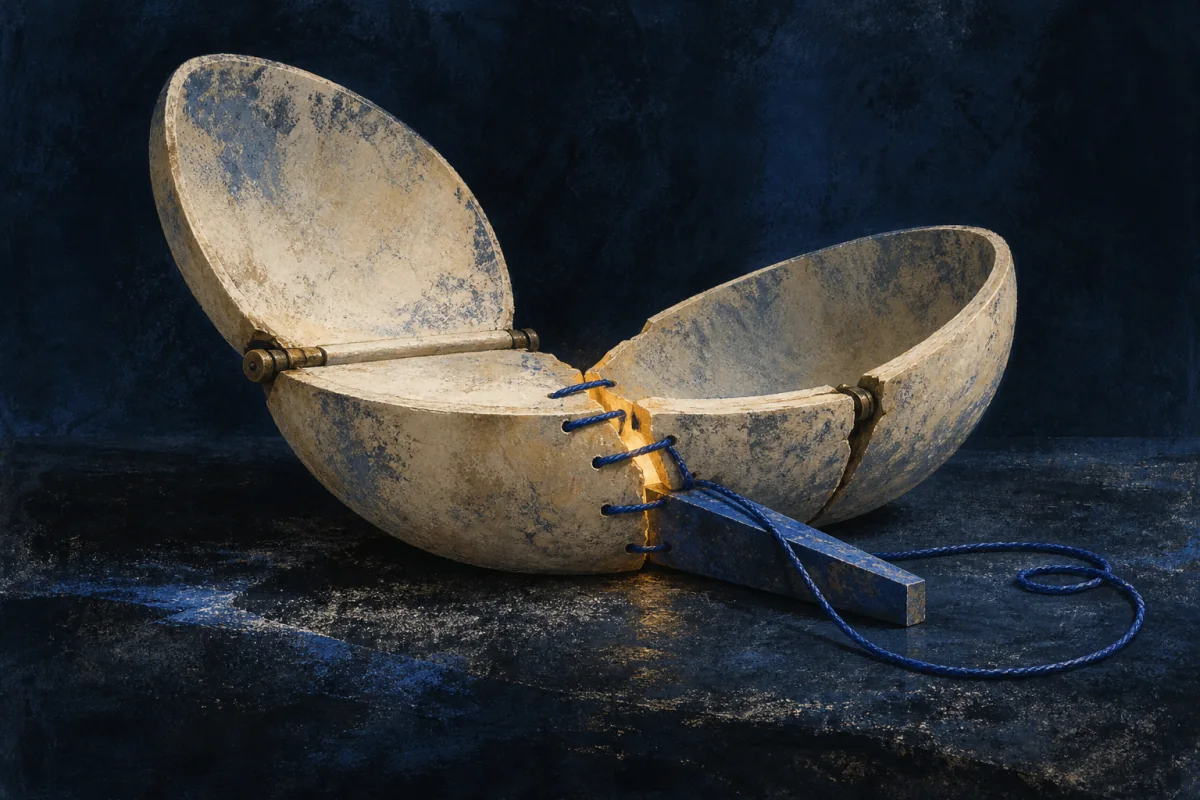
The brace you cannot see.
The repair that holds is rarely the repair that shows. It is a small piece of material put somewhere out of sight, chosen because the load was never really travelling through the part that broke.
Carry that one. It works on furniture and on arrangements between people, and it is a good question to ask of anything that has failed twice: where is the load actually going?
Where It Stops
Slowness on its own is nothing. Plenty of slow, careful people make repairs that fail, and some very quick hands are exact. Speed is not the variable; what changes under pressure is.
It goes wrong as repair where replacement was the right answer. Some things are finished. Rebuilding a failed part at four times the cost of a new one is not craft, and the pull to do it anyway is part of this pattern rather than a lapse from it.
There is a failure that reads as thoroughness: investigating past the point where the information stops changing the decision. The chair gets flexed for the fourth afternoon. Nobody is any wiser and the chair is still broken.
And take the plainer explanation first. Anyone trained in a protocol will look like this inside that protocol. Surgeons, technicians and electricians are all taught to slow down at the difficult step. The test is whether it shows up somewhere with no procedure at all — a bicycle, a plumbing fault, an argument that keeps recurring for reasons nobody has looked at.
Where It Pays
Inside a job. Anywhere failure is expensive and the fault is not where the symptom is: clinical work, repair and maintenance, forensic engineering, incident investigation, quality work, anything with a recurring defect nobody has got to the bottom of.
The real contribution is not the fix. It is that a problem gets correctly located, once, instead of being treated five times. Most organisations are extremely good at fixing the visible part and have no one whose job is to ask why it keeps coming back. That is the gap this fills, and it is usually filled by accident rather than by design.
It pays badly where throughput is the measure — high-volume work scored on units per hour, or any role where the honest answer is that the thing should be thrown away and a new one ordered.
Outside one. Houses, vehicles, instruments, bodies, and the small running repairs of a family. Also the recurring argument, where the same approach applies: the fault is rarely at the point where the shouting starts.
The cost worth saying plainly is that this makes you the person everyone brings broken things to, and that claim on your evenings grows quietly. It also makes wanting a new one feel like a failure of character, which it is not.
Try This
Take one thing that has failed twice — an object, a process, a conversation that keeps going the same way. Do not fix it this time.
Spend twenty minutes finding out why the first fix was answering the wrong question. Put your hands on it if it is physical. Load it, flex it, watch where the movement actually is rather than where the damage showed.
Then write one sentence naming where you now think the load is going. You may be wrong, and being wrong is the useful part, because it is the only version of this that tells you anything.
The brace is a tool, not a self. Pick it up where something has failed more than once. Put it down when the answer is that the thing is finished.
If This Isn't You
Plenty of capable people replace rather than repair, and they are right more often than this page will make it sound. If reading it felt like being asked to care about chairs, that is a clear enough answer.
Where To Go Next
Its near-twin — Mender. Very close, and the difference is the material. Mender works on living things and reads what a body is doing. This one works on structure, and would rather flex a joint than take a pulse.
Its shadow — Triage-Mind. Triage-Mind acts fast on whatever can still be altered and accepts an imperfect result. This one slows down to find the true fault and will spend the afternoon. Both are right, on different days.
Most often confused with — Form-Realizer. Form-Realizer brings something new out of material and is led by what the material wants. This one is led by what already failed, and has no interest in making anything that does not already exist.