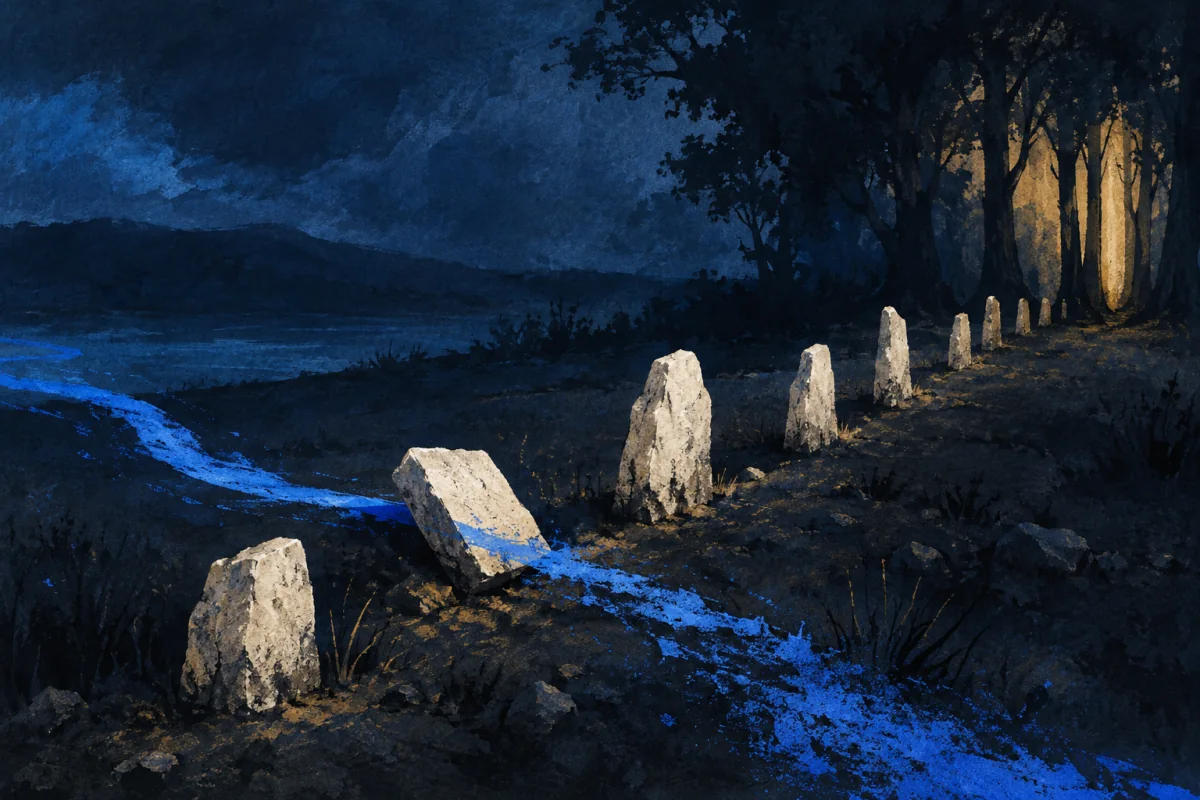
In Plain Sight
Some people give their attention to the edge of held ground. The fence line, the tree line, the place where the known stops. They walk the perimeter often enough to carry it exactly, so a print that does not belong or a branch bent the wrong way stands out before anyone can say what is wrong. You'd notice this in the one who knows which stones have moved.
The Pattern at Work
The walk takes an hour and covers ground that has not changed in years, which is the entire point of doing it. Along the top hedge there is a gap where the wire was pushed down last winter and repaired, and the repair is checked every single time without any decision to check it. Two hundred yards on, the grass at the foot of a gatepost is flattened in a way that was not flattened on Tuesday, and the whole walk stops there. Not because anything is obviously wrong. Because the ground at that post is held in memory at a resolution nobody asked for, and the difference arrived before any reason for it did. The reason usually turns out to be a badger or a dog, and occasionally it turns out to be the thing the walk exists for.
The same reading works on a building, a campsite, a yard, a stretch of coastline. A person who has walked the perimeter of a site every morning for a month knows which door is always ajar, which fence panel rattles in a south wind, which corner collects litter and which one does not. The knowledge is almost entirely useless as information. Its only function is to make one unfamiliar thing loud, and it does that reliably, which is why a night watchman with two years on a site is worth more than a new one with better equipment. The equipment reports events. The walker reports differences, and differences come first.
What the Examples Show
It gets read as suspicion, or as territoriality, or as somebody with too much time and a fence.
The first thing running is a stored baseline. Not a description of the perimeter but the perimeter itself, held closely enough that recall is not required and only departure registers.
The second is that the attention is spatial before it is social. The question is not who did this. It is what is different here, which arrives first and often arrives without any answer attached at all.
The third is that it concentrates at the edge. The middle of held ground gets very little of this attention, because the middle is not where anything arrives from. Everything that matters crosses a line, and the line is what gets carried.
Going Deeper
Held ground has always had somebody who walks its edge, and the role is older than any of the words we have for it.
Parish boundaries in England were beaten once a year by a procession that walked the whole line, children included, so the shape survived in living memory before it survived on paper. Cattle stations in Australia still run bore and fence runs that exist as much to see what has changed as to fix anything. Frontier and march wardens along contested borders in medieval Europe held office on exactly this basis, and Japanese village forests kept watchers on the edge of the common ground to see who was taking wood. Every one of these jobs was defined by a line and by repetition rather than by any event.
What that role has always cost the person doing it is worth stating plainly. The work is invisible while it succeeds, so the watcher is judged only on the occasions it failed, and a decade of nothing happening reads to everybody else as a decade of nothing being done. The attention does not switch off with the job, which is why people who have held ground for years sleep badly in unfamiliar houses and cannot sit with their back to a door. It attracts hostility, since the same walk that spots an intruder spots a neighbour shifting a stone, and the line is exactly where relationships are thinnest. And it sours easily: the difference between a person who notices what has changed and a person who believes somebody is always coming is one bad year, and from the outside the two look much the same.
The Image
The line.
Not a wall and not a defence. A boundary that gets walked so often it lives in the body of the walker, and whose only job is to make one thing out of place loud.
A wall stops nobody who is determined. A line that is genuinely known cannot be crossed without leaving a difference, and a difference is enough for somebody who was going to walk it anyway.
Where It Stops
Being wary is not this, and neither is owning a fence. This is a stored baseline and a habit of walking, and it takes months of the same ground to build.
It goes wrong as the assumption that every difference means intent. Most of what changes along a line changed because of weather, animals or somebody's short cut, and a watcher who reads each one as approach becomes exhausting to live beside long before becoming useful.
It also fails on ground that changes on its own. A working site, a river bank after floods, anywhere in real growth: the baseline is overwritten faster than it can be laid down, and the signal disappears into noise.
Take the plainer explanation first. Anybody guarding a place walks its perimeter, because that is the job. The test is whether the walking happens where nothing is held at all — a rented flat, a borrowed field, a hotel corridor on the first night.
Where It Pays
Inside a job. Site and estate security, ranger and warden work, gamekeeping and fisheries protection, border and customs patrol, harbour and airfield ground staff, utilities and pipeline inspection, and rail and coastal path maintenance. Also anywhere a physical perimeter has a compliance duty attached to it, from quarantine and biosecurity to nuclear and water sites.
What is being bought is the difference between monitoring and knowing. Cameras record everything and notice nothing; a person who has carried the same line for a season notices the one thing that is not as it was, and does it in the first four seconds of looking.
Where it pays badly is on any site the watcher is rotated around, since rotation destroys the baseline the whole reading rests on. It pays badly in operations that measure patrols by coverage rather than by familiarity, and in any role where reporting a difference without a reason attached is treated as wasting somebody's time.
Outside one. Smallholdings, allotment sites, community woodland, shared buildings, and the informal watch that holds most streets together. The cost worth naming is that the walking does not stop when the ground stops being yours, and it can make a person unwelcome in places that did not ask to be watched.
Try This
Pick one perimeter you cross regularly. The edge of a garden, the outside of a building, the path around a park.
Walk it once slowly and pick out five fixed things — a post, a gap, a stain, a particular stone, a bent railing. Do not photograph them. Just look at each one for a few seconds.
Walk the same line four more times over a fortnight and see how many of the five have changed, and whether you caught the change before you went looking for it.
Carrying a line is a tool, not a self. Pick it up where ground is held and something arriving matters. Put it down in places that belong to other people, because there the same attention reads as a threat rather than as care.
If This Isn't You
Most people walk past a fence for years without knowing a single thing about it, and are the better for the quiet. Not carrying a line is an answer, not a carelessness.
Where To Go Next
Its near-twin — Protective Watcher. Both watch in order to keep something safe. Protective Watcher is watching people and reads intent in a room. This one is watching ground and reads difference along a line, often with no person involved at all.
Its shadow — Threshold-Holder. Threshold-Holder stands at the opening and decides who comes through. This one never stands still and rarely meets anybody, because the work is the walking and the answer is in what moved.
Most often confused with — Trail Sign Mapper. Both read marks on the ground. Trail Sign Mapper reads them anywhere and reconstructs what happened. This one only reads one line, and only needs to know that something is not as it was.