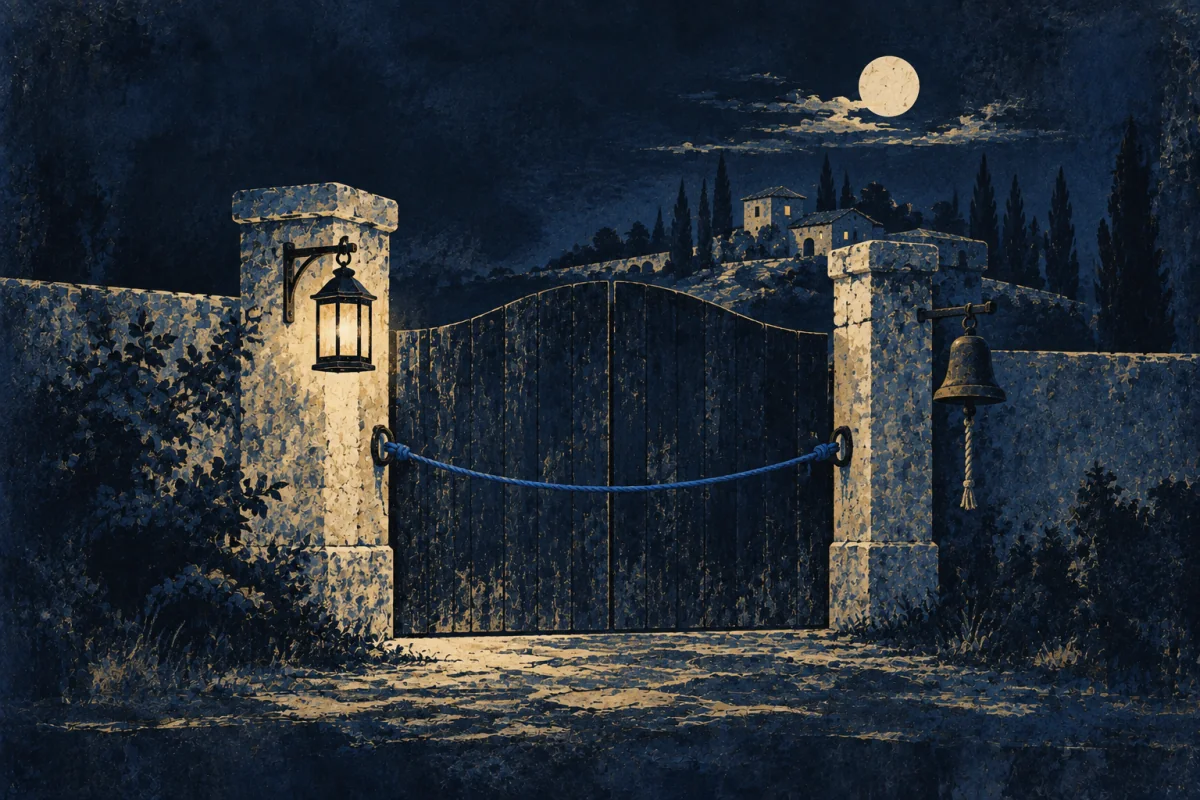
In Plain Sight
This person can hold a post for hours while nothing happens at all. They are not bored and they are not on show. They stay ready in a quiet way, so that the one second that matters does not find them asleep. You'd notice this in the friend who takes the seat facing the door without thinking about it.
The Pattern at Work
A night porter in a sixty-room hotel, eleven at night until seven. The work, on paper, is four check-ins and a fire panel. What he actually does is walk the building twice an hour on no fixed pattern, know which fire doors the kitchen staff prop, and recognise from the lobby that the man coming in at two is not a guest, before he reaches the desk. In four years nothing has happened that made the news. Twice he has stopped something at the stage where a sentence still worked, and neither made it into a report, because there is no form for a thing that did not occur.
An indoor pool in a coastal town in February. Six swimmers, all of them regulars, all of them strong. The lifeguard is nineteen and has been told the job is boring, which is true and beside the point. She does not read, does not lean, and does not watch the strong swimmers. She watches the shallow end, the steps, and the one man swimming with his head high, which is the first thing that goes when somebody is in trouble and does not know it yet. Her shift ends without incident, as almost all of them do.
A woman in her fifties sleeps in the back bedroom now, because her father wanders. She wakes at the sound of the third stair and not at the fridge. She has been doing this for two and a half years. Nobody has fallen. The cost of that sentence is not visible in it.
What the Examples Show
The obvious reading is that these are undemanding jobs done by patient people, and the word boring carries a lot of that description.
What is actually running is sustained readiness against an event that almost certainly will not come tonight. That is much harder than acting in a crisis, and the difficulty is measurable: attention to a rare signal falls off sharply after about half an hour, and the fall is a property of how minds work on unchanging input, not a character failing. Everything the three do is built against that decline. The irregular patrol, refusing to read, sleeping in the back bedroom — each is a structure that holds attention up when it would otherwise sag.
The second half is knowing what to watch. None of them scans everything. Each has a short list of what goes first: the propped door, the high head, the third stair. Vigilance without that list is just staring.
Going Deeper
Every society with anything worth losing has organised somebody to sit up with it. Rome's vigiles walked the streets at night watching for fire, the one thing that could take the whole city. Ships have run four hours on and four off for centuries, and an anchor watch keeps one person awake all night confirming the vessel has not moved. Sentries have been executed for sleeping, in most armies, for most of history — a penalty that seems wildly out of proportion until the reason surfaces: the post exists for the night the attack comes, and a sentry who cannot be relied on is worse than none, because the camp behind him sleeps on the strength of him.
The American West put people in towers for whole summers to watch for smoke, alone, and their accounts are mostly about how much structure they built into days that had none. Both Norman Maclean and Jack Kerouac did the work and wrote about staying awake to a landscape that has looked identical for six weeks.
Norman Mackworth put numbers on it in 1948 with a clock whose hand occasionally jumped twice, and found trained observers missing the jumps within half an hour. That result reshaped how radar watches and control rooms were staffed, and it is the fact underneath every scene above.
They are paid in a currency that does not spend. There is no product at the end of a night, no record of what did not happen, and no way to show competence except the absence of disaster, which looks like the absence of anything. They are routinely the first role cut, on the reasonable grounds that nothing has gone wrong in years. And they carry a tiredness that rest does not fix, because the body has spent years prepared for something that never arrives.
The Image
The empty doorway.
Somebody has to look at it. Not stare at it, and not worry about it — look at it often enough, and with enough attention left, that if something ever comes through it the first second is not wasted on surprise.
The job is to be wrong about it night after night without becoming careless, which is the actual skill and is nothing like courage. Try it for an evening and feel how quickly the doorway stops being interesting.
Where It Stops
Anxiety is not this, and the difference matters. A person scanning because they cannot stop is exhausted and less accurate, not more. This is deliberate, switchable, and has a shift that ends.
Being calm is not it either. Calm people fall asleep at posts.
It goes wrong as a watch that never comes off. Somebody who cannot sit with their back to a room, on holiday, in a friend's kitchen, is no longer holding a post. They are being held by one.
It goes wrong again as guarding what does not need it, which becomes surveillance of people who have done nothing, and the attentiveness that protects a building can make a household feel watched.
It also fails where the danger is slow. A business failing over three years does not announce itself at the third stair, and this pattern will watch the wrong doorway.
Take the plainer explanation first. Anybody on a night shift performs a version of this. The test is whether it is still running off duty, in an ordinary room.
Where It Pays
Inside a job. Security and site work, night shifts of every kind, lifeguarding, marine watchkeeping, control rooms, monitoring and on-call, nursing observations, custody and residential care. The contribution is not deterrence. It is that the gap between something starting and somebody noticing stays short, and almost everything that becomes a catastrophe was survivable in its first two minutes. Insurers have understood this for a century.
It pays badly wherever the measure is activity, since a good night produces none of it and looks, on any report, like an empty shift.
Outside one. Small children near water, an elderly parent at home, a house on a road, a group camping, and every situation where somebody has to be the one who is not fully off duty. The cost worth naming is cumulative: two and a half years of listening for a stair is a load, and because the danger never materialises nobody ever says that was worth it. The second is that this person is hard to relieve. Handing the watch over requires trusting somebody else to hold it, and the pattern does not hand over easily, which is how a family ends up with one person doing it for a decade.
Try This
Take one evening and pick a doorway — a door, a gate, the entrance to a room you are in.
Give it an hour. Do not watch it constantly; that is not the task and it does not work. Decide first what three things would tell you something was wrong, then check every few minutes whether any is true.
At the end, write down how long it took before you stopped noticing the doorway at all. The honest number is usually under twenty minutes, and knowing yours is the whole value of the exercise.
The empty doorway is a tool, not a self. Pick it up when something needs watching and there is a shift. Put it down at the end of the shift, which takes practice.
If This Isn't You
Most people relax into a room, assume the door will look after itself, and sleep through the third stair, which frees a great deal of attention for other things. Feeling no pull toward the seat facing the door is an answer, not a gap.
Where To Go Next
Its near-twin — Live-Contact Defender. Both stand between people and harm. The Defender's work begins at contact and is over quickly. This one's work is the hours before contact, and the best version means contact never happens.
Its shadow — Crisis-Mind. The Crisis-Mind is at its best once something has broken. This one is the reverse, and a good night for one is a wasted night for the other.
Most often confused with — Quiet Watcher. Both hold a post for long stretches and both look like patience. The Quiet Watcher is watching for change and wants to see it. This one is watching for an event and wants it never to arrive.