In Plain Sight
Some people make puzzles as carefully as they solve them. They are not passing the time. Words get fitted to constraints and constraints to shapes until the thing closes with a click that only the maker hears first. You'd notice this in the one who leaves folded paper problems on the kitchen table for somebody else.
The Pattern at Work
A crossword clue has been rewritten nine times and the answer has not changed once. What has changed is whether the surface reading — the sentence as ordinary English — is convincing enough to mislead without being unfair. The test the setter applies is not whether it is hard. It is whether a solver who gets it will feel that they were beaten honestly, which is a question about the solver's experience of a mind they will never meet, and it is the whole craft.
The chess problem takes a week to build and most of that week is spent taking pieces off the board. Every piece on the board must be necessary; one that is there to make it harder is a fault, because the solver will eventually notice it doing nothing and the illusion of inevitability collapses.
A locked-room plot is constructed backwards from the one physical fact the reader will not think about, and everything else in the story exists to make that fact ordinary. The characters, the weather and the argument in chapter four are all doing structural work. A reader who finds the solution unfair has usually found a place where the writer needed something and did not lay it down early enough, which is a construction fault rather than a failure of cunning.
Three different crafts and one standard: the thing must close completely, with nothing left over and nothing required from outside it, and the solver must be able to get there on their own.
What the Examples Show
It gets read as cleverness, or as a taste for showing off, or as a hobby for people with time.
What is running is construction against constraint, and the aim is the opposite of showing off. A puzzle that beats everybody is easy to build; the difficult thing is one that is solvable, that feels inevitable afterwards, and that gives the solver the satisfaction rather than keeping it.
That makes it an unusually other-directed craft for something done almost entirely alone. Every decision is a model of a stranger's mind: what they will assume, where they will look first, what will look like a red herring and what will look like nothing at all.
And the standard is closure. Nothing extraneous, nothing needed from outside, one route. The click is a real perceptual event and the maker gets it first, usually at a bad hour, and is then the only person who cannot experience the puzzle as a solver.
Going Deeper
Made puzzles are old, widespread, and have always been slightly apart from serious intellectual work while borrowing its tools.
The Exeter Book riddles are Old English poems built entirely on double meaning, and several of them are still argued about. Sanskrit and Arabic traditions both developed elaborate riddle forms with their own rules and their own recognised masters. Chess problems became a discipline with its own aesthetics in the nineteenth century, judged on economy and surprise rather than on practical value. The cryptic crossword was assembled in Britain in the nineteen-twenties and thirties into a form with rules no one ever quite wrote down. Sam Loyd and Henry Dudeney both built careers on constructed problems, and Martin Gardner spent several decades demonstrating that the same instinct sits underneath a great deal of genuine mathematics rather than beside it.
The tension in all of it is that the work is genuinely rigorous and socially classified as a diversion.
That means it is done for very little money by people who are frequently capable of much more remunerative things, and it attracts a slight embarrassment — a career spent on crosswords is not a career anybody planned. The craft is also invisible by design: a good puzzle looks effortless and inevitable, and the nine rewrites and the week of removing pieces leave no trace. And there is a particular solitude in it, since the maker can never be the audience for their own work and has permanently lost access to the experience they are manufacturing.
The Image
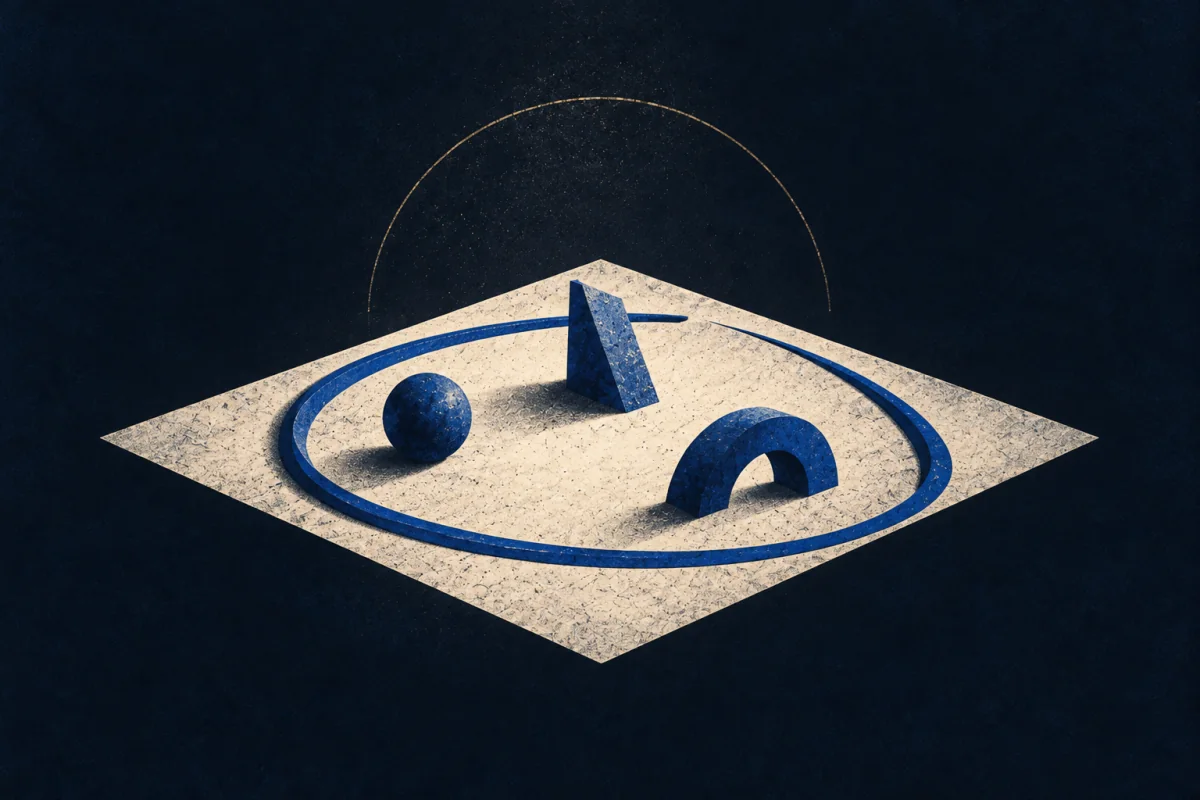
The click.
Not the answer. The moment the last constraint drops into place and the whole thing becomes inevitable, with nothing left over.
It is a real sensation and it is what the maker is manufacturing for somebody else. Anything constructed to be solved can be tested by whether it produces one, and most things that call themselves puzzles do not.
Where It Stops
Being good at puzzles is not this. Solving and setting are close to opposite: solvers want to get in, setters have to model somebody else getting in, and most excellent solvers set badly.
It goes wrong as difficulty for its own sake. A puzzle nobody can do is a failure that looks like a success, and a maker who has lost sympathy with the solver produces work that is technically admirable and joyless.
It also fails where the situation is not closed. Real problems have missing information, competing goals and no guarantee of a solution, and a mind trained on closed systems will keep looking for the one route through a situation that does not have one.
Take the plainer explanation first. Anybody who does crosswords daily will try setting one. The test is whether the effort goes into the solver's experience — nine rewrites of a clue whose answer never changed.
Where It Pays
Inside a job. Puzzle and game design, crossword and quiz setting, escape room and alternate reality game design, level design, assessment and examination writing, and the construction of training scenarios and exercises. Also cryptography and security testing, where the discipline of closed systems and the hunt for the unintended route are precisely the same habit pointed at something with consequences.
The transferable part is the modelling: this is somebody who thinks continuously about how another person will approach a thing they have made, which is rarer than it sounds in anybody who designs anything.
What is being bought is a designed experience of difficulty that people complete rather than abandon. That is a narrow skill with a wide market: every game, test, exercise and interview problem either gives somebody a route and the satisfaction of finding it, or does not, and the difference between the two is almost entirely craft rather than subject knowledge.
Where it pays badly is anywhere the problems are open-ended, anywhere the answer matters more than the route, and in any organisation that regards the construction as trivial compared with the content — which is most of them, and is why so many tests are badly made.
Try This
Take a question you already know the answer to and write it as a clue for somebody else. Anything: a place, a person, a word.
Write it three times. The first is too easy. The second is unfair, because you will have hidden something they could not have known. The third is usually the first one worth showing.
Then give it to somebody and watch them, and say nothing at all while they work.
Almost every fault turns out to be in your model of them rather than in the puzzle.
The click is a tool, not a self. Pick it up where a closed problem can be built for somebody to walk into. Put it down where the situation is real, open and missing information, because there the search for the single route is a way of not deciding.
If This Isn't You
Most people do the crossword, or do not, and either way have never wondered who made it, which is the correct relationship to have with a puzzle. Feeling no urge to build one is an answer, not a dullness.
Where To Go Next
Its near-twin — Idea-Shaper. Both work on closed structures of meaning and both look for the place where a word is doing two jobs. Idea-Shaper is trying to remove the ambiguity. This one is manufacturing it on purpose and hiding it fairly.
Its shadow — Word-Smith. Word-Smith answers to an inner ear and will accept a blurred meaning for a line that lands. This one has no ear to satisfy and a hard external test: the thing either closes or it does not.
Most often confused with — Symbol Maker. Both compress meaning into a small form. Symbol Maker wants immediate recognition. This one wants delayed recognition, engineered to arrive after a struggle, and would regard instant understanding as a botched job.