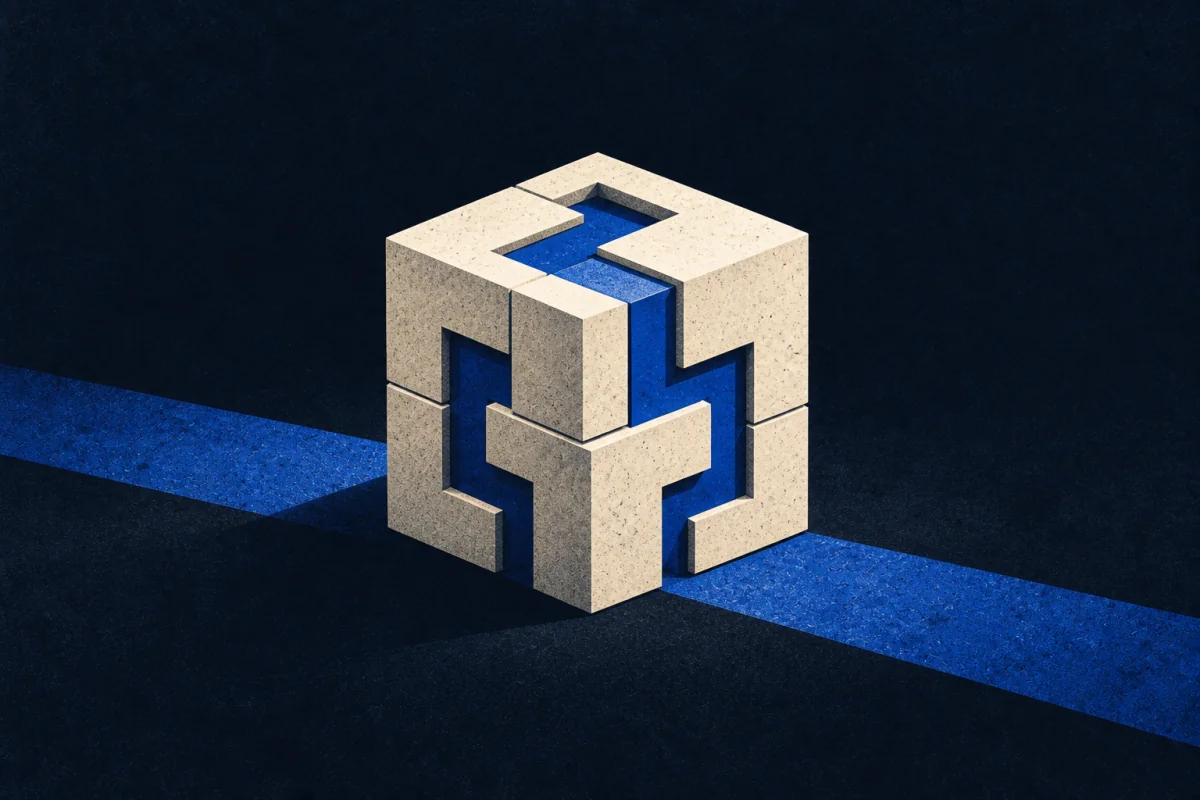
In Plain Sight
Some people build a puzzle so that the answer feels obvious once it is seen. They are not showing off. They hide a structure and then leave a fair way to reach it, because the pleasure they are making is the click rather than the struggle. You'd notice this in the one who writes a clue nobody can solve, then rewrites it until three people can.
The Pattern at Work
A clue is written on a Tuesday and is beautiful and nobody gets it. Six people try. Each of them, told the answer, says the same thing, which is some version of oh, that's not fair, and in four cases out of six they are right. The clue goes back. What changes over the next three drafts is not the difficulty. The misdirection stays, the concealment stays, and what gets added is a second way in — a definition that is exact if read correctly, an indicator that is doing honest work. By the fourth draft three of the six solve it, and all six, on being told, say the other thing, which is oh followed by a short pause. The pause is the product. Everything else was scaffolding for it.
A pub quiz round built by somebody who has thought about it more than the occasion requires. Four questions that most tables will get, one that divides the room, and one at the end that nobody is expected to know and everybody can work out from the four before it. The round is designed so that a table which has been losing all night gets that last one and knows, for certain, that they earned it rather than guessed.
An interview problem set for an engineering role, rewritten seven times because each earlier version rewarded having seen it before rather than thinking it through. The final one has no trick in it at all, which took longer than the tricks did.
What the Examples Show
Wordplay is what it looks like, and the wordplay is the least of it.
What is being constructed is an experience in somebody else's head that the constructor will never have: a period of being stuck, followed by a rearrangement, followed by the thing becoming obvious. Every decision is made against that, which is why difficulty is not the target. Too easy and there is no rearrangement. Too hard, or unfair, and there is no click — only a reveal, which is a different and much cheaper sensation.
Which is why the fairness rules matter so much to the people who do this and appear pedantic to everyone else. A clue must not mean what it says but must say what it means, and the entire value of the form rests on that being kept even when nobody would catch the breach.
And it explains why the maker cannot check their own work. Once the structure is known it cannot be unknown, so every puzzle has to be tested on other people or it is being built blind.
Going Deeper
The Exeter Book was copied around the year 970 and contains roughly ninety riddles, some obscene, some about a bookworm or an iceberg, and several that have never been solved. They were not written to defeat anybody. They were written so that a listener who thought about a creature that eats words and is none the wiser would arrive somewhere and feel the arrival, a thousand years before anyone had a word for that.
Sanskrit had prahelika as a recognised literary form. Japanese nazo were exchanged as a social art. And the English cryptic crossword produced the clearest statement of the ethic anybody has managed, from a setter writing under the name Afrit: the setter need not mean what they say, but must say what they mean. It is a constraint that makes the work much harder and is the only reason the form is worth anything.
The costs follow from the shape of the thing.
A good puzzle looks effortless, which means the work is invisible in direct proportion to how well it was done. Seven drafts produce something that reads as though it fell out that way.
The maker is permanently excluded from the product. Whatever the click is, they cannot have it, and they are making it for strangers they will never meet.
The work is solitary and cannot be shared even in progress, because describing a puzzle to somebody destroys it for them.
And there is a standing temptation toward cleverness at the expense of fairness — which is the failure mode, is enormously satisfying to commit, and is invisible to everybody except the six people who could not solve it and were right not to.
The Image
The click.
Not the answer, which anybody can be told, and not the difficulty, which is easy to manufacture. The half-second in which a rearrangement happens and a thing that was opaque becomes obvious. It is the whole product, it happens in somebody else, and it takes about seven drafts to build.
Carry that one into anything built to be understood rather than followed.
Where It Stops
Cleverness is not the ingredient, and quite a lot of extremely clever people build unfair puzzles all their lives without ever noticing.
It goes wrong as showing off. The tell is a puzzle whose solution requires knowing what the maker happened to know — a reference, a speciality, a private joke — which converts the click into an advertisement and leaves the solver feeling smaller rather than quicker.
It also fails where the audience did not consent. Setting a puzzle for somebody who wanted an answer is a small, common cruelty, and the pattern is drawn toward it: explaining by means of a question is delightful for the explainer and can be miserable for a person who is simply stuck and tired.
Take the plainer explanation first. Anybody who has solved cryptics for twenty years can write one, because the moves are learnable. The test is whether the drafts are being tested on other people and rewritten for fairness, which is the part that cannot be faked and nobody does for fun.
Where It Pays
The contribution is a specific kind of understanding that cannot be delivered by telling. Anything arrived at by rearrangement is held differently from anything received: it is remembered, it is trusted, and it can be rebuilt by the person later because they built it once already. That is worth most in assessment and examination design, teaching of every kind, training simulations and scenario work, games and level design, museum and exhibition interpretation, interview and selection, and in security, where constructing a problem that is hard and still fair is the whole of a red team's craft. It pays badly anywhere the point is throughput of information, and badly again wherever people are already stretched to the limit, since a puzzle offered to somebody with nothing left is an imposition however well it is made.
Outside work it lives in crosswords, puzzle hunts, quizzes, escape rooms, treasure hunts for children, and the long domestic tradition of setting things for one's own family at Christmas. The cost worth naming plainly is that this person spends their life manufacturing a pleasure they are structurally unable to receive, for people who will never know they existed, and the better the work the more complete the anonymity.
Try This
Take something you want somebody to understand and build a way for them to arrive at it instead of telling them.
Then apply the only rule that matters: does the path work for a person who does not already know the answer, using only what is in front of them? Not what you know. What is on the page.
Test it on one person. Watch where they stop. The place they stop is almost never where you expected, and it is the only useful information you will get.
Then rewrite it once, keeping the difficulty and adding a second way in.
The click is a tool, not a self. Pick it up where somebody wants to understand. Put it down where they want an answer, which is most of the time and is not a failure of curiosity.
If This Isn't You
Most people explain things by explaining them, which is faster, kinder and usually right. Having no wish to build the long way round is not a lack of imagination; it is respect for how little time anybody has.
Where To Go Next
Its near-twin — Hidden Pattern Finder. The same machinery, running backwards. Hidden Pattern Finder uncovers a structure nobody concealed. This one conceals a structure on purpose and then builds the road back to it.
Its shadow — Route-Changer. Route-Changer finds the obstacle in somebody's understanding and removes it. This one puts an obstacle there deliberately, having calculated exactly how much of one a person can get over.
Most often confused with — Game-Mind. Game-Mind plays against a mind that is playing back and wants to win. This one is building for a mind it will never meet and wants that mind to succeed.