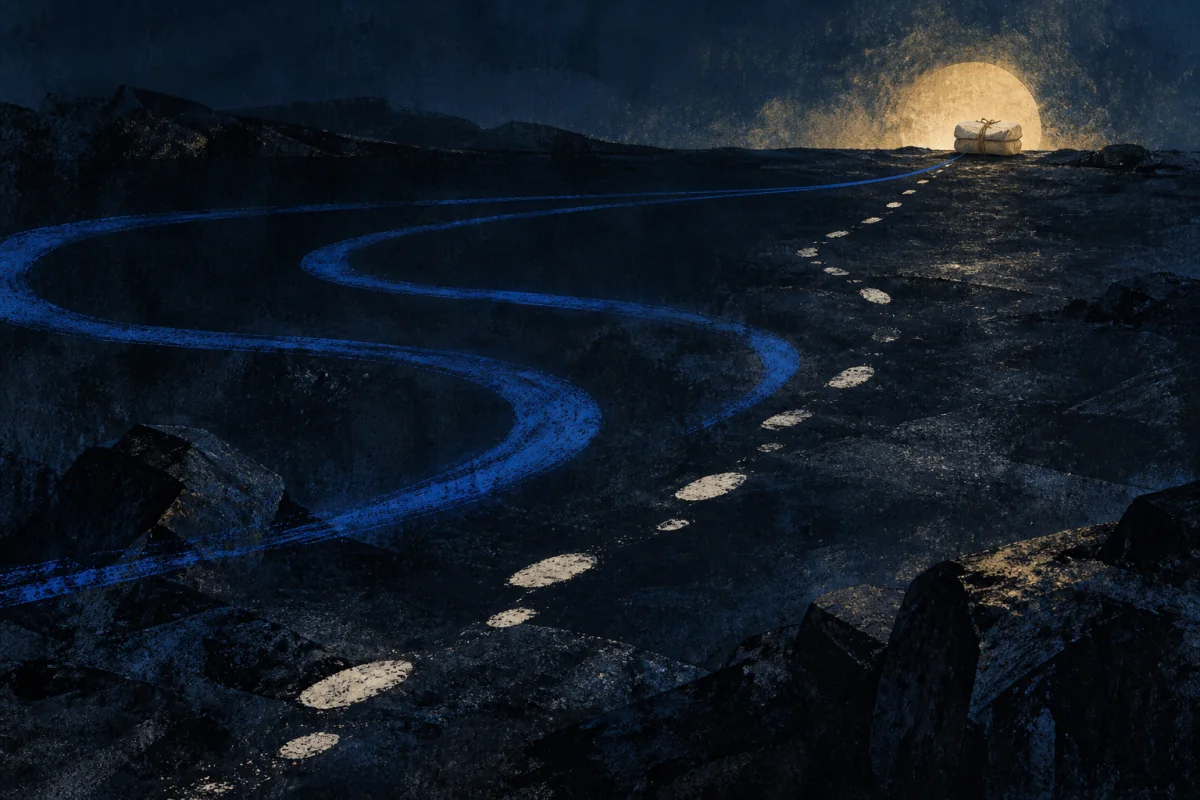
In Plain Sight
For this person, the pull is to follow small signs until action is worth taking. They are not chasing a thrill; they wait because moving too soon can miss the useful thing they came to get. You'd recognize this in the teammate who notices one loose screw after practice and will not leave until it has tape on it and a repair text sent.
The Pattern at Work
Four o'clock in the morning, a small boat, and by eleven-forty nothing has gone in the water. Three other boats have shot their nets twice already and are working back across the bay. The gannets have been busy since first light, which is the sign everybody else moved on, and the one still waiting has been watching the direction they come back from and how high they are climbing before they fold. Around eleven the birds shift thirty degrees and start working shorter. The tide turns eighteen minutes later. One set goes in, in a place nobody else has been all morning, and it is the only set of the day worth the diesel. Asked about it afterwards, the answer is not a system. It is that the first two things were normal and the third one wasn't.
A trip of nine people, three days in, and one of them has been keeping a quiet tally that nobody requested. Day one, the second van sounded wrong pulling out of the car park. Day two, the rope bag came back wet and went into the shed wet. This afternoon, a screw on the frame has worked itself half out. Any one of those is nothing at all and would be fussy to mention. Together they describe a group that has stopped checking things, which is a fact about the next four days rather than about the screw. The screw gets taped, the text gets sent, and the van gets looked at on the morning of day four by somebody who would otherwise have found out about it on a mountain road.
What the Examples Show
Patience is the word people reach for, and it puts the attention in the wrong place entirely.
Patience is a temperament — an ability to tolerate waiting. What is running here is not tolerance, it is accumulation. Signs are being collected and held against each other, and none of them is worth acting on alone. The waiting is not endured. It is the work.
That is also why the move, when it comes, is fast and looks unhesitating to anyone who arrives at that moment. They are seeing the last two seconds of something that has been going on for six hours.
And it explains the part that gets misread as fussiness. A loose screw is not a hazard, it is a data point, and a data point is only worth anything next to the two before it. The tape is incidental. The tally is the thing.
Going Deeper
Every group that ate what it caught had to solve a problem that is not about skill with a weapon or a net at all. Skill decides whether the attempt lands once it is made. Something else decides when to make it, and getting that wrong does not merely waste a day — it teaches the animals, moves the fish, burns the fuel, and sends everybody home with nothing.
So the role was carved out and given to particular people, everywhere, under different names.
The San tracker who will follow for eight hours and decline to close, because the spoor says the animal is not yet tired and a bad approach costs the whole afternoon. The hunter at a seal's breathing hole in the Arctic, motionless for a day and a half, reading a set of signals in ice and sound that will not appear in any summary of what happened. The Shetland skipper reading birds, the same trade conducted upward. The orchard keeper who knows not the month but the week, and will lose a crop by picking it seven days early. The shepherd choosing which morning to bring the flock down, where a fortnight late is a disaster and a fortnight early a slower, quieter one.
What they shared was not temperament but exposure, and the costs were the same in all of those lives.
From the outside it is indistinguishable from doing nothing, and somebody is always watching who wants a decision now. Success is a non-event: the waiting buys a thing that did not go wrong, which cannot be shown to anyone. The knowledge is stubbornly local — thirty years of reading one bay is worth very little in the next bay. And when the judgement is wrong, it is wrong alone, in public, and with a timestamp on it.
The Image
The third sign.
One odd thing is noise. Two odd things are a coincidence, and people are extremely good at manufacturing those. Three odd things pointing the same direction is a fact, and it is the first point at which moving is worth what moving costs.
Carry that one into anything where acting early destroys the information you were about to act on.
Where It Stops
Calm is not this, and neither is reluctance. Some of the most placid people never accumulate anything, and some who carry this are visibly impatient the whole time they are doing it.
It goes wrong as waiting past the moment. Sign-collecting is comfortable and carries no risk of being wrong, and it can quietly become the point, so that the third sign arrives, and the fourth, and the window shuts while the tally goes on being kept.
It also fails where there is no real signal to read. A hiring decision, a negotiation with a deadline, a market: those throw off enormous amounts of material that looks exactly like signs and is not, and the waiting is delay wearing better clothes.
Take the plainer explanation first. Anyone with long experience of one specific task waits well at that task, which is what experience mostly is. The test is whether it appears somewhere unfamiliar, on a problem the person has no history with at all.
Where It Pays
It pays badly on a fixed cadence. A service desk, a production line, a newsroom, anything where the work arrives on a clock and the answer to when has already been given to you: there is nothing here to use, and the person carrying it will read as slow.
Inside a job. Field work, maintenance, agriculture, fisheries, surveying, drilling, logistics, safety-critical inspection — anywhere the cost of acting early is not a delay but a destroyed opportunity. Also anything seasonal, where the window opens and shuts on its own schedule.
The real contribution is not good timing. It is that the organisation stops paying for premature action, which is one of the largest invisible costs there is: the launch that went out before the data, the repair done to the wrong part, the negotiation opened a month before there was any leverage in it. None of those appear as losses. They appear as work.
Outside one. Boats, hills, allotments, old houses, and any family with a car nobody wants to pay for. This is the person who says not yet about the roof, the operation, the conversation.
The cost worth naming: it reads as passivity for as long as it is going on, and when the eventual move works, the credit goes to the move.
Try This
The next time you notice something slightly off and feel the pull to mention it, do not. Write it down instead, with the date, and say nothing.
Then wait for the second one and the third. Watch where your own pull sits — most people discover it fires on sign one and has almost nothing to do with evidence.
When the third arrives, act, and check afterwards whether the first two turned out to be related to it or whether you were building a pattern out of unrelated material, because that is the actual evidence and it is usually uncomfortable.
The third sign is a tool, not a self. Pick it up where acting early destroys what you came for. Put it down where the clock belongs to somebody else and waiting is just lateness.
If This Isn't You
A great many capable people act on the first thing they notice and are right often enough for it to work. Moving early is a strategy, not a failure of one, and most of the world runs on it.
Where To Go Next
Its near-twin — Land-Reader. Both read small signals in a place over long stretches. Land-Reader is building a picture of the ground itself. This one is only ever asking one question of it, which is whether now is the moment.
Its shadow — Speed-Chaser. Speed-Chaser treats the moving itself as the reward and will find a reason. This one treats moving as a cost to be paid once, as late as possible, and as few times as it can manage.
Most often confused with — Quiet Watcher. From across a room the two look identical: attentive, not intervening. Quiet Watcher is not building toward an action and may never take one. This one is loaded the entire time.