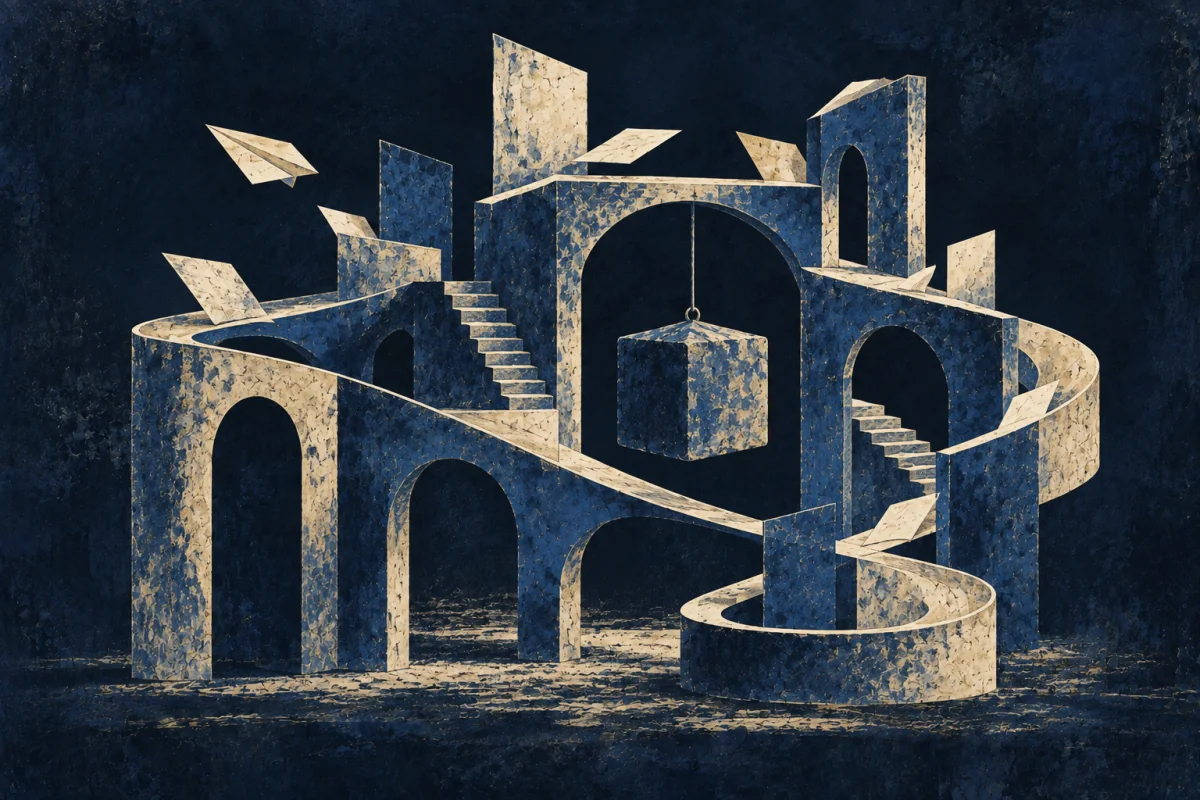
In Plain Sight
This person builds ideas the way other people build things. They are not just having opinions. They write a thought down, test whether the parts hold, and keep reshaping until someone else can walk through it. You'd recognize this in the relative who argues about what a word means and turns out to be right.
The Pattern at Work
A charity is six months into a policy paper about support for carers and cannot get past the third section. Every draft fights itself. One of the writers eventually works out why, and it is not a disagreement: the word support is doing two jobs in the same document. In the first half it means money. In the second it means somebody coming to the house. All the recommendations that seemed to contradict each other were answers to two different questions wearing one word. She splits the term, renames both halves, and the paper reorganises itself in a fortnight.
A teacher is writing a definition of fairness for a class of fifteen-year-olds and has thrown away four versions. The fourth was accurate and useless, because it covered every case and could not be held in the mind. What he is looking for is not precision, which is easy, but a distinction the class can carry out of the room and apply to something he has not mentioned. He gets there by testing each draft against three awkward examples he keeps deliberately at hand, including one where his own instinct comes out on the wrong side.
A man writes eleven hundred words on a Sunday to work out what he actually thinks about something at work, and finds at the bottom of the page that he does not think it. Step three, which had felt obvious in his head for a month, will not survive being written in sequence. He does not have a better position yet. He has a sound one fewer, which he did not have on Saturday.
What the Examples Show
The obvious reading is that these people are clever, or pedantic, depending on the observer. Both readings miss the third scene, where the result was losing an opinion rather than winning one.
What is running is treating an idea as something with parts that either hold or do not. Most thinking stops when a conclusion feels right. This carries on to ask what the conclusion rests on, and what that rests on, until it reaches something solid or finds the gap. The carer paper had a gap invisible for six months because one word was covering it.
The second half is the reader. The teacher was not after the true definition but one a fifteen-year-old could carry. Building a structure somebody else can walk through is a different job from having a correct view, and it is the one being done here — which is why the writing is not a record of the thinking but the method of it.
Going Deeper
Aristotle began by separating the ways a thing can be said to be, and almost everything afterwards refines that move: an argument needs to know which kind of claim it is making. The scholastics turned it into a technique. The medieval distinguo was a tool rather than an evasion: when two authorities contradicted each other, the assumption was that a term had shifted sense, and the work was to find the shift. That is what the carer paper needed.
Hume took the ordinary word cause, pulled it apart, and showed that what everyone thought they observed they were inferring. Philosophy has been dealing with it ever since. Darwin called the Origin one long argument and meant it structurally: a reader who accepts each step cannot easily refuse the last, and he spent twenty years on the steps. Wittgenstein wrote a short, extremely tight book, was celebrated for it, then spent the rest of his life saying it was wrong — the same instinct running on his own work, which is the hardest version.
The people who do this pay for it in ways that are easy to miss. The structure is invisible to anyone who reads only the conclusion, so twenty years look like a book, and an argument that holds together reads as obvious rather than built. They are experienced as difficult in ordinary rooms, because a question about what a word is doing sounds like an objection when it is meant as a repair. And the habit turns on its owner: a mind that tests every structure tests its own, which is why the manuscript is still being revised at eighty.
The Image
The hinge.
A door is not its hinge. But everything the door does happens there, and a door that will not close is almost never suffering from a problem with the door.
Most arguments have one. A single distinction, often a single word, that the whole thing swings on. Find it and you can usually fix or break the argument in one move, including your own.
Where It Stops
Being well read is not this, and neither is being articulate. Fluency and structure are different things, and some of the most fluent people alive are assembling conclusions with nothing underneath them.
It goes wrong as building for its own sake. A framework can become elaborate enough to be beautiful and useless, answering questions nobody asked.
It goes wrong again as taking a structure into a room that wanted a conversation. Not every disagreement is a fault in an argument. Some are two people who want different things, and dismantling their terms is a way of refusing to notice.
It also fails where the matter is not verbal. Skill, grief, taste and most of what a body knows do not decompose into distinctions, and insisting that they must is how a clear mind produces a stupid answer.
Take the plainer explanation first. Anyone trained in law or philosophy does this inside their field. The test is whether the eleven hundred words get written on a Sunday, for nobody.
Where It Pays
Inside a job. Policy and strategy, law, standards and governance, research design, teaching at any level where the syllabus has to be built rather than delivered, technical specification, and the early stages of anything where a team is about to spend two years on a shared assumption nobody has stated. The contribution is that a group stops arguing past each other, which is what most long arguments are: the carer paper was a collision rather than a dispute, and six months went into it before anybody looked at the word.
It pays badly where speed is everything, and badly again in any room that treats a request for definition as obstruction.
Outside one. Anywhere something has to be thought through rather than felt through — a family decision with several interests tangled in it, a difficult letter, a dispute where both sides use the same word for different things, which is most disputes. The cost worth naming is the room effect above: this reads as argumentative even when offered as help, and people sure of something rarely enjoy being asked what it rests on. The second is that certainty is harder to come by. A person who has watched several of their own positions fail at step three holds the current one loosely, which is honest and not always what a family wants at a kitchen table.
Try This
Take something you believe about your work and write it in steps. Not the conclusion — the road to it, each step a sentence, in order.
Then ask of each step: what would have to be true for this to be false? Not whether you can defend it. What would break it.
Most people find one step that cannot answer. Sit with it rather than repairing it, because the interesting result is not a mended argument but discovering which part you never examined despite using it for years.
The hinge is a tool, not a self. Pick it up where a thing has to hold weight for other people. Put it down where somebody is telling you how they feel, which has no steps and wants none.
If This Isn't You
Most people form a view, act on it, and correct it when the world objects, which is a faster and often better method than building the whole structure first. Feeling no urge to take an argument apart is an answer, not a gap.
Where To Go Next
Its near-twin — Word-Weaver. Both work in prose and both look for what is getting in the way. The Word-Weaver serves a writer's intention and never substitutes their own. This one builds its own structure, and the prose is scaffolding rather than the object.
Its shadow — Case-Maker. The Case-Maker aims at agreement and assembles whatever gets a listener there. This one aims at a structure that holds whether or not anybody agrees, and counts a room won by a weak step as a loss.
Most often confused with — Truth-Seeker. Both refuse to let a claim pass unexamined. The Truth-Seeker walks a statement back to where it came from and asks whether the source holds. This one never leaves the argument, and asks whether the parts fit at all.