In Plain Sight
Some people make a count into an object. They are not keeping records on paper alone. Knots, notches and beads are made so the number can be held in the hand and checked by anybody who picks it up. You'd notice this in the one whose marks can be read by somebody who cannot read.
The Pattern at Work
The stick is split down its length after being notched across, and each party keeps half. That is the whole mechanism and it is a good one: neither side can add a notch, because a new cut will not match the grain on the other half, and the count can be verified in about four seconds by anybody, including somebody who cannot read and does not trust either party. Nothing about it requires literacy, an official, or a shared language.
The person who makes these is not being quaint.
The design problem is verification by a stranger. A record kept in a book is only as good as the honesty of whoever holds the book and the willingness of everybody else to take it on trust, and in most of the situations where counts matter that trust is exactly what is missing. A physical tally moves the proof out of the relationship and into the object.
The beads are strung in tens and hundreds with a different material at each break, so the total can be read by running a thumb along it in the dark or with cold hands, which is when it will actually be needed. The notches on the beam are cut deeper every fifth, for the same reason.
A rosary does the same job for a different kind of count: it lets somebody keep a place while their attention is entirely elsewhere, which no written tally allows.
None of these are primitive versions of writing. They are solutions to a problem that writing does not solve and never has.
What the Examples Show
It gets read as folk craft, or as a picturesque survival, or as something people did before they had paper.
What is actually being designed is trust between parties who have none. Every element — the split stick, the change of material, the deeper fifth notch — exists so that verification requires nothing but the object and a pair of hands, and specifically does not require believing anybody.
The second element is physical legibility under bad conditions. Cold, dark, tired, in a hurry, unable to read: those are the normal circumstances for most counting that has ever mattered, and a design that works in good light at a desk is a design that fails where it is used.
And the count is made permanent at the moment of agreement rather than afterwards. The notch goes in while both parties are standing there. That closes the gap in which a record becomes a claim.
Going Deeper
Physical counting devices are older than writing and better than it at the specific job they do.
The Ishango bone carries deliberate groupings of marks tens of thousands of years old, and whatever it was counting, somebody wanted it to be checkable. Tally sticks were the standard receipt across medieval Europe and were used by the English Exchequer until 1826, because a split stick is forgery-proof in a way no document is. Inca quipu encoded numbers and categories in knotted cord with enough sophistication to administer an empire without any writing at all, and parts of it have still not been decoded. Abacuses and counting boards make a calculation into something the hands carry out, and were faster than paper for centuries. Shepherds in northern England kept scoring numerals for counting sheep which survived into living memory and were still being used by people who had perfectly good arithmetic and simply found them faster at a gate.
Almost all of it was displaced, and the reason is worth being precise about.
Paper and then databases are enormously better at storage, transmission and calculation, and worse at exactly one thing: allowing a stranger to verify a count without trusting the system. That property was dropped rather than solved, and most modern disputes about numbers are disputes about whose record to believe. The people who kept the older methods were also rarely the powerful ones, so the techniques went with the trades, and what survives is mostly in museums and labelled as folk practice.
The Image
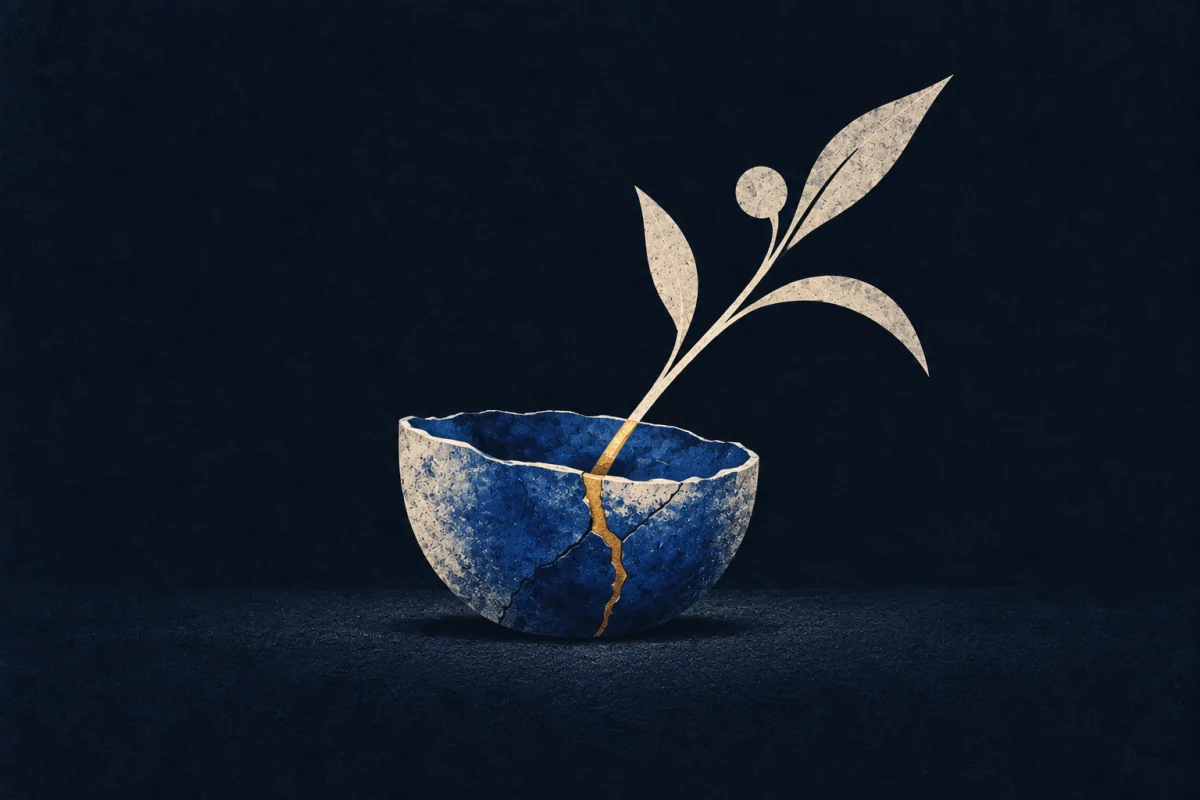
The split stick.
Notched across, then split down the grain, one half to each party. Neither can alter it, and both can check it in seconds without reading anything or trusting anybody.
That property, verification without trust, is rarer in modern record-keeping than anybody thinks. A great deal of argument would simply disappear if it were designed for, and almost nothing is.
Where It Stops
Liking old crafts is not this. The interest here is functional: these objects solve a problem, and making a decorative tally stick is a different activity entirely.
It goes wrong as refusing better tools. Databases really are better at almost everything, and a mind attached to the physical version can impose a slow and limited method on work that has no trust problem at all.
It also fails where the thing counted is complicated. A tally is good for quantities of identical things and hopeless for anything with attributes, conditions or exceptions, which is most of what anybody needs to record now.
Take the plainer explanation first. Anybody working with stock or cargo will use a physical count sometimes. The test is whether somebody designs one — whether the breaks, the materials and the marks are chosen so a stranger can check it.
Where It Pays
Inside a job. Stock and inventory work, logistics and cargo handling, metering and calibration, construction and quantity checking, and anywhere counts are exchanged between parties with a reason to disagree. Also interface and instrument design, safety-critical checklists, and the physical end of voting and audit, where the entire argument is whether a count can be verified by somebody who does not trust the counter.
What is being supplied is a count that survives a dispute. Most record systems are designed for the ordinary case, where everybody is honest and the question is efficiency, and then fail in the case they were actually needed for. One person who thinks about verification by a hostile stranger designs differently from the start, and the difference only ever shows up once.
Where it pays badly is anywhere trust is not in question, anywhere the data are complex, and in any organisation that regards a paper or physical check as a sign of not having modernised. Outside one. Clubs, allotments, shared costs, anything counted between friends who would rather not have to ask. The cost worth naming is that this looks like distrust, and explaining that it is precisely the opposite almost never works on the person who has taken offence.
Try This
Find something you count regularly and share with somebody else — miles, hours, money, turns.
Design a physical record for it that neither of you could alter alone. It does not have to be a stick. Two copies, a witnessed mark, anything where the check does not require either party's word.
Then use it for a month and notice how the conversation about it changes.
Most people find the argument stops before it starts, which is the entire point and has nothing to do with anybody having been dishonest.
The split stick is a tool, not a self. Pick it up where a count will be argued about and trust is thin. Put it down where everybody trusts each other, because there it is an accusation with no accusation in it.
If This Isn't You
Most people write it down, believe each other, and are almost always right to, which is how nearly all record-keeping works and why it is cheap. Feeling no urge to make the count into an object is an answer, not a naivety.
Where To Go Next
Its near-twin — Field-Counter. Both insist that a count be made where it can be checked. Field-Counter writes it at the gate with the conditions attached. This one makes an object so that anybody at all can verify it later without reading.
Its shadow — Scribe-Hand. Scribe-Hand makes a page that a stranger can read in forty years and relies entirely on the record being believed. This one assumes it will not be.
Most often confused with — Symbol Maker. Both compress something into a physical form. Symbol Maker is after meaning that is recognised at a glance. This one is after a quantity that can be counted by hand, and the marks are not meant to mean anything at all.