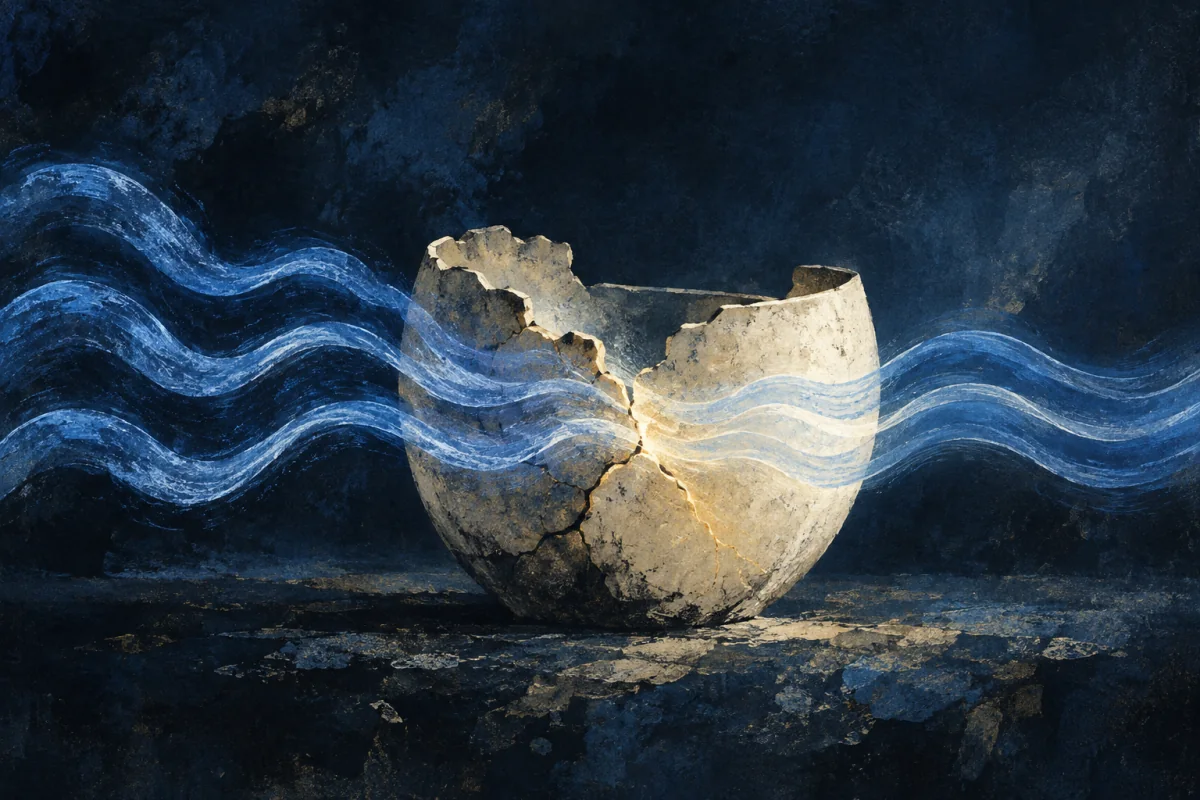
In Plain Sight
Some people carry relief on patterned sound. They are not performing a ritual for its own sake. A steady chant is held while somebody else moves inside it, and what comes next is chosen by listening to the room. You'd notice this in the one whose voice settles a fevered room and who keeps going when everyone else has stopped.
The Pattern at Work
The woman has been in labour for nineteen hours and has reached the part where she has stopped being able to organise herself. The person beside her is not saying encouraging things, which stopped working four hours ago. She is repeating a short pattern of sound, low, in time with the contractions rather than against them, changing it only at the edges as the rhythm of the labour changes. It is not a song and could not be recorded usefully. What it provides is a structure outside the woman's own body that is still holding when her own has stopped, and she can put her weight on it in a way she cannot put her weight on reassurance.
A ward at three in the morning, with an old man frightened and disoriented and two staff who have tried everything. Somebody sits and recites — a prayer, a poem, it does not matter which, and the fact that it does not matter is itself informative. What settles him is that it does not vary, does not respond to him, and does not stop. Reassurance responds. Response is what a frightened mind interrogates.
In a fever ward the same voice carries for two hours and changes pitch very slightly when the room does — when somebody comes in, when the light shifts, when the breathing in the next bed alters. None of those adjustments would be audible on a recording and all of them are the reason a recording does not work. What is being offered is not the sound.
It is somebody continuing to be there, expressed as sound, for long enough that it can be relied on.
What the Examples Show
It gets read as religious practice, or as tradition, or as something on the edge of medicine, and all three arguments happen on the wrong ground.
What is running is structural. Distress disorganises a person's own rhythm — breathing, attention, the ability to hold onto anything for more than a few seconds — and what helps is a pattern outside them that is reliable, repetitive and unvarying. It works precisely because it is not interpersonal: it makes no demand, asks no questions, and cannot be argued with or disappointed.
The second element is endurance. This is held for an hour or two hours, not for four minutes, and the difficulty is entirely in continuing after it has stopped being interesting and while nothing appears to be happening.
And there is live judgement inside it. The pattern changes at the edges when the room does. That is what distinguishes this from a recording, and it is why a recording does not work nearly as well.
Going Deeper
Patterned sound used on suffering is close to universal, and the explanations attached to it vary enormously while the practice barely varies at all.
Navajo chantways run for days at a time, and the singer's endurance is understood to be part of what is being given rather than a practical detail. Vedic and Buddhist chant, Sufi dhikr, Orthodox liturgical repetition, Catholic rosary and the rocking recitation of Jewish prayer all place a person inside a repeating pattern held by somebody else. Midwives, keeners and sickroom attendants in every culture have done the same thing without any tradition attaching to it at all, which is a reasonable indication that the practice came first and the explanations were fitted to it afterwards.
Modern practice has arrived at the edge of this and does not quite know what to do with it.
The effects are real, small, hard to separate from presence and attention, and entirely free, which is a difficult combination for anything seeking standing. The practice is also inseparable from the frameworks it grew up in, so it either carries beliefs the setting cannot endorse or is stripped of them and loses the conviction that made the practitioner able to continue for two hours. There is a genuine hazard too: the same technique used on somebody who needs a diagnosis is a way of filling the time while something is missed. And the work is done at the worst hours, unpaid, by somebody who absorbs a great deal and is offered nothing to put it down into.
The Image
The thing that does not respond.
Reassurance answers. It adjusts, it reacts, it can be tested and found wanting, which is precisely what a frightened mind will do with it.
A pattern that simply continues cannot be interrogated and cannot fail a test, because it is not making any claim. That is the whole mechanism, and it is why the words matter far less than anybody expects and why arguing about which words is usually beside the point.
Where It Stops
Being religious is not this, and neither is having a good voice. Plenty of devout people cannot hold a pattern for an hour and plenty of fine singers make it a performance, which reintroduces exactly the responsiveness that has to be absent.
It goes wrong as substituting for treatment. Pain that has a cause, an infection, a deterioration: all of those need somebody with different training, and an hour of chanting can be an hour in which nobody looked.
It also fails with people who are fully present and want to talk. An adult in ordinary distress is asking for a conversation, and being chanted at is alienating and slightly frightening.
Take the plainer explanation first. In any tradition with a liturgy, somebody will recite at a bedside because that is what is done. The test is whether the person adjusts the pattern to the room and can continue for two hours when nothing is happening.
Where It Pays
Inside a job. Chaplaincy and pastoral care, hospice and palliative settings, midwifery and birth support, dementia and end-of-life care, and music therapy where the goal is regulation rather than expression. Also traditional practice in communities where it remains ordinary, and any setting holding people through long distress with very little else available.
What is being supplied is a structure for the hours in which nothing can be done. Those hours exist in enormous quantity — the long night, the last days, the labour that will not progress — and clinical services are organised around events rather than around duration. One person able to hold a pattern for two hours covers something no rota is designed to cover.
Where it pays badly is anywhere outcomes must be evidenced, anywhere staff cannot sit down, and in any setting that treats the practice as belief rather than as method, which forces it either out of the building or into a form that does not work. Outside one. Families, deathbeds, births, long nights. The cost worth naming is that the person is called at the worst moments, is expected to be able to do it on demand, and does it through their own grief.
Try This
Next time you are with somebody distressed for a long stretch — a child, an ill relative, a friend in a bad night — try saying nothing responsive at all.
Pick something short and repeat it, quietly, for ten minutes. A poem, a counting pattern, anything at all. Do not vary it in response to them and do not check whether it is working.
Ten minutes is much longer than it sounds. Most people stop at three because nothing appears to be happening.
The nothing appearing to happen is the condition, not the failure.
The thing that does not respond is a tool, not a self. Pick it up where somebody has to get through hours. Put it down where somebody wants an answer, or where something needs looking at by a clinician.
If This Isn't You
Most people offer words, company and a hand to hold, which is what almost everybody wants and what almost always helps. Feeling no urge to repeat a pattern for two hours is an answer, not a shallowness.
Where To Go Next
Its near-twin — Lullaby-Voice. Both use sound to settle a suffering person. Lullaby-Voice meets a rhythm and moves it, working on breathing and pulse over minutes. This one holds a fixed pattern for hours and does not try to move anything.
Its shadow — Song Giver. Song Giver wants a room to join in and counts the job done when the singing belongs to everybody. This one wants no participation at all and is deliberately uninteresting.
Most often confused with — Touch-Healer. Both offer relief outside medicine and both work by staying. Touch-Healer's instrument is contact and the effect is physical. This one never touches anybody and is supplying a structure to be held onto.