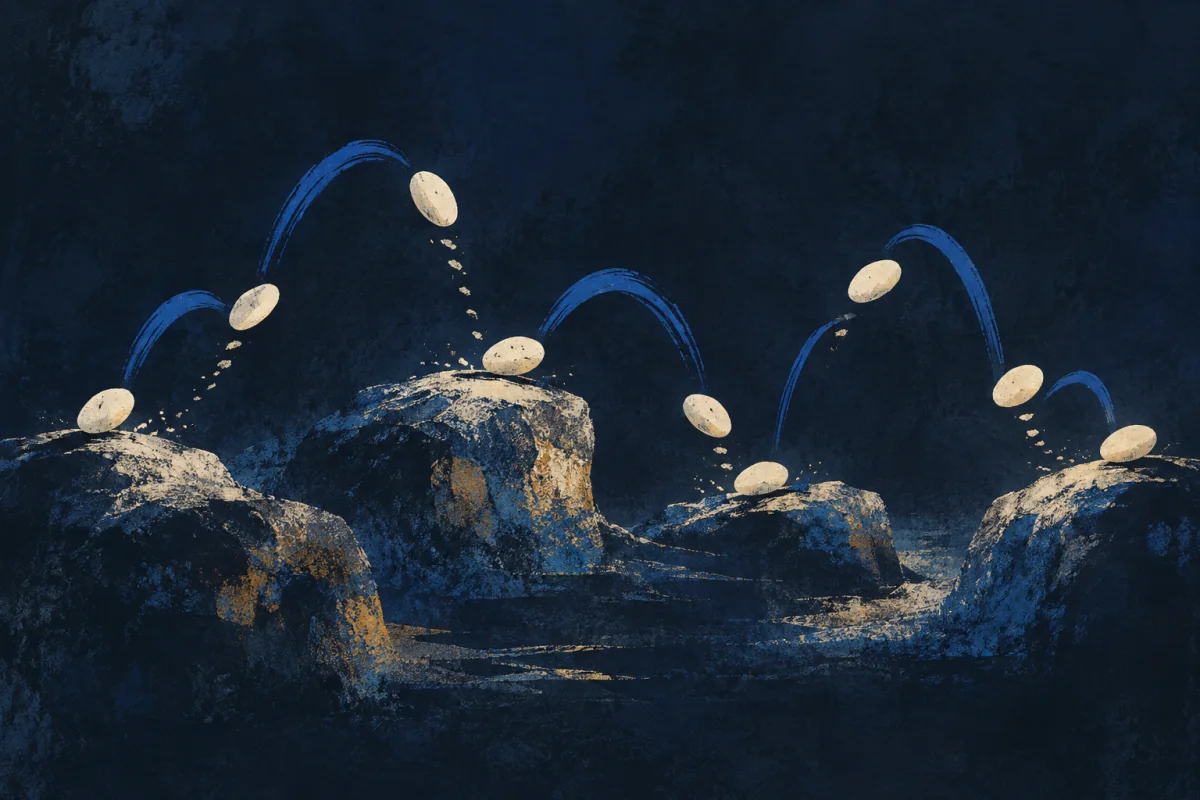
In Plain Sight
Some people gather children into motion. Circle games, chases, clapping rhythms, the invented rule that everybody suddenly follows. The tempo is set with body and voice, the teaching happens without looking like teaching, and twenty small attentions are held by movement alone. You'd notice this in the kid who organises the whole playground at break.
The Pattern at Work
Nothing is announced. A game is started alone, or with one other child, in full view and with obvious enjoyment, and within a minute there are six players and nobody was asked. Children do not join instructions; they join something that already looks worth being inside. So the opening move is always to be visibly playing rather than visibly organising.
The rhythm does the holding. A clapping pattern, a chant, a chase with a regular beat: the pulse keeps twenty children synchronised without anybody being managed, and it can be sped up when the group is flagging or dropped to a whisper when it needs settling. Somebody good at this changes the tempo constantly and never explains why.
Rules get invented in motion and revised without ceremony. A game that is working for the fast children gets a rule added that gives the slow ones a role, and the addition is made mid-play as though it had always been there. The child who is on the edge is folded in by being given the job nobody competes for — the counting, the calling, the holding of the rope — and the whole arrangement is done so lightly that nobody is labelled as needing help.
The teaching is real and invisible. Turn-taking, counting, rhyme, running, losing without collapse, all of it arrives inside the game, and none of it would survive being taught directly to the same children in the same hour. Ask a group of six-year-olds to practise taking turns and the hour collapses. Put the same requirement inside a chasing game with a good chant and they will do it forty times without complaint.
What the Examples Show
It gets read as being good with children, or as high energy, or as somebody who never grew out of it.
The first element is that participation is attracted rather than requested. Nothing works if it starts as an instruction, and the whole craft is in starting something that others want to be inside.
The second is that rhythm is the instrument of control. A group of children is held by tempo rather than by voice, and tempo can be adjusted continuously without anybody noticing they are being managed.
The third is that inclusion is built into the mechanics. Rules are shaped so that the slower, smaller or newer child has a genuine part, and it is done inside the game rather than announced around it.
Going Deeper
Children's games are one of the most durable bodies of culture there is, and they have always been transmitted by children rather than by adults.
Iona and Peter Opie spent decades collecting playground rhymes and games across Britain and found material that had travelled centuries and crossed counties without any adult involvement at all. Clapping games in West Africa and the Caribbean carry rhythm training that musicians later name as their foundation. Street games in Naples, Lagos or Mexico City run on rules negotiated by seven-year-olds in real time. In every case an older child sets the tempo and the rest learn by being inside it. The adults were never the carriers. They were, at most, people who did not interrupt.
What that role has cost, in the last few generations, is mostly a matter of its conditions disappearing. It needs unsupervised time and a space to run in, both of which have been steadily removed, so the transmission that used to happen between children now depends on an adult creating the circumstances. Adults doing it professionally are paid at the bottom of the scale and treated as supervision rather than as teaching. It is physically relentless in a way that ends careers early, and being the person who holds the noise means never being the person who gets a quiet break. And the skill has no record: somebody can hold four hundred children for a decade and leave nothing behind but twenty games that the children took with them.
The Image
Starting alone.
Playing the game by yourself, properly, in the middle of the yard, with no invitation issued.
An instruction produces four reluctant volunteers. A game that is visibly already happening produces twenty players in ninety seconds. The move costs nothing except being willing to look slightly foolish for the first minute, which is the only real barrier and the reason most adults never try it.
Where It Stops
Liking children is not this, and neither is having a lot of energy. The skill is in tempo, in attraction and in rules built so that everybody has a part.
It goes wrong as needing the noise. A person can become dependent on being at the centre of twenty children, and the games stop being for them and start being for the adult who runs them.
It also fails with older children. What pulls a group of seven-year-olds into a circle makes twelve-year-olds withdraw, and somebody who cannot read that change keeps offering something that is now embarrassing to accept.
Take the plainer explanation first. Anybody supervising children starts games, because the hour has to be filled. The test is whether it happens with no responsibility attached — a family party, a waiting room, a beach with other people's children on it.
Where It Pays
Inside a job. Primary teaching and teaching assistance, early years and playwork, playground and lunchtime supervision, camps and holiday schemes, sports coaching for young children, children's entertainment, and museum and library outreach. Also paediatric play specialist roles, where getting a frightened child moving is the clinical task.
What is being bought is a group of children who are occupied, physically active and not in conflict, without anybody raising their voice. Any institution holding children in numbers knows what the alternative costs in injuries, complaints and exhausted staff. It also produces children who come back into a room settled rather than wound up, which decides what the next hour is worth.
Where it pays badly is nearly everywhere: this is classed as supervision, paid accordingly, and the people who are best at it are usually on the lowest grade in the building. It pays badly wherever break time is treated as a gap between lessons rather than as where a good deal of the learning happens.
Outside one. Families, streets, extended families, congregations, and every gathering where somebody has to take the children outside. The cost worth naming is that this person is handed every child at every occasion for the rest of their life, and never gets to sit down at one.
Try This
Next time there are children around and nothing much is happening, do not suggest a game.
Start one. On your own, visibly, with a clear rhythm — a clapping pattern, a bouncing count, a simple chase with a chant in it — and carry on for a full minute without looking at anybody.
When people join, add one rule that gives whoever is least able a real job.
Then speed it up, and later drop it almost to silence, and watch the group follow the tempo without being told.
Setting a tempo is a tool, not a self. Pick it up where a group has to be gathered and cannot be instructed. Put it down when they are old enough to organise themselves, because then being pulled into a circle is a small humiliation.
If This Isn't You
Plenty of people find twenty loud children genuinely tiring and would rather read to one. Not wanting the playground is an answer, not a coldness towards children.
Where To Go Next
Its near-twin — Small-Words Steadier. Both work with young children all day. Small-Words Steadier works at close range, slowly, mostly through language. This one works at speed, across a whole group, and mostly through movement.
Its shadow — Practice Teacher. Practice Teacher improves a skill through deliberate repetition that everybody knows is training. This one hides the teaching entirely inside the game and would rather nobody noticed.
Most often confused with — Rhythmic Mover. Both run on pulse and body. Rhythmic Mover is inside the movement for its own sake. This one uses tempo as a way of holding a group together, and would drop the rhythm the moment it stopped doing that.