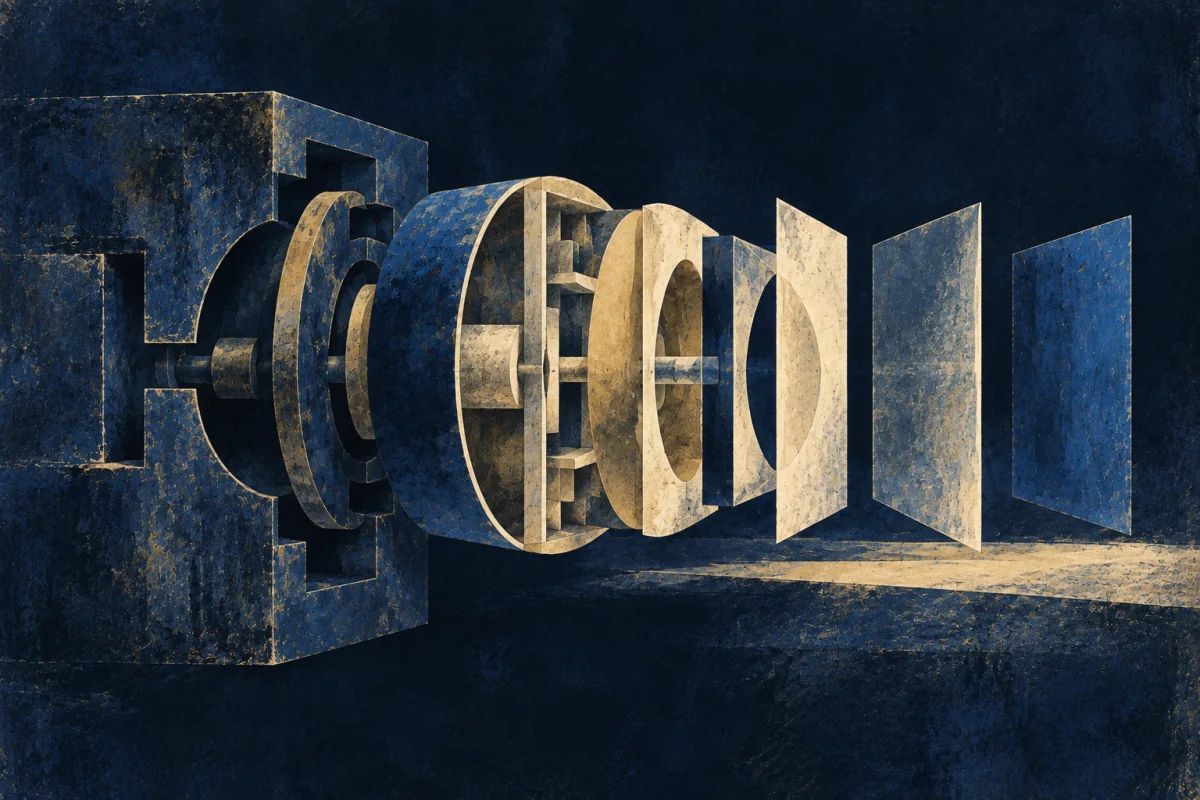
In Plain Sight
Some people make hidden structure visible by drawing it. They are not illustrating what they said. A cross-section or an exploded view carries the relationship the words could not, and the model gets turned in the air until the learner sees it. You'd notice this in the one who reaches for a napkin mid-sentence.
The Pattern at Work
The explanation of how the valve works has been given twice and the apprentice is nodding in the way people nod when they have stopped following. The third attempt is not an explanation at all. It is a drawing, made upside down so it is the right way up for the other person, showing the valve cut in half — which no photograph and no manual in the building does, because the whole difficulty is that the important part is inside and cannot be seen. Thirty seconds. He understands it, and more usefully he can now predict what happens when it fails, which no amount of telling had produced.
A patient has been told she needs a stent and has agreed to it while understanding nothing. The registrar draws two lines and a narrowing on the back of a form, and then draws the same thing with a tube in it. She asks a question she could not have formed before, which is about what happens to the bit beyond, and it is a good question.
A committee has spent forty minutes arguing about a process, with increasing heat, and has in fact been arguing about two different processes. That becomes apparent within a minute of somebody drawing the thing on a flip chart with six boxes and some arrows, at which point two people say that is not what I thought we meant, and the meeting ends early. Nothing was resolved by argument.
It was resolved by everybody looking at the same object at the same time, which had not happened at any point in the previous forty minutes.
What the Examples Show
It reads as being good at drawing, or as a visual learner teaching the way they learn.
The actual work is selection and orientation. A diagram is not a picture of a thing; it is a decision about which relationships to show and which to discard, made against what the learner is currently confused about. The valve gets cut in half because that is where the misunderstanding lives. A different confusion would produce a different drawing of the same valve.
The second element is that it is drawn in front of the person rather than produced ready-made. Watching a diagram being built shows the order things relate in, and the learner is following a construction rather than decoding a finished object. It is why the napkin beats the textbook figure, which is better in every technical respect.
And it is a shared surface. Once it is on the table, both people are looking at the same thing, which is why forty minutes of cross-purposes can end in one minute.
Going Deeper
Making structure visible is a technique with a long and slightly disreputable history, because diagrams have been treated as aids rather than as thinking.
Euclid's propositions are inseparable from their figures, and were transmitted for two thousand years with the drawings copied as carefully as the words. Leonardo's anatomical sheets invented the exploded view and the cutaway, and he was solving a teaching problem rather than an artistic one. Vesalius changed medicine partly by paying for good plates. Feynman diagrams turned an intractable calculation into something that could be drawn and then read off the drawing. Florence Nightingale used a diagram to win an argument about sanitation that tables of precisely the same numbers had already lost twice, which she understood perfectly well and designed for.
In every case the difficulty is the same, and it is about status.
The drawing is treated as illustration of the real thing, which is assumed to be the words or the equations, when it is frequently where the understanding actually happened. So the skill is undervalued, undertaught, and left out of most training entirely — doctors, engineers and teachers are rarely taught to draw, and most of them stop at about fourteen. The work is also ephemeral: the napkin gets thrown away and the whiteboard is wiped, so nothing accumulates and the same drawing is made again next year. And a diagram simplifies, which means it is always attackable by somebody who wants to point out what was left out, and what was left out is usually the point.
The Image
Drawn upside down.
The teacher draws it facing the learner, which means drawing it the wrong way round for themselves. It is awkward, and it is the difference between presenting something and handing it over.
Look for it wherever somebody explains well. The page is nearly always turned toward the other person, and almost nobody notices that this costs the explainer something.
Where It Stops
Being able to draw is not this, and neither is liking diagrams. The specific skill is choosing what to leave out for this particular confusion, which requires knowing where the person is stuck.
It goes wrong as drawing everything. Some things are sequential and a diagram of them is worse than a sentence, and a mind that reaches for the pen will produce elaborate pictures of simple processes and call it clarity.
It also fails when the diagram becomes the subject. A beautiful figure that the learner admires rather than uses has failed, and so has any model detailed enough to need explaining itself.
Take the plainer explanation first. Any engineer or anatomist sketches, because the field is full of sections and exploded views. The test is whether it happens outside the subject — on a napkin, about a family arrangement, a football tactic, how a dispute actually works.
Where It Pays
Inside a job. Technical and medical teaching, engineering and architectural communication, technical illustration, instructional design, consultancy of the useful kind, and any role explaining a system to people who have to act on it. Also facilitation, where a drawn model settles arguments that are really about definitions, and clinical consent, where the standard is whether somebody actually understood.
What is being bought is speed of comprehension and, more valuable, the ability to reason forward. A person who has been told how something works can repeat it; a person who has seen the structure can predict what happens when it breaks, which is the entire difference between trained and competent.
Where it pays badly is in work that is genuinely sequential, in organisations where the slide deck is itself the deliverable, and anywhere the visual work is handed to a design team after the thinking is finished, which produces something handsome and removes the entire mechanism.
Outside one. Explaining anything to anybody: a family decision, a repair, a form, a diagnosis somebody has been given and not understood. The cost worth naming is that the drawing gets thrown away, so the same explanation is rebuilt from nothing every time and none of it ever accumulates into anything anybody can be shown.
Try This
Take something you understand and somebody near you does not — how a mortgage works, why the boiler does that, a process at work.
Do not explain it. Draw it, on paper, facing them, while they watch. Use at most six elements and leave out everything you are tempted to add.
Then hand them the pen and ask them to add one thing.
What they add, or cannot, is the diagnosis. It is usually the part you thought was obvious, and you will not find it any other way.
Drawn upside down is a tool, not a self. Pick it up where relationships matter more than sequence. Put it down where the answer is a fact, because there a picture is only decoration.
If This Isn't You
Most people explain in words, are understood well enough, and get on with the job, which is how the majority of knowledge has always moved. Feeling no urge to reach for a napkin is an answer, not a limitation.
Where To Go Next
Its near-twin — Map Translator. Both flatten something complicated so another person can use it. Map Translator is working on ground and making something to be carried away. This one is working on structure and making something that exists for ninety seconds on a napkin.
Its shadow — Picture-Teacher. Picture-Teacher is trying to change how somebody sees the world in front of them. This one is drawing what cannot be seen at all, and would happily draw it badly.
Most often confused with — Route-Changer. Both find where a learner stopped following. Route-Changer rebuilds the path in language and will go back two years to do it. This one stays on the spot and changes the medium instead.