In Plain Sight
Some teachers hand down how to see before how to draw. They are not giving a lecture on technique. A single mark is made in the corner of the student's page, and the student works out what it meant. You'd notice this in the one who stands beside a young hand and adjusts the grip without saying anything.
The Pattern at Work
The drawing of the chair is wrong and the student cannot see where. The teacher does not say that the perspective is off, or explain vanishing points, or take the pencil. She makes one short line in the margin, at the angle the front edge of the seat actually goes, and moves on to somebody else. The student looks at the line, looks at the chair, looks at the drawing, and in about ninety seconds finds it herself. That ninety seconds is the lesson. Told the answer, she would have corrected this chair. Having found it, she has acquired the habit of checking an angle against the world rather than against what she assumed.
An adult class is drawing hands and everybody is producing the same five-sausage hand they drew at nine, because they are drawing the idea of a hand. The instruction is not about anatomy. They are asked to draw only the shapes of the gaps between the fingers, and not the fingers at all. The hands that come out are unmistakably real, and nobody has been taught anything about hands.
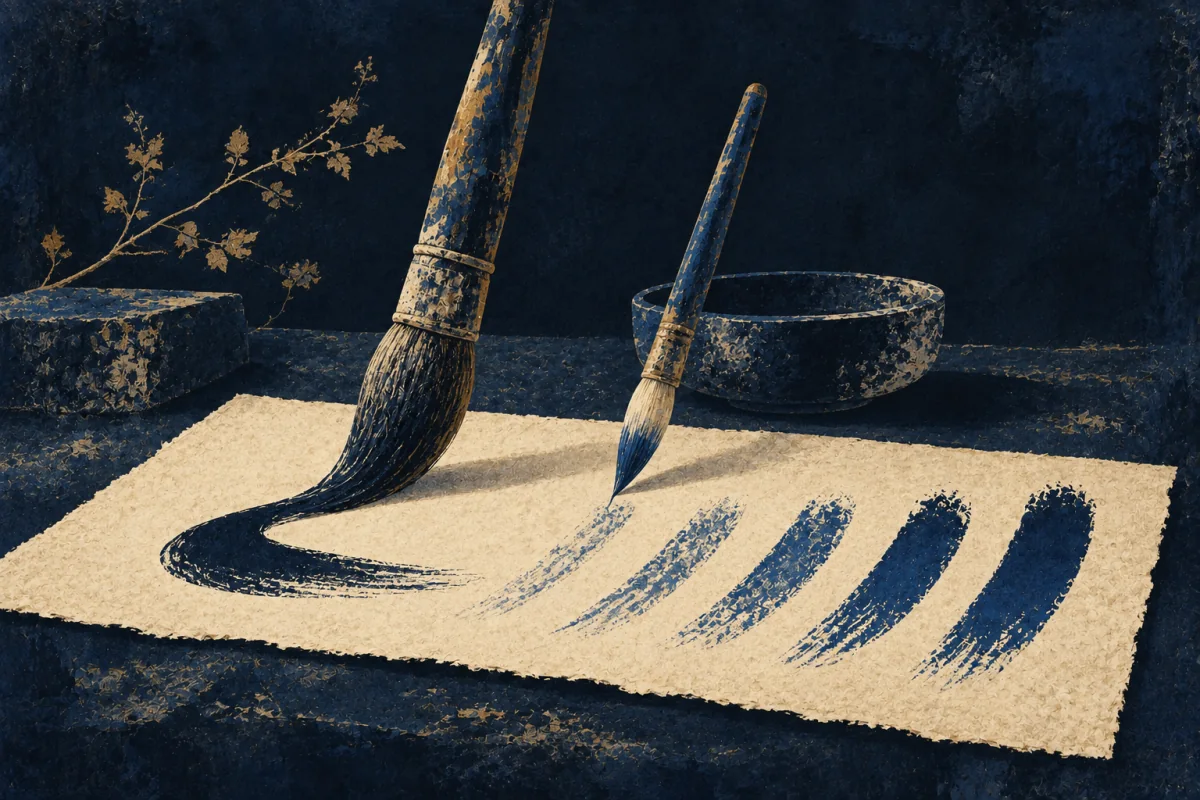
A child is holding the brush like a pencil, rigidly, high up near the ferrule, and every mark comes out cramped and hesitant. The teacher moves two fingers and slides the hand an inch further down the shaft, in passing, on the way to somebody else. Nothing is said about it, then or afterwards. The marks loosen within a minute, the child's next painting is noticeably freer, and she never knows that anything was done to her at all, which is the intention.
What the Examples Show
It gets read as artistic talent passed on, or as a good eye, or as somebody patient with beginners.
What is actually being taught is not drawing. It is a way of looking that overrides a default: the mind supplies what it knows is there — a chair has four legs, fingers are sausages — and the hand draws the knowledge rather than the sight. Every exercise in this tradition is a device for interrupting that, and the gaps between the fingers is a device, not a technique.
The correction is delivered as a mark because a mark is in the same language as the work. A sentence has to be translated into seeing and then into hand, and both translations lose something. A line in the margin arrives already in the right form.
And the grip is adjusted rather than described. The physical half of this is taught by contact, silently, because a description of how to hold a brush produces a student thinking about their hand.
Going Deeper
Teaching eye and hand together is one of the oldest apprenticeships and it has always been done by proximity rather than by explanation.
Renaissance bottegas had apprentices grinding pigment and copying the master's drawings for years before touching a commission. Chinese ink painting is taught by copying a teacher's strokes thousands of times, on the understanding that the discipline enters through the wrist. Academy training in Europe ran on the same principle with plaster casts, and required years of them before a student was allowed near a living model or a colour. Kimon Nicolaides and Betty Edwards both, in different centuries, built famous teaching on interrupting the knowing mind rather than instructing the hand.
What all of them run into is that the results cannot be produced quickly.
Seeing changes slowly and invisibly, over months, and there is nothing to show a parent, a funder or an inspector at week three. The method also looks like neglect. A teacher who makes one mark and walks away is not obviously teaching, and students who came expecting to be told what to do experience the first weeks as being ignored by somebody who does not think they are worth the time. It requires the same teacher and student over a long period, which most provision no longer offers. And the whole discipline is now optional almost everywhere in general education, so the people who hold it are increasingly teaching evening classes to adults trying to undo what was installed at nine and has had thirty years to set.
The Image
The line in the margin.
Not a correction and not an instruction. One mark, in the student's own language, placed where it can be compared with what they drew.
The ninety seconds the student spends working out what it means is the entire lesson. Anything said aloud in that gap replaces a change in how they see with a fact they will have forgotten by the following week.
Where It Stops
Being a good artist is not this. Plenty of fine draughtsmen cannot teach, because they can no longer remember not being able to see, and what they transmit is intimidation.
It goes wrong as never explaining. Some students genuinely need the vanishing point named, and a teacher committed to silence on principle leaves them guessing for a term at something a sentence would have settled.
It also fails where the student wants an outcome rather than a discipline. Somebody who wants a decent picture of their dog by Christmas is not served by three months of unlearning, and both parties end up frustrated.
Take the plainer explanation first. Any art teacher corrects by drawing because that is how they were taught. The test is whether it happens outside a classroom — beside a child, on a beach, on somebody else's sketch, without a word.
Where It Pays
Inside a job. Art and design teaching at every level, illustration and animation training, craft and workshop instruction, technical and medical illustration, and the apprenticeship end of any trade where the eye has to be trained before the hand is useful. Also therapeutic and community art, where the unlearning matters more than the output.
What is being bought is a permanent change in perception rather than a set of techniques. Techniques can be looked up and are worth very little; a person who has stopped drawing what they know is a person who will keep improving for forty years without further teaching. That is why this training shows nothing at week three and everything at year three. Where it pays badly is anywhere results are required in weeks, anywhere classes are large and one-off, and in any system that asks for learning to be evidenced in writing at the point of delivery, since the whole method is one mark and a silence.
Outside one. Children, evening classes, a friend who says they cannot draw. The cost worth naming is that this pattern sees badly taught drawing everywhere and can do very little about it, and that the people who most want help usually want to be told how, which is the one thing that will not work.
Try This
Draw something in front of you for ten minutes — a shoe, a hand, a mug.
Then draw it again, but only the negative shapes: the spaces around it and between its parts. Do not draw the object at all.
Most people find the second drawing is better, and are annoyed by this, because they did not learn anything about shoes.
That annoyance is the lesson. The first drawing came from what you know. The second came from what is there.
The line in the margin is a tool, not a self. Pick it up where somebody is drawing what they know instead of what they see. Put it down where they want a picture finished by Friday.
If This Isn't You
Most people who say they cannot draw are right, have made peace with it, and lose nothing whatever by it. Feeling no urge to correct somebody else's perspective is an answer, not an indifference.
Where To Go Next
Its near-twin — Practice Teacher. Both correct sparingly and then say nothing. Practice Teacher is building a physical habit through repetition over a fortnight. This one is trying to change what a person perceives, which happens in ninety seconds or not at all.
Its shadow — Showmaster-Teacher. Showmaster-Teacher works thirty people at once with timing and a reveal. This one works beside one person's page and would find a demonstration a distraction from looking.
Most often confused with — Body-Translator. Both teach by touch and silence. Body-Translator's hand changes a movement in seconds. This one adjusts a grip in passing and is really after the eye, with the hand as a secondary problem.