In Plain Sight
Some makers build the object that eases one body. They are not producing a standard item. A crutch is cut to a particular shoulder and a foot is weighted just so, and the thing is fitted to the person rather than the other way round. You'd notice this in the one whose workshop quietly supplies half the town.
The Pattern at Work
The crutch from the hospital is the right height and is rubbing a nerve, because it was designed for a shoulder at ninety degrees and this man's right shoulder has not been at ninety degrees since 1998. What the maker does is not adjust it. He makes one, in wood, with the top shaped to the shape the shoulder actually is, which takes three evenings and involves the man coming round twice to lean on it while it is still rough. It is heavier than the aluminium one and slightly ugly. He uses it for eleven years, and the nerve pain stops within a fortnight, and at no point does anybody in the health service learn that this happened.
A child with one hand wants to play the recorder and has been offered a tin whistle and sympathy. The thing that gets made is a lever arrangement, clamped and reclamped over five visits, which is not good engineering and is in the right place — because it was fitted while she played rather than designed while she was absent, and the sixth version is the one that lets her into the school band.
A prosthetic foot is weighted deliberately heavier than the specification because the man walks on a hill farm and a light foot swings wrong on a slope. A bird is carved for somebody who is dying, to be held rather than looked at, and the only part that has been worked carefully is the underside, where a thumb rests.
Everything about that object is a decision made after watching how a weak hand actually holds something, which is not how a strong one does.
What the Examples Show
It gets read as kindness with a workshop attached, or as a hobbyist making gadgets, and both miss the technical claim being made.
The claim is that standard equipment is designed against a population and every actual person is a departure from it. A shoulder that was broken, a gait altered by a hill, a hand that is not there: those are not edge cases, they are most people, and the difference between an aid that is used and one that sits in a cupboard is almost always a detail that was not in the specification.
Getting at that detail requires the person present while the thing is being made. Five visits, six versions, adjustments made with the object in use. That is a different process from taking measurements and delivering, and it is why this work cannot be done at a distance or at volume.
And the standard is use rather than appearance. Heavier, uglier, odd-looking: all acceptable. Unused is the only failure.
Going Deeper
Making things to ease bodies is old work and it has mostly happened outside medicine, in workshops, unrecorded.
Village carpenters and smiths made crutches, callipers, back braces and wheeled chairs to order for centuries, and almost none of it survives because it was used until it broke. Ambroise Pare, a barber-surgeon rather than a physician, designed prostheses by working directly with the people who would wear them. The great period of limb-making after each of the world wars was driven by workshops fitting and refitting rather than by any theory. Every hospital has somewhere in its history a technician who made the thing that worked, for years, and was never named in any paper, any budget line or any account of the service. The knowledge went when they retired and the service did not notice for about a decade.
What that position costs has not changed either.
The work sits outside the regulated world, which means it carries real liability and no protection, and a maker doing it properly spends a good deal of energy on the question of when to stop and refer. It does not scale: each object is a fitting process, so nothing can be repeated or sold on. It is also systematically invisible to the systems that provide equipment, which supply the standard item, record it as provided, and never learn that it is in a cupboard. And the emotional weight is heavy — a great deal of this is made for people who are declining, and the objects come back.
The Image
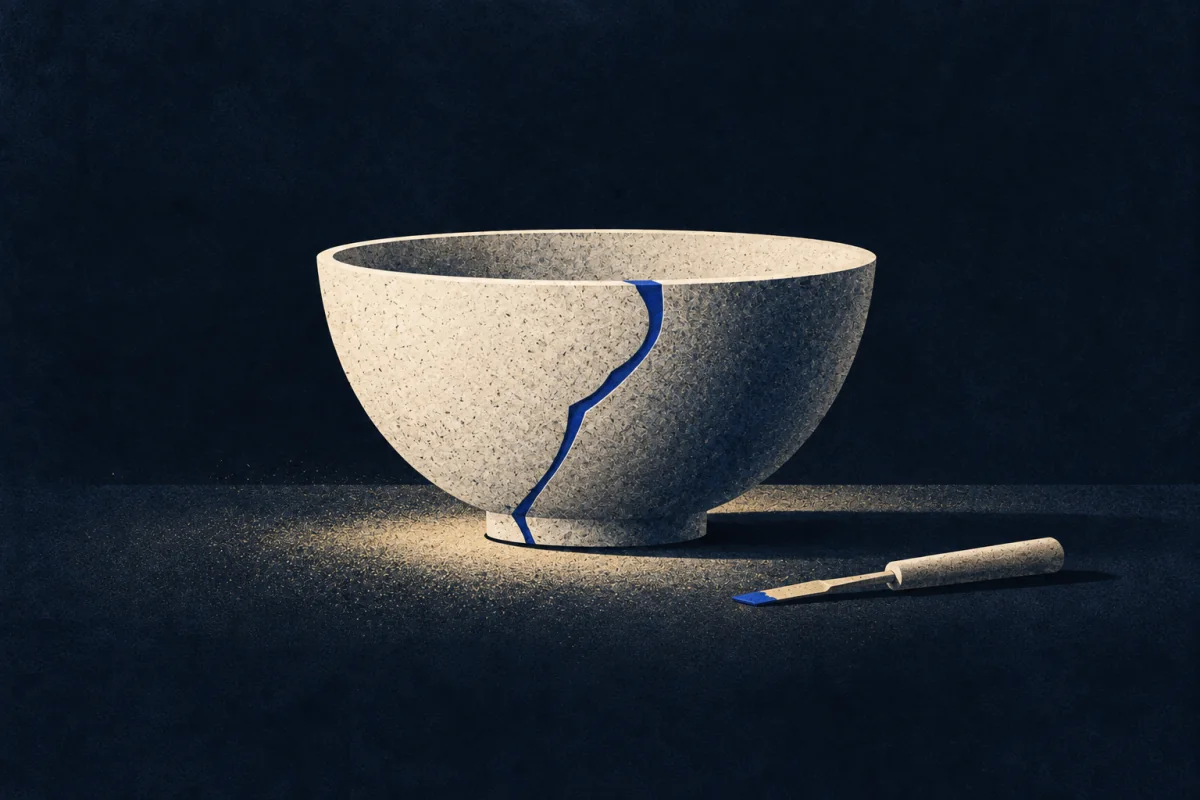
Fitted while in use.
Not measured and delivered. Made roughly, leaned on, walked with, played, and then changed — five times if necessary, with the person present and the thing still unfinished.
Anything meant to help a body has to be shaped against that body doing the actual thing. Almost nothing is, which is why so much of it ends up unused.
Where It Stops
Being handy is not this, and neither is wanting to help. The combination is specific, and the useful half is the willingness to make a sixth version.
It goes wrong as replacing proper assessment. Some problems are clinical rather than mechanical, and an ingenious object can delay a diagnosis or brace a limb that needed something else entirely. The good makers are the ones most willing to say this is beyond me.
It also fails at volume or at a distance. Asked to produce twenty of something, or to work from measurements posted to them, this pattern produces an adequate standard item, which is what already exists.
Take the plainer explanation first. Any workshop trade will make an aid for a relative sooner or later. The test is the fitting: whether the person came back five times, and whether the version that got used was the sixth.
Where It Pays
Inside a job. Prosthetics and orthotics, rehabilitation engineering, assistive technology, occupational therapy workshops, seating and mobility services, and the technical side of hospice and palliative care. Also adaptive sport equipment, instrument adaptation, and the bespoke end of furniture and joinery where the client's body is the specification.
What is being supplied is compliance in the real sense: equipment that people actually use. Provision systems measure what was issued, and the gap between issued and used is enormous and almost entirely invisible. One maker who fits in use closes it for the people they reach, at a cost of hours nobody has funded, and removes a class of problem that would otherwise generate falls, pain and readmissions.
Where it pays badly is anywhere the item must be catalogued and standardised before it can be supplied, anywhere assessment and manufacture are separated between two professions who meet in writing, and in any service measured by throughput rather than by whether the thing is still in use a year on. Outside one. Family, neighbours, a club, a child who has been told a thing is not possible. The cost worth naming is that the requests are unending once known about, arrive with real distress attached, and cannot honestly be charged for.
Try This
Find something a person near you uses to manage a physical difficulty — a stick, a jar opener, a chair, a rail.
Watch them use it. Not once: three times, on an ordinary day, without commenting.
Find the one moment where the object makes them adapt rather than the other way round — a wrist turned, a reach, a pause before standing.
Then change one thing about the object, roughly, and watch again. Rough is correct at this stage. Finished things cannot be tested.
Fitted while in use is a tool, not a self. Pick it up where a standard object is making somebody work around it. Put it down where the problem is medical and somebody needs a clinician rather than a workshop.
If This Isn't You
Most people use what they are given, adapt to it, and get on, which is what the equipment is for and what it mostly achieves. Feeling no urge to make a sixth version is an answer, not an indifference.
Where To Go Next
Its near-twin — Fit Shaper. Both make for one particular body and both remake rather than adjust. Fit Shaper is answering to how a body looks and moves in cloth. This one is answering to pain and function, and will accept any amount of ugliness.
Its shadow — Tool and Toy Crafter. Tool and Toy Crafter iterates against a mechanism and can fail cheaply at the bench alone. This one cannot iterate without the person present, because the person is the specification.
Most often confused with — Healing Image Maker. Both make one object for one suffering person. Healing Image Maker makes something to be held and looked at, aimed at what words cannot reach. This one makes something to be used, and judges it entirely by whether it is.