In Plain Sight
Some people make a picture for one person who is ill or grieving. They are not producing art for a wall. Line and colour are worked slowly toward something a particular person can hold when words have stopped helping. You'd notice this in the one who paints a small panel for a bedside and gives it away without signing it.
The Pattern at Work
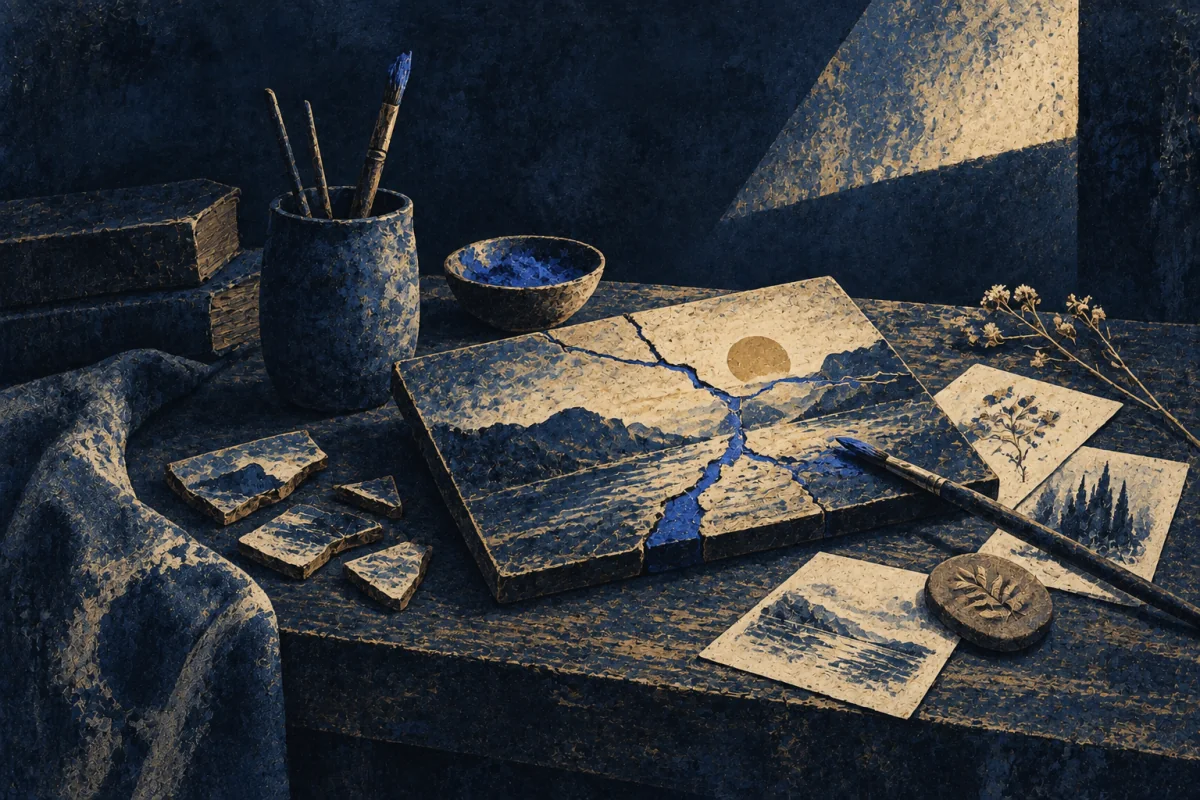
The panel is about the size of a hand and it takes four weeks. It is for a woman who is dying and who mentioned, once, a particular hillside. What gets painted is not the hillside — a photograph would do that better and she has one. What gets painted is the hillside at the hour she described, with the weather she described, and with the part she did not mention left out. It goes on the table by the bed and she looks at it, her daughter later says, more than she looks at any of the photographs, and nobody in that room could explain why.
A child in hospital for a long stay is drawn, by somebody who comes on Thursdays, as herself doing something she cannot currently do. Not as a fantasy and not as a cartoon: carefully, at her actual age, with her actual face, running. It is on the wall by her bed for eleven weeks. What it is doing is holding a version of her that the ward does not see and she is in danger of losing.
A man who has lost his wife is given a small ink drawing of their kitchen table with two cups on it, by a friend who sat at it for years. He cannot look at it for two months. Then he can, and it is the first thing that has helped.
The maker of any of these is not trying to be understood by anybody else. The audience is one person and there is no second showing.
What the Examples Show
It gets read as a kind gesture, or as a hobby put to good use, or as art therapy, which is a different practice with a different aim.
What is running is a translation. Something has happened that the person cannot take in through language — they have heard the words, they can repeat the diagnosis — and an image does not go through the same door. It arrives whole, it can be looked at without being agreed with, and it can be put down and picked up again on a day when a conversation would be impossible.
The choices are all made for one viewer, and what gets left out matters more than what goes in. Those decisions can only be made by somebody who has listened closely and is willing to be wrong in private.
And it is slow, hand-made, and given away. The slowness is not inefficiency. Something made over four weeks for one person carries evidence of that, and the evidence is part of what is received.
Going Deeper
Making images for the sick and the grieving is one of the oldest uses of image-making, and it has almost always been done by people who were not called artists.
Ex-voto panels were painted across Catholic Europe and Latin America by ordinary hands and hung in thousands where somebody had recovered or had not. Russian and Greek icon painting was disciplined, repetitive and intended for a person in front of it rather than for a viewer looking at it. Japanese ema tablets carry a wish and are left. Retablo painters in Mexico worked to commission for specific events in specific lives. Mourning miniatures in the nineteenth century, often worked in hair, were made small enough to be carried in a pocket for the rest of a life.
None of that belongs to the history of art as it is usually told, and the omission says something about the bargain.
The work is unsigned, unsold and unseen by anybody but its recipient, so it accumulates into no body of work and no reputation. It is also made at the worst moments of other people's lives, which means the maker spends a great deal of time close to illness and death by choice, and carries what they learn there alone. The result cannot be judged: nobody can say whether it helped, including the person who received it, and asking would spoil it. And there is a particular exposure in it — the image is a guess about what one person needs, offered without being requested, and it can be quietly wrong.
The Image
The thing on the bedside table.
Small enough to be within reach. Made for one person, by a hand they know. Looked at at four in the morning, when there is nobody to talk to and nothing to be done.
Almost everything made to be seen is made for a room of strangers. This is the other kind, and there is far less of it than there should be.
Where It Stops
Being artistic is not this, and neither is being kind. The combination is specific: it needs somebody who can make a real image and who is willing to aim it at one person and then let it go.
It goes wrong as making what the maker needs. Grief and helplessness both want an outlet, and an image made to discharge the maker's feeling arrives as a demand rather than a gift, which the recipient will feel and will not say.
It also fails where practical help is what is wanted. Somebody without food in the house, or without a lift to the hospital, has a problem that a painting does not address, and the painting can become a way of doing the comfortable part.
Take the plainer explanation first. Anyone who draws will sooner or later draw something for somebody who is ill. The test is whether it was built for that person specifically — whether things were left out because of who they are.
Where It Pays
Inside a job. Arts in health and hospital arts programmes, hospice and palliative settings, bereavement services, chaplaincy, children's wards, memorial and commemorative commissions, and the making of objects for ritual use. Also illustration for health information, where the aim is that a frightened person can take something in.
What is being supplied is a route in when the usual one is shut. A great deal of care runs entirely on talking, and there is a large group of people — children, the very ill, the newly bereaved, anybody exhausted — for whom talking has stopped working. An image reaches them, costs them nothing to receive, and stays in the room after everybody has gone home.
It pays badly wherever outcomes must be evidenced, badly at volume, and badly in any arrangement that requires the work to be exhibited or explained, both of which turn a private object into a public one and empty it.
Outside one. Family, neighbours, a friend in a bad year. The cost worth naming is proximity. Doing this means being near a great deal of illness and grief, repeatedly and by choice, and receiving nothing back that could be described as a result. There is no way to know whether any of it worked, and the one question that would settle it is the one question that must not be asked.
Try This
Think of somebody having a hard time, and do not make them anything yet.
First, write down three things they have mentioned in passing that were not about the difficulty — a place, a habit, a small pleasure. Those are the material.
Then make one small thing, by hand, slowly, using one of the three. It does not have to be good. It has to be specific and unmistakably made rather than bought.
Give it without explaining it, and do not ask about it afterwards. Both of those are harder than the making.
The thing on the bedside table is a tool, not a self. Pick it up where words have stopped getting through. Put it down where somebody needs a lift to the hospital, and give them the lift.
If This Isn't You
Most people send the card, say the true thing plainly, and turn up with food, which is what nearly everybody in trouble actually wants. Feeling no urge to make something by hand is an answer, not a coldness.
Where To Go Next
Its near-twin — Symbol Maker. Both reduce an image to what cannot be removed. Symbol Maker is making something that will work for anybody who sees it, for a long time. This one is making something for one person and would not expect it to work for anybody else.
Its shadow — Image-Maker. Image-Maker makes work to be looked at, exhibited and judged. This one gives it away unsigned and would find a room full of these deeply uncomfortable.
Most often confused with — Grief-Holder. Both stay near what cannot be fixed. Grief-Holder offers presence and nothing else, and would say that an object is beside the point. This one leaves something behind that is still there when everybody has gone.