In Plain Sight
Some people lead a craft from inside it. Hands still on the work, and the voice still trusted because the work still gets made. They speak for the trade because the trade has been earned, handling apprentices, suppliers and the outside world without ever leaving the bench. You'd notice this in the one whose shop is where younger makers come for the unwritten rules.
The Pattern at Work
Speaking for a trade only works while the speaking is done by somebody who is still in it. A supplier pushing an inferior material gets an answer from somebody who used it last week and can say precisely how it failed. A client asking for an impossible deadline gets a number from somebody who is making the thing. A regulator or an association hearing from this person is hearing from the floor rather than from a representative, and everybody in the room knows the difference.
Inside the trade the role is about transmitting what is not written down. Not technique, which gets taught anyway, but the conventions: what one maker does not do to another, what the work is charged at, what is owed to an apprentice, which corners are acceptable and which are theft. These are real rules and they exist nowhere except in the practice of the people who keep them, and a young maker learns them by being in a shop where somebody does.
The mediating is constant and unpaid. Standing between an apprentice and a customer, between a supplier and a small workshop that cannot absorb a price rise, between the trade and whoever has decided to regulate it. Somebody doing this is protecting a group of people who have no other representation, and is usually doing it in the evening, after a full day, for nothing.
And the making never stops, because it cannot. The moment the work goes, so does the standing, and everybody notices within about a year.
What the Examples Show
It reads as being a respected old hand, or as natural leadership, or as somebody with strong opinions about their trade.
The first element is that authority is continuously earned rather than granted. It comes from current work, it is checked constantly by other makers, and it expires quickly when the making stops.
The second is that what is being passed on is convention rather than technique. The unwritten rules of a trade are its real structure, and they survive only through people who both keep them and are visible keeping them.
The third is that the role is representative without being formal. Nobody elected this person, they hold no office, and they speak for a trade because the trade lets them, which is a fragile and entirely real form of authority.
Going Deeper
Trades have always produced leaders from inside the work, and the formal structures that replaced them have never quite done the same job.
Guild masters were working craftsmen before they were officials, and the authority ran from the bench upwards. Japanese craft houses kept the head of a line actively making, on the understanding that a head who stopped was no longer qualified to judge. Trade unions in their early form drew their strength from people still on the tools, and the shop steward remains the clearest surviving version. Small-scale trades everywhere — boatbuilding, instrument making, stonework — still organise around a handful of people whose standing is entirely informal. In none of these cases did the authority come from a title. Where a title existed at all, it was awarded afterwards to somebody the trade had already decided to listen to.
The costs are consistent wherever this appears. The work is done on top of a full working life, unpaid, in the evenings, and it comes out of the person's own making time. The position cannot be handed on, because it is not a post, so when somebody stops the trade loses its representation until another one emerges, which can take years. It produces conflict with the organisations that claim to speak for the trade formally and do not know it. And it carries an unfair exposure: this person is blamed by suppliers, by clients and by other makers for positions they took on behalf of people who were not in the room.
The Image
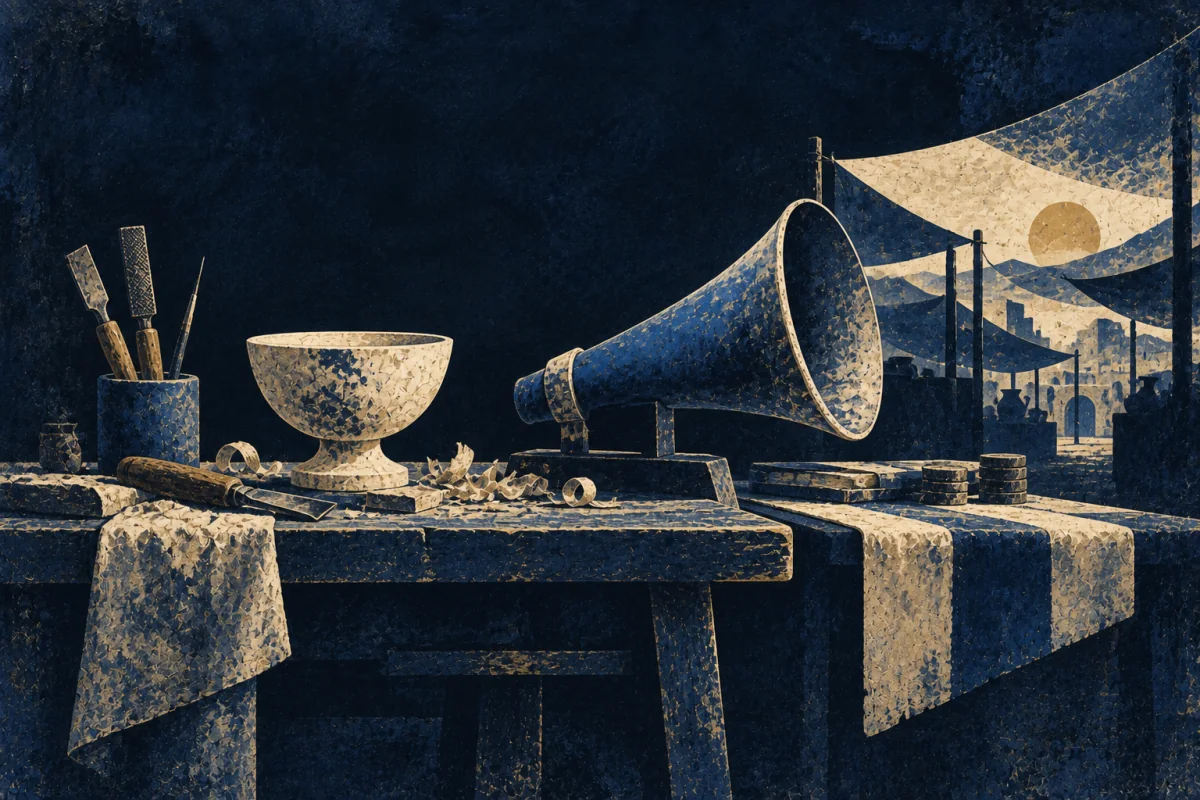
Still making.
The person speaking for the trade, with work on the bench behind them, half finished.
That unfinished work is the credential. Nothing else about the position is documented, nobody appointed them, and the whole of their authority rests on the fact that everybody present knows they will go back to it when the conversation ends. Take the bench away and the same sentences, said by the same person, stop carrying anything at all.
Where It Stops
Being good at the work is not this, and neither is being senior. Plenty of excellent makers speak for nobody, and the role requires a willingness to carry other people's problems.
It goes wrong as a personal fiefdom. Informal authority has no checks on it, and a trade can end up shaped around one person's preferences, with makers who disagree quietly frozen out and no process to appeal to.
It also fails at scale. This works in a trade small enough for everybody to know everybody, and beyond a few hundred people it needs a structure, which is exactly the thing this form of authority is worst at building.
Take the plainer explanation first. Anybody senior in a small trade gets asked things, because there is nobody else. The test is whether they keep making when they could stop, and whether they would give up the role before giving up the bench.
Where It Pays
Inside a job. Master craft roles across building, boatbuilding, instrument making, furniture, metalwork and restoration, lead technician and working foreman positions, chef-patron and head chef roles, union shop stewarding, and standards and apprenticeship bodies that recruit from practice. Also anywhere a client needs to hear a judgement from somebody who will be doing the work rather than selling it.
What is being bought is trusted judgement with nothing between it and the material. Organisations pay a great deal for consultancy and get advice from people who last did the work a decade ago; this is the same advice from somebody whose hands are still in it, which is both scarcer and more accurate.
Where it pays badly is in the role itself, which is almost never funded. Representation, mentoring and mediation are done in a maker's own time, and the usual reward for being good at it is more of it. It pays badly wherever promotion means leaving the bench, which removes the thing that made the person worth promoting.
Outside one. Trade associations, community workshops, clubs and the informal networks that hold small trades together. The cost worth naming is that the making time goes: somebody doing this is producing less work than they should be, and the trade benefits while their own practice quietly suffers.
Try This
If you have any practical skill, try holding the representative half of it once.
Find one thing in your trade or hobby that is genuinely conventional rather than technical — what people do not do to each other, what is fair, what is expected of a beginner — and write it down in a sentence.
Then say it out loud to somebody newer, once, at the moment it is relevant. Not as a lecture. As an aside, while working.
Notice whether it lands differently coming from somebody who is doing the thing at that moment.
Speaking from the bench is a tool, not a self. Pick it up where a group of practitioners has nobody to speak for them. Put it down if you stop making, because the authority was never yours; it belonged to the work.
If This Isn't You
Plenty of makers want to make, are happy for somebody else to sit on the committee, and produce better work for it. Not wanting to speak for the trade is an answer, not a disengagement.
Where To Go Next
Its near-twin — Workshop Steadier. Both keep a craft community functioning. Workshop Steadier runs the house — stock, orders, apprentices, standards — and often gives up their own bench to do it. This one refuses to give up the bench, because that is where the standing comes from.
Its shadow — Tongue-Of-The-Court. Tongue-Of-The-Court speaks with borrowed authority for somebody else's decisions. This one speaks only with what they have earned personally, and would rather say nothing than represent a position they cannot stand behind.
Most often confused with — Craft-Passer. Both hand on a trade. Craft-Passer is teaching the skill itself, hands to hands. This one is teaching what surrounds the skill, and much of the work is aimed outward at suppliers, clients and the world.