In Plain Sight
Put this person on ground with nothing on it, and they start with what must exist by winter. They are not chasing the adventure of it. Water, shelter, food and a way out get built as one thing, in the order the place allows. You'd recognize this in the neighbour who arrived to bare land and had a working place a year later.
The Pattern at Work
Two people buy eleven acres of rough grazing with a ruined shed on it and no services. Everyone who visits asks where the house will go. For the first eight months no house goes anywhere. The order is water, then a dry store, then a track that will take a delivery lorry in February, then fencing, then somewhere to sleep that is not good but is warm. The house happens in year three. Visitors in year one think nothing is being achieved, and the thing actually being built in year one is the set of conditions under which a house can be built at all — because a house on a site with no water, no access and no dry store is a house that takes five years and ruins whoever attempts it.
The sequence is the work. Anyone can list what a place needs; the difficulty is that the list has an order, the order is set by the ground and the season, and getting it wrong is not a delay but a loss.
A field camp goes up after a flood, for maybe four hundred people, on a site chosen in an afternoon. The person running it spends the first hour not on tents but on where the water will come from, where the latrines can go so that they are downhill of it and far enough from the kitchen, and where the vehicles will turn round when the ground softens. Those four decisions are effectively irreversible; everything else can be moved next week. The camp that gets built looks improvised and works for eight months.
What the Examples Show
It gets read as toughness, or self-sufficiency, or a taste for hardship. Some of that is present and none of it is the engine.
What is running is a sequencing judgement made against a place that has not been lived in yet. The knowledge required is not how to build — plenty of people can build — but which thing has to exist before which other thing can be attempted here, on this ground, with this weather coming.
That judgement is read off the place rather than brought to it. Where the water sits in August, which way the wind comes in January, how the track behaves when it rains, what grows. A person doing this spends a suspicious amount of the first month apparently doing nothing but walking about.
And it is all one project. Shelter, water, food and a way out are not four tasks but one arrangement, and a decision about any of them moves the other three.
Going Deeper
Settling new ground is one of the oldest things people do and it has a consistent failure mode: the settlement that builds the wrong thing first.
Polynesian voyaging canoes carried breadfruit, pigs and taro because arriving was the easy half. The Icelandic landnám divided ground by what could be wintered rather than by what looked best in summer. Antarctic bases are assembled in an order dictated entirely by the season and the last resupply, and the base that gets its fuel store wrong in February has no second chance. Modern camp engineering standards exist because the same four decisions kept being made badly under pressure, with the latrines uphill of the water, and the standards are written the way they are so that a tired person at dusk gets the order right without having to reason it out.
Every one of those is the same discipline, and it costs the same thing everywhere: it is done in advance of any visible result, in a period when there is nothing to show and everyone is asking.
Bare ground is judged by what stands on it, so the person doing the ordering looks idle for exactly as long as the ordering takes. The work is also physically hard, solitary, and largely unsharable — the reasoning is about a place that only one person has walked enough to know. And it does not end when the place works, because a working place is fully occupied ground, which means the pattern that built it has nothing left to do and quite often starts looking at another piece of land while everybody else is settling in.
The Image
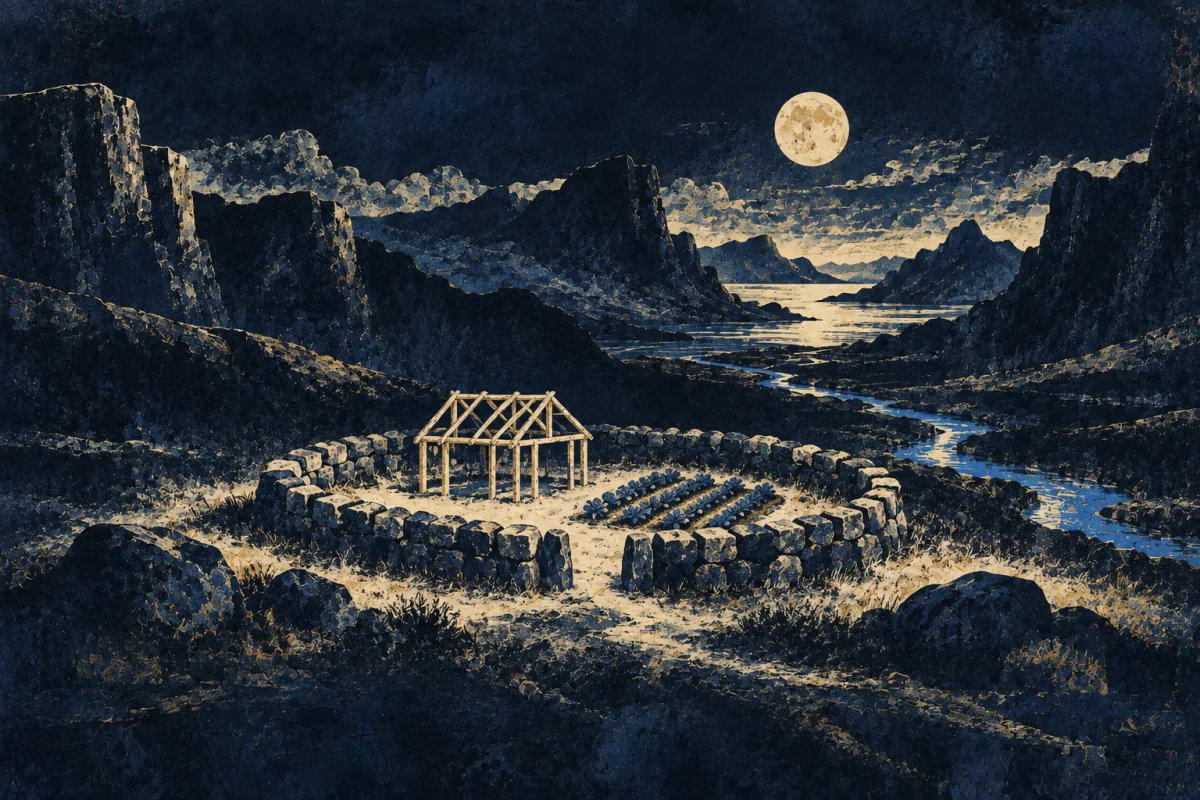
Water first.
Not because water is the most urgent thing on any given day, but because every other decision on a new site is made differently once it is known where the water is and what it costs to get it.
Every new undertaking has its water. It is rarely the thing anybody is excited about, and nothing sound gets built before it.
Where It Stops
Liking the outdoors is not this, and neither is a taste for roughing it. Plenty of people are entirely happy in a tent for a fortnight and would not know where to begin with a year.
It goes wrong as never inhabiting anything. The skill is in the founding, and once a place works the interest drains out of it, so the same person can spend a life starting places and living in none of them.
It also fails on ground that is already organised. Put this pattern on an established site with services, permissions and neighbours, and the sequencing instinct has nothing to grip; what comes out instead is impatience with arrangements that were settled for reasons nobody bothered to record.
Take the plainer explanation first. Anyone with military, expedition or humanitarian logistics training sequences a site because that is the training. The test is whether it appears untrained — on a smallholding, a boat, an allotment, a house with nothing connected.
Where It Pays
Inside a job. Humanitarian and disaster logistics, remote construction and mining camps, expedition and research station support, land development, smallholding and regenerative farming from a standing start, and the early phase of anything built where nothing is yet built.
The contribution is ordering, and it is worth more than it looks. Most new sites fail slowly rather than dramatically: the access road that was never properly made, the water that is a hundred metres further than anyone budgeted, the store that stays temporary for nine years. Every one of those is a first-month decision, and the difference between a site that works and one that is permanently half-finished was made before anything was visible.
It pays badly on mature sites, badly in institutional settings where the sequence is set by a funding calendar rather than by the ground, and badly wherever a visible result is required in the first quarter.
Outside one. Land, boats, sheds, long expeditions, a derelict house. The cost worth naming is the year of looking like nothing is happening, which is hard on whoever else is living through it, and harder because the explanation does not convince anybody until the second winter proves it.
Try This
Take something you are starting from nothing — a garden bed, a workshop, a room being converted, a new stretch of work.
Before doing anything, write down every part of the finished thing. Then do the harder half: put them in the order in which they have to exist, and mark the two that cannot be undone once done.
Start with one of those two. Not the exciting one, and not the one that would show.
Then leave the rest for a month while you find out what the place does in weather you have not seen yet.
Water first is a tool, not a self. Pick it up where the ground is genuinely new. Put it down where a place is already working, because there the sequence was settled long ago by people who had reasons.
If This Isn't You
Most people move into somewhere that already works and improve it from there, which is how nearly everybody lives and is a great deal less cold. Feeling no pull toward empty ground is an answer, not a softness.
Where To Go Next
Its near-twin — Settlement-Planner. Both work out how a place should be laid out. Settlement-Planner is arranging ground for other people to live on and thinks in streets and neighbours. This one is arranging ground it will be standing on this winter, and thinks in water and weather.
Its shadow — Map-Edge Walker. Map-Edge Walker goes past the known and comes back. This one goes past the known and stays, which is a different appetite entirely and rules out most of what the other one does.
Most often confused with — Under-Load Builder. Both build things that must hold. Under-Load Builder answers to the object and its stresses. This one answers to the site and the season, and will accept a crude building that exists by October over a good one that does not.