In Plain Sight
Here, the pattern is finding fair trades that leave both sides willing to meet again. They are not just trying to win the moment; they protect the next trade by making the present one feel clean. You'd find this in the cousin who writes two names on a fridge note before pairing a spare drill with needed childcare, then texts both people after.
The Pattern at Work
A builder is pricing a small job for someone he has worked for twice before. The job is awkward, the access is bad, and he could reasonably add forty per cent for the nuisance. He adds twelve. Not because he has misread it — he says out loud that it is a horrible job — but because this customer talks to four other households on that street, and the horrible job is cheap advertising that lasts a decade. He is not being generous. He is buying something, and he knows exactly what.
A woman running a stall notices a regular has picked up the wrong grade of flour for what she has described wanting to bake. It is the more expensive bag. The correction costs the stall about two pounds and takes fifteen seconds, and it is made without any visible pleasure in being helpful. It is what someone does who expects to be standing in that spot on Saturday, and the Saturday after.
A spare drill sits in a garage. Three streets away a couple are short of childcare on Thursdays. The person who connects those two facts does not take anything out of it, but does text both of them the following week to check it went all right — and that text, not the introduction, is the part of this that most people never do.
What links these is not kindness and not cleverness. It is that the transaction in front of them is never the whole thing being priced.
What the Examples Show
The obvious reading is that this is a people person who is good at selling. It gets filed under charm, or networking.
Charm is common and mostly useless here. Plenty of very likeable people are poor at this, because what is running underneath is arithmetic rather than warmth: a continuous calculation about whether the value taken today will still look fair to the other side in six months, when they have had time to think about it and compare notes.
That is the real skill, and it is a memory problem more than a social one. It means holding a long ledger of who has been dealt with, on what terms, and what each of them is likely to need next — across dozens of people, over years, without writing most of it down.
Which is why the follow-up call matters so much more than it looks. It is not politeness. It is checking whether the price was actually fair, while there is still time to fix it.
Going Deeper
The oldest thing said about merchants is that they cannot be trusted.
Almost every culture that needed them kept them slightly outside, and the suspicion never quite lifted. The same cultures built their cities where the trade routes crossed. A Silk Road merchant crossed a dozen jurisdictions and as many languages, and the only thing that travelled the whole distance was a reputation: the one asset no border could seize, and one bad transaction could destroy. The market-woman in a West African town ran credit for people no bank would touch, on a ledger held in her head, and decided who ate in a lean month. In an Ottoman or South Asian bazaar the guild fixed what could be charged, and a member who broke it lost not a contract but a trade. The frontier general store carried a whole season on credit because nobody had money until harvest, and whether that town survived a bad year turned on one person's judgement.
Strip the settings away and the figure is the same: the person who makes exchange possible between people who have no reason at all to trust each other. That is the actual product. Goods move because somebody has made it safe for them to move.
The cost has always been specific. This person is never off duty, since every interaction is also a transaction being observed by people who will deal with them later. They are judged by their worst deal rather than their average, and the ledger of grievance outlives the ledger of favours. They belong fully to neither side of any exchange, which is exactly what makes them useful and exactly why they are kept at arm's length. And a run of bad luck reads from outside as a run of bad faith.
The Image
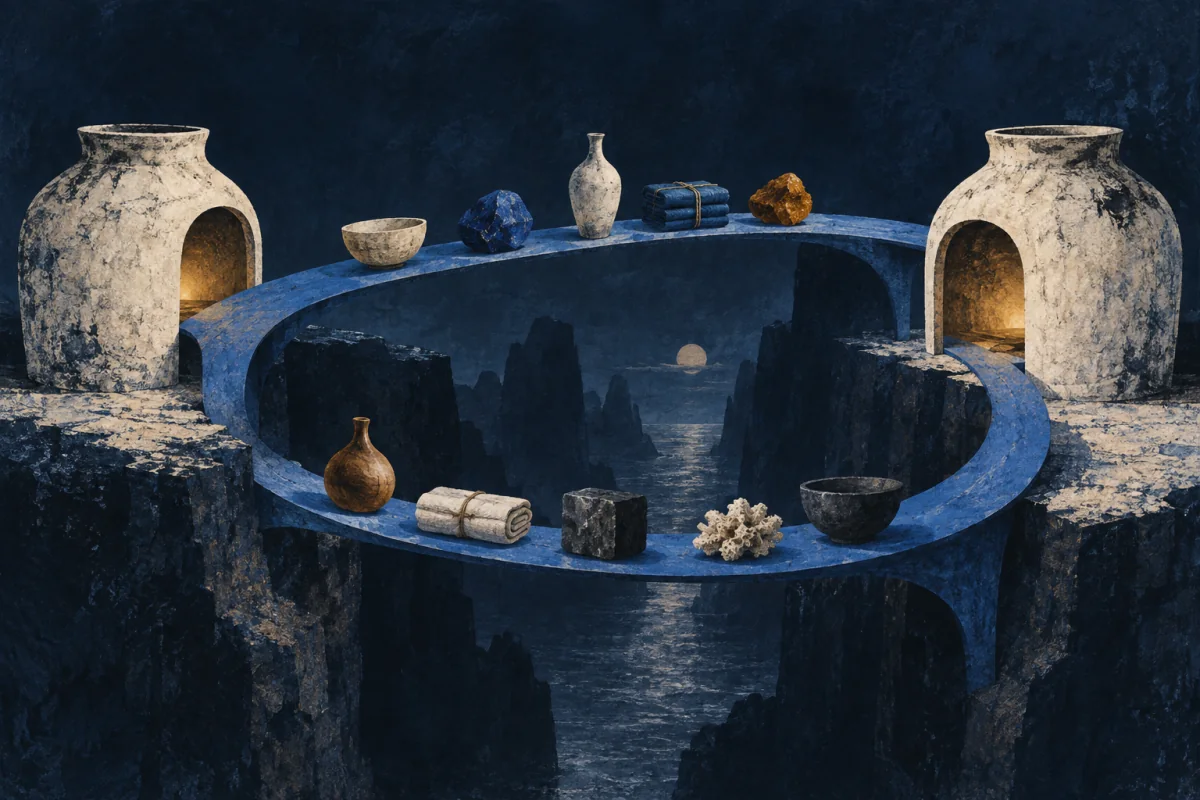
The margin left on the table.
The bit of value deliberately not taken. Not a gift, not weakness — a purchase. What it buys is the other person's willingness to come back, which is worth more than the margin and cannot be bought any other way.
Carry that one into negotiations, pay conversations, and any arrangement with somebody you expect to see again. Ask what you are leaving, and what you are buying with it.
Where It Stops
Liking people is not this. Nor is being a good negotiator — a great many skilled negotiators are optimising the deal in front of them, which is a different discipline and often the opposite one.
It goes wrong as never closing. The relationship becomes so precious that nothing gets asked for, prices drift down, and what looked like a long view turns into an inability to tolerate a moment of friction. Protecting the next trade is only sensible if a trade actually happens.
It also does not fit where there is no next time. Some exchanges are genuinely one-off, and treating them as the first move in a long game wastes something that had no future to protect.
And the plainer explanation first. Anyone trained in account management or relationship selling will produce this behaviour on demand, because that is what the training is for. The test is whether it shows up unpaid — in a street, a school gate, a lift club, a family where things are being quietly balanced and nobody is being invoiced.
Where It Pays
Inside a job. Anything with repeat counterparties: supplier relationships, partnerships, account work, small business, procurement, anywhere a contract is the beginning of something rather than the end. It pays badly in one-shot high-pressure sales, and badly again in any role scored purely on the current quarter, where the mechanism is invisible on the report and reads as money left behind.
The real contribution is not revenue, and framing it that way loses it. It is that the organisation acquires counterparties who will take its call in a bad year. Most firms discover the absence of that exactly once, in the middle of a shortage, when the people they squeezed through the good years are suddenly the ones allocating something scarce.
Outside one. Neighbourhoods, extended families, congregations, and any group at all that runs on favours rather than on money. This is where most of it happens, and it is usually the reason those groups function at all.
The cost worth naming plainly: everything starts arriving as an exchange to be balanced, including affection. Receiving something with no way to return it can be genuinely uncomfortable, and people close in will sometimes experience the running ledger as a distance they cannot name.
Try This
Take one thing you are about to agree this week — a price, a favour, a split of work.
Write down two numbers. The first is what you could probably get. The second is what would leave the other side feeling the deal was clean a month from now. Take the second, and note the difference.
Then wait six weeks and see what came back, if anything did. Sometimes nothing comes back, and that is the point of running it rather than assuming it: this only works where there is actually a next time, and part of the skill is knowing where there isn't.
The margin is a tool, not a self. Pick it up where the relationship outlasts the transaction. Put it down when somebody needs a straight answer about what something costs.
If This Isn't You
Some people deal cleanly and simply, ask what a thing is worth, and go home with no ledger running. That is a lighter way to live, and nothing is missing from it.
Where To Go Next
Its near-twin — Next-Winter Counter. Both move things to where they are needed. Next-Winter Counter is tracking who is short and giving to close the gap. This one is tracking who will deal again, and the exchange has to work both ways.
Its shadow — Builder-of-Trades. Builder-of-Trades grows a thing by taking on more risk and moving before the ground is firm. This one protects a network by taking less, and holds back at exactly the moment the other would push.
Most often confused with — Link-Finder. The Link-Finder introduces people and is genuinely finished once the introduction lands. This one stays in the transaction afterwards, because the follow-up is the part that makes the next one possible.