In Plain Sight
Certain players understand a game by seeing the next move before it lands. They aren't just trying to win. They read choices, traps, and timing while everyone else is still reacting. You'd notice this at the table where one person loses a round on purpose, learns how the others think, and quietly uses that to change the whole match.
The Pattern at Work
A club night, and a fourteen-year-old plays a move that three stronger players around the board agree is weak. It gives away a free tempo for nothing. What it also does is force a choice, and the choice reveals whether the opponent is the kind of player who takes material when it is offered. He is. Eleven moves later there is a second offer, larger and poisoned, and it gets taken for the same reason. The weak move was not a mistake, it was a question, and the answer was worth more than the tempo.
A four-player board game where one person spends the first hour visibly behind, trading badly and conceding small things. Everybody relaxes about them, which is the point of the hour. What is being built is not a position but a set of readings: who over-commits when threatened, who cannot resist a bargain, who will always punish the leader. In the last twenty minutes those three facts get used in that order, and the game ends before anybody has noticed it turning.
A school governors' meeting on a contested closure. One member says almost nothing for the first half, then asks a mild procedural question which splits two people who had appeared to be voting together. It was not a trap laid in the moment. It had been available for twenty minutes, and was held until the point at which it could not be recovered from.
What links the three is that none of them is reading the board. They are reading the people using it.
What the Examples Show
Competitiveness is the usual label, and plenty of ferociously competitive people cannot do any of this.
Wanting to win is about intensity. What is running here is a model of another mind — specifically, a model of what that mind believes the situation to be, which is almost never the situation. The move gets chosen against the belief rather than against the position.
Which is why information is bought rather than waited for. A round conceded on purpose is a purchase: a small, known cost paid to find out something that would otherwise take the whole game to learn. Most players treat every round as a thing to win. This treats some of them as a thing to spend.
And it is why the decisive move so often looks mild. By the time it is played, the work has already been done. What is visible is the receipt.
Going Deeper
Go has a word, aji, for a weakness that is not yet a threat and may never be played — a possibility held in reserve because its value lies in its being available. A tradition that needed such a word had already understood that the strongest move is frequently the one not made, and the masters who taught it spent their lives inside a discipline where that insight was prized and where almost nothing else they knew transferred outside the board.
The oware player in a Ghanaian courtyard reading which pit an opponent cannot leave alone. The composers of shatranj problems, setting positions that were tests of a reader rather than of a game. The card player whose entire income depends on being wrong in a controlled way, often enough to be worth watching. The person who writes the tender that three competitors will respond to, and who is not designing a document but a choice architecture for the rivals.
They were all paid unevenly for the same ability, and they all met the same three costs.
The first is that people stop playing with them. This is the tax nobody mentions: the skill is enjoyable exactly once from the other side, and after that the invitations thin.
The second is that it does not switch off cleanly. A mind that models other minds for advantage will keep doing it at dinner, and the people close by can feel it being done even when nothing is being taken from them.
The third is that they are judged on move one. Acting on a plan three steps out means being visibly wrong at the start, to an audience that scores the start, and the explanation is never available in time.
The Image
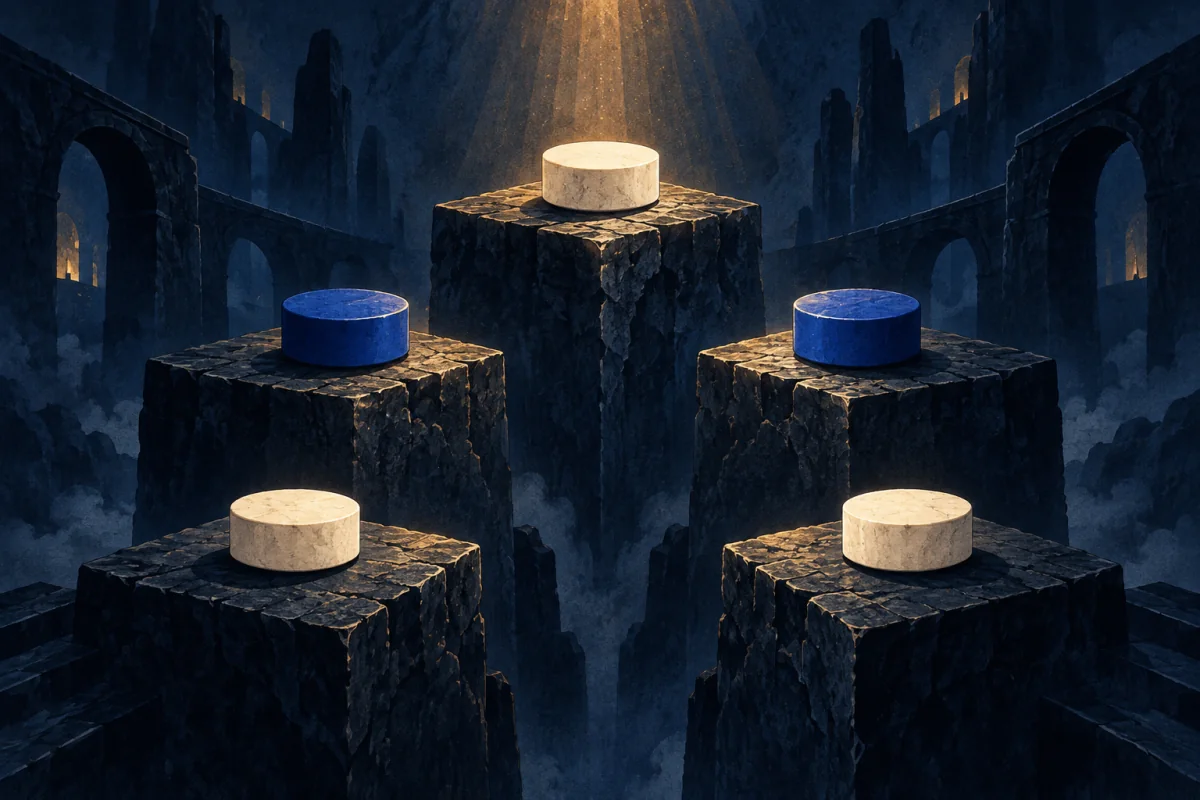
The round you lose on purpose.
It costs a known, small amount. What it buys is a piece of information about how somebody decides under pressure, which is not otherwise for sale at any price, and which stays true for the rest of the evening.
Carry that one into anything repeated against the same people, where what you need is not this outcome but the rule they are using.
Where It Stops
Being clever is not this, and knowing the rules cold is not this either. A great many strong technical players never look up from the position.
It goes wrong as playing people who are not playing. A team, a marriage, a friendship: these are not bounded contests, nobody consented to being modelled, and the damage is not that it fails but that it works. Being handled well is still being handled, and it is felt long before it is named.
It also fails against randomness and against full information. Where the other side has no strategy to read, or where everything is already on the table, the whole method has nothing to grip and will manufacture a plan out of noise.
Take the plainer explanation first. Ten thousand hours in one game produces this inside that game, which is what mastery is. The test is a game learned last week, or a situation that is not a game at all.
Where It Pays
Inside a job. Negotiation, procurement, trading, competitive strategy, litigation, market-making, security work of the kind that involves thinking like the other party, and coaching in any sport with an opponent in it. Also regulation and enforcement, where the whole task is anticipating how a rule will be worked around.
The real contribution is not winning more. It is that the organisation stops being surprised by moves that were entirely predictable — the competitor's response, the counterparty's walk-away, the objection that arrives on schedule and is treated as a shock every time. It pays badly in collaborative work where trust is the asset being built, and badly in any role that requires being read as harmless.
Outside one. Games, sport, and everything else, which is the difficulty. The ability does not come with a switch, and the cost worth naming plainly is not that it gets used cynically — most people carrying it are not cynical — but that it runs anyway, in the background, on people who are not opponents. Partners notice. Children notice earliest of all, and cannot say what it is they have noticed. The useful question is not how to get better at this. It is which tables it is allowed at, and whether that has ever been decided on purpose.
Try This
Pick a repeated situation with the same people in it — a weekly game, a recurring meeting, a household negotiation.
Before it starts, write down one prediction about one person: what they will do when they are behind, or when offered something cheap. One person, one prediction, in advance and in writing.
Afterwards, mark it right or wrong. Do it six times and count. Most people find they are around chance and were certain every time, which is the whole value of writing it down first.
The round you lose on purpose is a tool, not a self. Pick it up inside bounded contests where everybody knows they are playing. Put it down at the kitchen table.
If This Isn't You
Plenty of excellent players simply play the position in front of them, and win a great deal doing it. Taking the game at face value is a legitimate way to play it, and considerably better company.
Where To Go Next
Its near-twin — Hidden Pattern Finder. Both find structure nobody pointed at. Hidden Pattern Finder works on material that is not trying to hide from anyone. This one works against something that is actively adapting.
Its shadow — Missing-Fact Catcher. Both see what the rest of the group has not seen. Missing-Fact Catcher speaks so the group chooses well. This one keeps quiet so somebody chooses badly.
Most often confused with — Trader. Trader reads the other party inside an exchange where both sides want a deal to exist. This one operates where one side has to lose, which makes it a different instrument entirely.