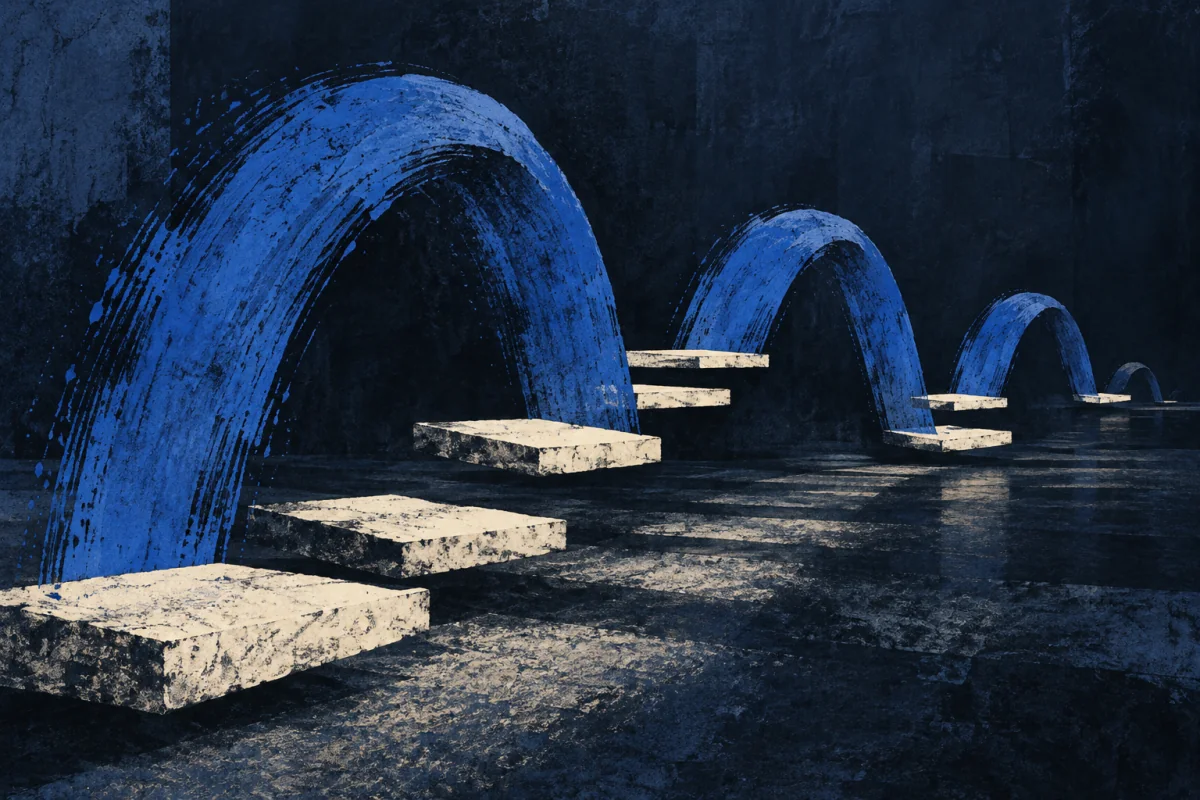
In Plain Sight
Some people understand the world through beat and motion. This is not restlessness; rhythm gives their body a way to think before words catch up. You'd notice this in the one who taps the table during a hard task, then suddenly finds the next step because the pattern settled into their hands.
The Pattern at Work
In each of these the movement is not accompanying the thinking. It is the thinking, arriving about four seconds ahead of anything sayable.
A meeting stuck on a sequencing problem, and one person has been tapping the edge of the table for two minutes — not idly, in a figure, changing it every few bars. Somebody asks them to stop. They stop, and the thing they were about to say goes. Ten minutes later, walking to the kitchen, it comes back whole: the three stages have to run in a different order because two of them share a resource. The tapping had been laying out that structure in a form the hands could hold before there were any words for it.
A dancer learning eight counts of unfamiliar material. Watching is useless and being told is worse. What works is walking it at quarter speed with the arms marking the accents, the whole thing coarse and ugly, repeated eleven times. On the twelfth it is not remembered — it is simply available, in a way that no longer requires attention at all.
A coach teaching a complicated changeover to a team that has not managed it in three sessions. Instead of explaining it again, they give it a count: four beats in, two across, one out. Nothing about the movement changes. The count changes what the players are holding, and the changeover works on the second attempt, because a sequence with a rhythm underneath it takes up almost no room in the head.
What the Examples Show
Fidgeting is what it gets called, generally by people trying to stop it.
Fidgeting is discharge — energy leaving with nothing attached. What is happening here is the opposite: a structure is being built outside the head, in time rather than on paper, and then read back. A rhythm can hold several things at once and keep their relations intact, which is exactly what a stuck problem needs and exactly what a sentence cannot do, since a sentence can only put one thing after another.
Which is why interrupting it loses the thought rather than merely pausing it. The pattern was the workspace.
And it explains why the method transfers so far from music. Anything with parts and an order — a sequence of tasks, a route, a changeover, an argument — can be held as a figure, and once it is a figure, it can be felt to be wrong before anybody can say why.
Going Deeper
South Indian percussionists learn by mouth before hand. Konnakol is a spoken language of drum syllables, and a student recites complex rhythmic structures long before touching an instrument, because the pattern has to live somewhere portable first. Capoeira keeps the ginga running underneath everything, so that no player is ever at rest and every move departs from a moving baseline rather than a stationary one. Tap dance carried its whole repertoire through bodies for generations with nothing written. And the drill cadence, which is not decoration: a hundred people step together because a count is the only instruction that arrives at a hundred bodies simultaneously.
All of these are systems for holding structure in time, built by people who needed it held and had no page.
The costs come from one fact: the world's serious rooms are built for stillness.
A body doing this in a meeting, a classroom, an exam, or a waiting room reads as bored, disrespectful or unwell, and gets corrected — early, and repeatedly, and usually by somebody kind. Children carrying this are told to sit still roughly a thousand times before they are ten, and a good proportion conclude that the way their own thinking works is a fault.
The method is also unexplainable in the moment. Asked how they got to the answer, this person genuinely cannot say, because the working was not in a form that converts. So the answer gets attributed to luck or instinct, including by the person who produced it.
And there is a real dependency underneath. Take the beat away — a silent room, a still body, a situation demanding composure — and the thinking does not merely slow. It stops finding things.
The Image
The tap before the thought.
The hand gets there first. Whatever is being worked out arrives in the fingers as a figure a few seconds before it arrives anywhere that could say it, and the gap between those two is not a delay. It is the work happening.
Carry that one into any problem with parts and an order that has stopped yielding to being talked about.
Where It Stops
Musical training has nothing to do with it. Plenty of trained musicians think entirely in words, and a good number of people who do this cannot play anything and never wanted to.
It goes wrong as needing the movement in rooms where it costs more than it returns. There are settings — a funeral, a negotiation, somebody else's bad news — where a moving body changes what the room thinks is happening, and the cost of that is real even when the objection is unfair.
It also fails on problems without structure. A question of values, a decision about how somebody feels, a thing that needs sitting with: none of those have parts in an order, so there is nothing for a figure to hold, and the rhythm just runs on empty.
Take the plainer explanation first. Anyone anxious moves, and anyone bored moves, and both look identical from across a table. The test is whether the movement is patterned and changing rather than repetitive, and whether stopping it costs an idea.
Where It Pays
Inside a job. Coaching and instruction of physical skill, dance, theatre, live sound, production line and process design, choreography of any kind including warehouse and kitchen layout, and physical trades with a repeating cycle.
Also, less obviously, complex scheduling.
The real contribution is that a sequence stops having to be remembered. Most operational failure is not people forgetting the steps; it is people holding eight things in mind under pressure and dropping the seventh. A sequence carried as a rhythm takes up almost nothing, survives noise and fatigue, and transfers to a new person in minutes rather than in a document nobody reads. One person who can convert a procedure into a count is worth more than the procedure. It pays badly in still, silent, seated work where the whole output is verbal — and badly again in any culture where composure is the measure, since the very thing that makes this work is the thing that will be marked against it.
Outside one. Sport, dance, music, driving, cooking, and every task with a cycle to it. The cost worth naming plainly is the early one: most people carrying this spent their childhood being asked to stop, and learned to do it under the table. Doing it openly, as an adult, in a room that will misread it, is a small ongoing decision that nobody else has to make.
Try This
Take something you are stuck on that has parts and an order to it.
Stop trying to say it. Give it a physical shape instead — tap the stages out, walk them across a room, count them with a hand on a table. Make the shape crude and repeat it a dozen times without trying to get anywhere.
Then notice whether something arrives, and notice specifically whether it arrives before you have words for it. That gap is the evidence.
If nothing comes after a dozen passes, the problem probably has no sequence in it, which is useful to know and takes four minutes to find out.
The tap is a tool, not a self. Pick it up where a thing has parts in an order. Put it down where the question is about meaning rather than sequence.
If This Isn't You
Most people think in sentences and are well served by them, and a still body is not an empty one. Needing quiet and no movement to work properly is its own arrangement and fits most rooms considerably better.
Where To Go Next
Its near-twin — Rhythm-Keeper. Both work in time. Rhythm-Keeper holds a tempo for other people and is measured by whether the group stays on it. This one uses rhythm privately, as a way of holding a problem, and may produce no sound at all.
Its shadow — Volume-Thinker. Volume-Thinker works a problem out in space, held still and turned over. This one cannot see it until it is moving, and each finds the other's method oddly airless.
Most often confused with — Mid-Air Adjuster. Both are fluent and physically assured. Mid-Air Adjuster is correcting a thing that has just started going wrong. This one is not reacting to anything — the pattern was running before there was a problem.