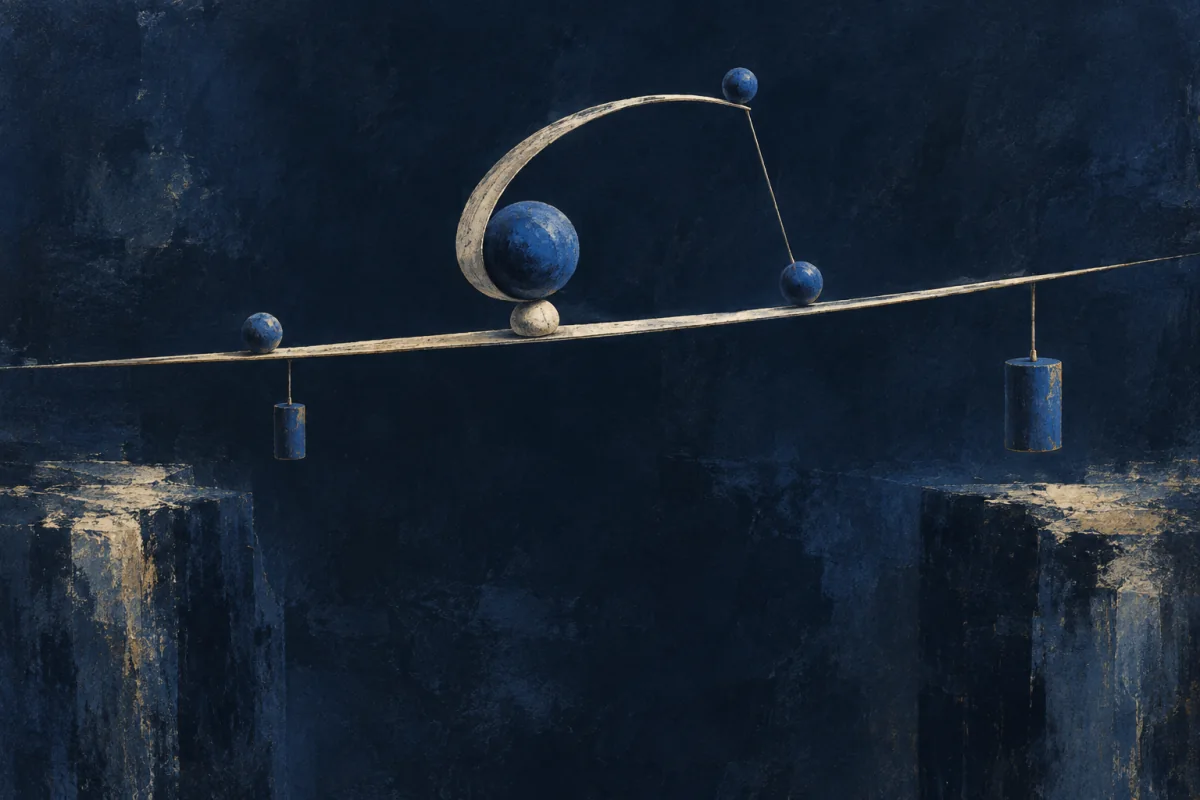
In Plain Sight
Physical challenge makes this person think through movement, not just words. They are not chasing danger. They read small shifts in weight and timing, then adjust before the rest of the group knows what changed. You'd spot this in the teammate who tests the slick log with one foot, pauses, then crosses only after the wood holds.
The Pattern at Work
A hand-to-hand act, third show of the day, and the woman on the bottom feels the weight above her go about two centimetres to the left of where it belongs. Nothing has gone wrong yet and nothing will. Her right heel comes back a fraction, her ribs turn maybe five degrees, and the shape resolves. The flyer does not know it happened. The audience is watching a perfectly ordinary lift, which is exactly the intention, and afterwards neither performer mentions it because there is nothing to mention.
A wet root on a descent, and the back wheel starts to go. The rider's hips are already moving before any of it has been thought about — a weight change that looks, on the video somebody posts later, deliberate. It was begun a fifth of a second into a slide that had not yet become one, and finished before the front wheel picked a side.
A two-hander, forty minutes in, and the other actor comes in four beats early on a line that a whole sequence of business depends on. The correction takes place in the body: a half-turn upstage that buys a beat, a prop picked up that was not going to be picked up, a pause that reads as a character's hesitation. The stage manager sees it. The director at the back sees it. Nobody in row F sees anything but a scene. All three would give the same answer if asked how they did it, which is that they did nothing, they simply did not let it get worse.
What the Examples Show
Quick reflexes is the usual verdict, and reflexes are the wrong unit.
A reflex is a claim about latency: how fast a response follows a stimulus. What is running here starts earlier than that. The correction is under way while the error is still only a tendency — before there is anything a stopwatch could mark. It is a prediction, made continuously, about where a moving system is heading, and the adjustment is applied to the prediction rather than to the event.
Which is why the adjustments are so small. A fall caught late requires a large, visible, expensive save. The same fall caught at the point where it is still just a drift in the weight costs two centimetres of heel.
And it is why nothing appears to happen. The output of this pattern is a series of non-events, and non-events do not get counted, remembered, or paid for.
Going Deeper
The Beijing opera academies took children at seven and kept them a decade, and what was being built was not strength. It was a body that knows where it will be. The Wallendas worked a seven-person pyramid on a wire with no net for the same reason a rope team on a glacier works as it does: not bravery, but each one continuously reading the others and correcting into them.
The trials rider standing still on the pedals on a wall. The guide who puts a boot on a snow bridge, takes it off, and goes round, on evidence that never becomes a sentence. The roofer who has never fallen in thirty years and cannot tell anybody why. The Kerala kalari practitioner whose training is largely about being in the right place before it matters. These are unlike each other in every way that shows and identical underneath.
The costs arrive late and all at once.
The first is that the body has a deadline, and all of the above is written on material that degrades. The window closes slowly, and it closes on a person whose whole way of meeting the world was built inside it.
The second is that the work is only ever visible when it fails. Thirty years of corrections buy nothing that can be pointed at; one bad day becomes the record. Nobody counts the falls that did not happen, and nobody can, which is the shape of the problem rather than anyone's fault.
The third is the slow bill: not the dramatic injury, which is rare, but the ankle, the shoulder, the disc, accumulated too gradually to notice and presented in a lump around fifty.
And the fourth is being read as reckless by people who see only the crossing of the wet log and never the foot that tested it.
The Image
The half-inch.
A save that everyone can see is a save that was left too late. The thing worth having is the half-inch of heel, applied while the problem is still a tendency and not yet a fact, which costs almost nothing and which no one will ever notice.
Carry that one into anything that is drifting rather than failing — including the things that are not physical at all.
Where It Stops
Fitness is not this, and neither is fearlessness. Several who carry it are frightened much of the time, and the fear is part of the reading rather than an obstacle to it.
It goes wrong as trusting the correction where there is nothing to correct with. Some situations have no recoverable error: a fixed rope that is either tied or not, a chemical process, a hold that either takes the weight or does not. A person who has spent years catching things will walk onto one of those and discover the method was built on a margin that is not there.
It also fails where the environment gives nothing back. This needs live feedback — weight, sound, resistance, another body. Remove that and there is nothing to read, while the confidence stays behind after the information has gone.
Take the plainer explanation first. Any trained athlete does this inside their own sport, because that is what training builds. The test is whether it appears off the mat: on ice, on a ladder, carrying a wardrobe downstairs with somebody untrained.
Where It Pays
Inside a job. Performance and stunt work, rigging, trades at height, ski patrol, physiotherapy, materials handling, live events, anything on a vessel. Also emergency response, where the ground keeps moving under the plan.
The real contribution is an absence, which is what makes it so badly paid and so frequently cut. It is the incidents that never became incidents, the shows that ran clean, the load that did not shift. It pays badly wherever the work is static and the body is only a way of getting hands to a fixed point, and badly again wherever the measure is output per hour, because the whole of it reads as somebody doing an ordinary amount of work and never once having a problem, which is indistinguishable from an easy job.
Outside one. Sport, climbing, dance, boats, horses, small children, and the ordinary business of a house with stairs in it. Most of this happens there, unpaid and unremarked, over a lifetime.
The cost worth naming: the assignment attaches itself permanently. You become the one who goes up the ladder, moves the heavy thing, carries the awkward end, and the requests keep arriving at forty-five and at sixty in the same tone they arrived at twenty-two.
Try This
The next time you nearly drop something, stop where you are and reconstruct the moment you knew.
Not the moment you reacted. The moment the information arrived — usually a change in weight or sound that preceded any thought about it. Most people find it is earlier than they expected, and that the reaction was already under way before they had named the problem.
Do it three or four times over a week and see whether the gap between knowing and moving is closing, because that gap is the thing, not whether you caught the object.
The half-inch is a tool, not a self. Pick it up where something is drifting and can still be met. Put it down where the margin does not exist and the answer is to go round.
If This Isn't You
Large numbers of people meet the physical world by planning it in advance and are safer for it. Preferring to work out the ground before standing on it is a method, not a deficit.
Where To Go Next
Its near-twin — Vertical Surface Scaler. Both read a moving relationship between a body and a surface. Vertical Surface Scaler is solving a problem that stays still while it is solved. This one is solving a problem that will not hold still for a second.
Its shadow — Edge-Measurer. Edge-Measurer establishes the tolerance in advance, on paper, and will not proceed until it is known. This one finds the tolerance in the air, and has no way of writing it down afterwards.
Most often confused with — Rhythmic Mover. Both are fluent and hard to look away from. Rhythmic Mover is moving with a pattern that already exists. This one is moving against something that has just gone wrong.