In Plain Sight
The higher the wall, the quieter it gets. On a rock face or an ice climb, there is no option to be anywhere else — no distraction survives the exposure. The body takes in the surface the way others take in a sentence. You'd see this in the free-solo climber who moves faster and more precisely the higher the route gets.
The Pattern at Work
Four hundred feet up a granite slab, and the movement is noticeably better than it was at fifty. Not braver — better. The foot placements are more exact, the pauses shorter, the reading of the next twenty feet happening while the hands are still working the last of it. Anybody belaying from a ledge can see it, and every climber who has been above their own comfort knows the feeling of a body that has stopped arguing.
A Scottish winter route in poor light, and the ice is in a condition that would sensibly be called marginal. The axe goes in and comes out three times in one spot, each placement judged by sound rather than by look. There is no thinking about it in any ordinary sense. There is a surface, and a set of facts about the surface arriving through a steel pick and a pair of front points, and a body making decisions on them at a speed that language cannot get near.
The same person, on a Tuesday, at a climbing wall six feet off a padded floor, is distractible and mediocre. They chat. They fall off things they could do in their sleep. They check a phone between problems. A coach who has only seen them indoors would not put them on a serious route, and would be wrong, because it is not a question of ability being switched on and off. Take the exposure away and the thing that organises them is simply not present.
What the Examples Show
Fearlessness is the explanation everyone reaches for, and it is not available.
Fear is present in almost every case. What changes is what the fear does. For most people it adds noise: competing impulses, a running commentary, the body doing two things at once. Here it does the opposite. The consequences are large enough that everything not relevant to the next two moves is simply not admitted, and what is left is a very clean channel between a surface and a body.
That is why performance rises with exposure rather than falling. Height is not being tolerated. It is doing work.
And it is why the indoor version looks so unimpressive. Without the consequence there is nothing narrowing the field, and the same person is as scattered as anybody else, which is the part nobody believes until they have seen both.
Going Deeper
The Gurung honey hunters of central Nepal go down cliffs on rope ladders made of bamboo, into smoke, above a drop of two or three hundred feet, for the combs of the world's largest honeybee. The St Kilda fowlers went up sea stacks barefoot for birds and eggs, and every visitor reported that their ankles had thickened from it, which is what a lifetime of one thing does to a body. The samphire gatherers on the chalk of the south coast, a trade old enough to be a line in King Lear and dangerous enough to be proverbial.
None of these people were sportsmen and none had chosen exposure for its own sake. The exposure was where the food was. What they had in common was a body that worked better in the place that would kill it, which is an unusual thing to be true of an animal and is the whole of what this pattern is.
The costs are consistent and none of them are dramatic.
The first is that there is no margin to learn in. Most skills are built by being wrong cheaply and often. Here the cheap version is a different activity and the expensive one permits no second attempt, so the learning has to happen in the one place it cannot safely happen.
The second is that ordinary life is under-stimulating in a way that is hard to explain and easy to mistake for depression. The clarity is available in one place. Everywhere else the noise comes back.
The third is that it reads as a wish to die. It is very nearly the opposite, and no amount of saying so helps, and the people closest to it live with a fear the climber does not share and cannot answer.
And the fourth is the ending. The body slows without announcing it, and the signal that it has slowed arrives, in this discipline, later than is useful.
The Image
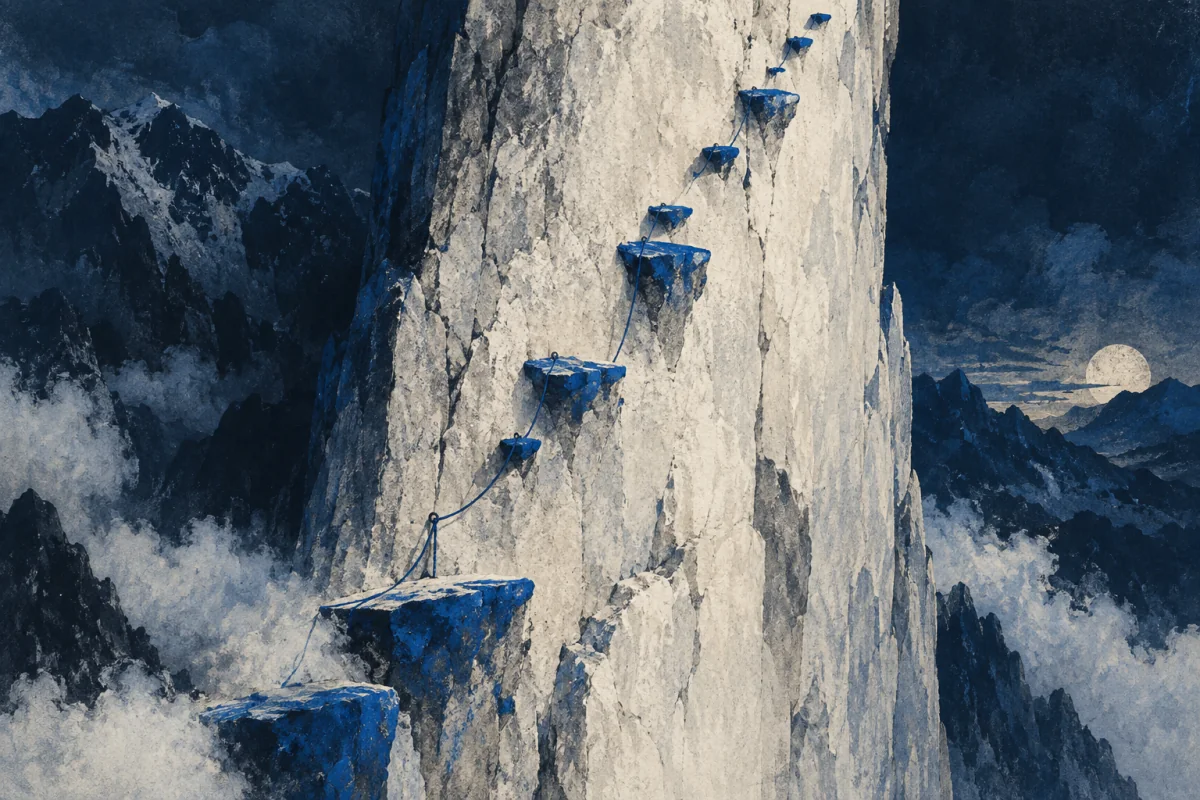
Two moves of world.
Above a certain consequence the available world shrinks to the hold under the hand and the one being reached for. The mortgage, the argument, the unanswered message: none of them are admitted, not by an effort of will but because there is no room.
Carry that one into anything that has to be done well and is being done badly because everything else is in the room at the same time.
Where It Stops
Courage is the wrong frame, and so is confidence. Plenty of people who carry this are anxious on the ground and privately certain they are not good enough.
It goes wrong as needing the consequence. A person organised by exposure can end up seeking it in places that do not warrant it — the unnecessary solo, the decision taken because a safer one would be dull. The pattern is a way of working, and when it becomes a requirement the margin starts being spent on nothing.
It also fails where the danger is not physical and not immediate. A financial risk, a legal one, a slow-moving one: the body has nothing to read, the channel does not clear, and the clarity that arrives on a wall does not arrive at all.
Take the plainer explanation first. Anyone with a decade in a risky trade gets calm in it, because that is what habituation does. The test is whether the performance actually improves with exposure, rather than merely surviving it.
Where It Pays
It pays badly almost everywhere, and that has to be said before anything else. Very few jobs supply consequence of the right kind, and the substitutes on offer — deadlines, targets, an angry client — do nothing for this at all.
Inside a job. Rope access and industrial climbing, wind turbine and tower work, arboriculture, steeplejacking, rescue, survey work on structures, and the guiding and instruction that sit alongside all of them. Film and television rigging. Anything where the workplace is vertical and the alternative to competence is not a bad quarter.
The real contribution is not daring. It is that a category of work which is otherwise done slowly, expensively, and with a great deal of scaffolding gets done by one person in an afternoon, accurately, by somebody whose judgement is at its best in exactly the conditions where everyone else's degrades. That is a narrow contribution and an extremely valuable one.
Outside one. Climbing, mountaineering, caving, and the long quiet apprenticeship that surrounds them.
The cost worth naming: the people who love you are carrying something you are not carrying, and the arrangement is not fair to them. That does not mean stopping. It means the conversation is owed, and it is usually the one conversation this pattern is least equipped to have.
Try This
Pick something you do badly that you know you could do well, and remove the alternatives rather than adding effort.
Not motivation — options. Put the phone in another room, take the second screen away, give yourself a window with a hard edge at the end of it and nothing else in it. What you are copying is not the danger. It is the narrowing.
Then check whether the work got better or only faster, because those are different results and only one of them is the point.
Two moves of world is a tool, not a self. Pick it up where a thing needs doing properly and everything else is crowding it. Put it down where the risk is real and unnecessary and somebody else has to live with the outcome.
If This Isn't You
Most people get worse as consequence rises, which is the sane arrangement and the reason we have handrails. Wanting the ground firmly underfoot is not timidity. It is the ordinary condition.
Where To Go Next
Its near-twin — Mid-Air Adjuster. Both work at the boundary between a body and a surface that will not forgive much. Mid-Air Adjuster is correcting something already going wrong. This one is reading something that has not moved and must not be made to.
Its shadow — Crowd-Mover. Crowd-Mover comes alive in the middle of as many people as possible. This one comes alive where there is nobody at all, and the two would find each other's best hour unbearable.
Most often confused with — Speed-Chaser. Both get sharper when the stakes rise. Speed-Chaser is cleared by time running out. This one is cleared by the drop, and is no better than average against a clock.