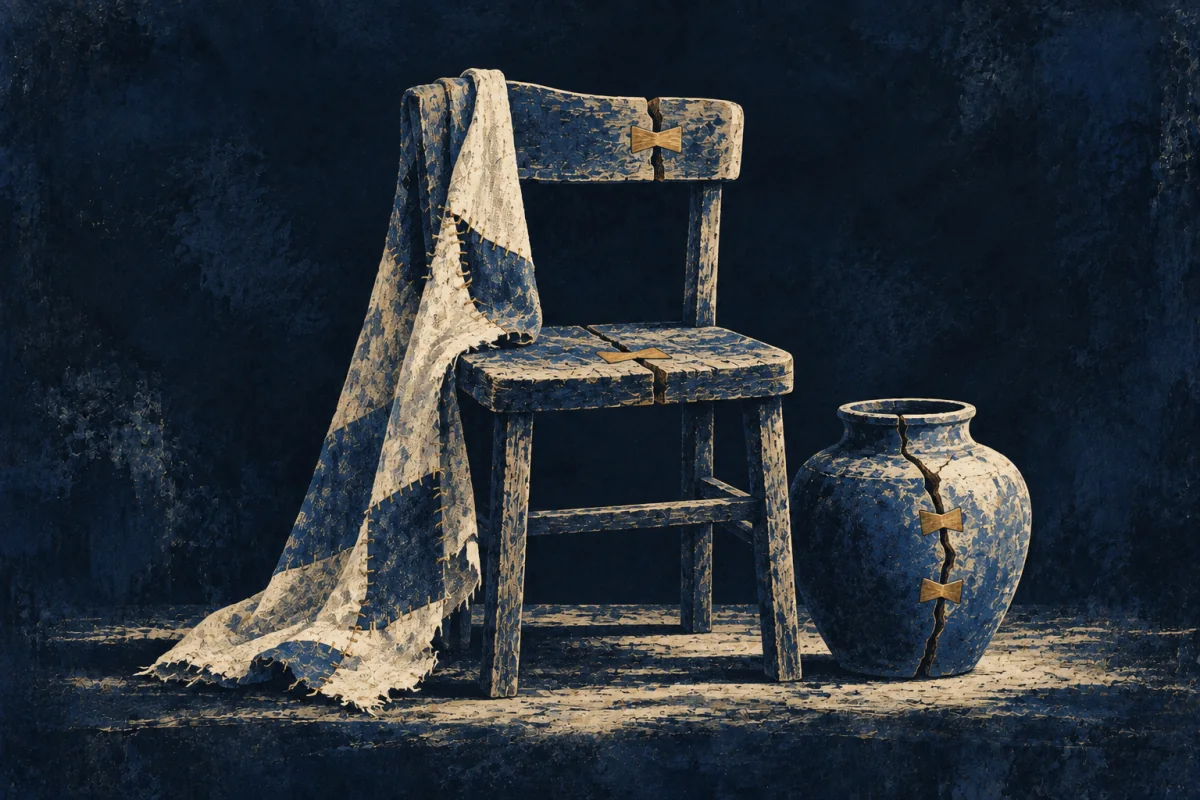
In Plain Sight
When something is torn, this person looks for the nearest clean repair. They do not treat damage as the end. They study how the break happened, then make the fix strong enough to be trusted. You'd find this in the person at home who keeps the cracked chair in use by tightening one hidden screw before anyone asks.
The Pattern at Work
A dog has come off worse in a fight and the cut on its shoulder is long but shallow. The vet is closed until Monday. Somebody clips the hair back, gets a good light, and spends twenty minutes cleaning rather than four — which is the part that matters and the part everybody skips — then closes it with strips rather than reaching for a needle, because the edges will hold if the animal is kept quiet and it is the keeping quiet, not the closing, that decides how this goes. The instruction afterwards is about the next ten days, not about the wound. It heals flat.
A woman in her eighties has a shoulder that has not worked properly since a fall in the spring. Two people have told her it is age. Somebody with no medical training at all sits with the arm across a quarter of an hour, moving it slowly through what it will do and stopping exactly where it objects, and works out that the shoulder itself is fine — the problem is that she has stopped using the arm above chest height and everything has tightened around the not-using. What follows is six weeks of very small things, done daily, that look like nothing. She gets the shoulder back.
Neither of those is heroic and neither is fast. Both begin with a long look at how the damage actually happened, which is the step that determines whether the repair holds and the step that almost nobody takes.
What the Examples Show
The names offered are caring, or good with people, or handy — and all three are true of plenty who cannot do this.
What runs underneath is reading a material. A body, a fabric, a joint, a piece of wood: each has a grain, a tolerance, a way it wants to come back together, and the repair is chosen to suit that rather than imposed on it. The hands are doing the reading, not just the work, which is why this pattern slows down at the point others speed up.
The second half is the time horizon. The fix is not the moment of closing. It is the ten days afterwards, and a repair that is perfect at the bench and unsupported for a fortnight is not a repair.
Which is why what gets said afterwards matters so much. The most important instruction is nearly always about what not to do next — don't lift, don't wash it, don't use that chair for a week — and delivering it so somebody actually follows it is half the craft.
Going Deeper
Before there were physicians there were menders, and most of the world had them for far longer.
The Ayurvedic vaidya worked from an idea of restoring balance rather than removing a disease, which sounds vague until it produces a practitioner who asks what the person has been doing rather than only what is wrong. A Tibetan bone-setter reduced fractures by hand and by feel alone, working from an anatomy learned entirely through touch, with an accuracy that surprised the people who arrived centuries later with imaging and checked. The curandera in Latin America held herbs, massage, bone-work and counsel as one practice, because to her they were one practice. The village midwife-mender attended births and also set the arm, sewed the gash, and knew who in the parish was not eating.
None of them separated the body from the life around it, and that was not sentimentality. If the repair depends on the ten days afterwards, then knowing whether somebody has ten days available is clinical information.
What it cost is consistent. These figures were trusted absolutely and recognised by nobody official, which made them the first to be blamed when something went wrong and the last to be credited when it did not. They carried an accumulated knowledge that could not be written down usefully, because it lived in the hands. And they were available — there is no closing time in a village — which meant the role took the whole of a life without ever quite becoming a livelihood.
The Image
The weight it will take.
A repair is not judged by how it looks. It is judged by what somebody will dare put on it — the chair sat in without thinking, the arm raised without checking first.
Carry that one into anything mended, including arrangements between people. Ask what weight the repair can now take, and whether anyone has tested it or everybody is simply being careful around it.
Where It Stops
Kindness is not this, and neither is thrift. Plenty of careful people repair things badly and repeatedly, and some who do this well throw a great deal away.
It goes wrong as mending what should be let go. Some damage is the end, some illness is not reversible, and some arrangements between people have finished. The pull to restore does not come with a sense for when restoration is the wrong offer, and a repair pressed on somebody who has moved on is its own small unkindness.
There is a failure that looks like competence: working beyond what the person in front of them can safely receive. Confidence with hands, no training, and a genuine problem is a combination that occasionally does harm, and the discipline is knowing that edge in advance rather than discovering it.
And take the plainer explanation first. Anyone trained in nursing, physiotherapy or veterinary work will produce this inside their scope. The test is whether it appears outside any scope at all — a torn coat, a neighbour's wrist, a friendship that has gone quiet.
Where It Pays
Inside a job. Nursing, physiotherapy, veterinary and animal care, rehabilitation, dentistry, conservation and restoration work, textiles, instrument repair, and the whole quiet middle of maintenance trades. The real contribution is not the fix. It is that the thing goes back into use trusted — which is a different outcome from being technically repaired, and it depends almost entirely on whether the person doing it understood how the damage happened in the first place.
It pays badly where volume is the measure, because the long look at the cause has no billing code, and badly in any setting where the aftercare is somebody else's department. A repair handed off at the moment of closing is the one most likely to fail, and it will fail quietly.
Outside one. Households, animals, clothes, furniture, and people as well — the friend who is not coping, the relative after a loss, the relationship that has taken a knock and is still standing. The cost worth naming plainly is that this gets taken for granted quickly. A thing that keeps working does not remind anybody it was mended, and the person who mends it is usually asked again rather than thanked, which over years is a great deal of unrecorded work.
Try This
Find one thing that is damaged and still in use — an object, a routine, a relationship that has gone slightly wrong.
Before touching it, spend ten minutes on the cause. Not what is broken: how it came to break. Was it loaded wrong, used wrong, neglected, or simply old. Write one sentence.
Then make the smallest repair that answers that sentence, and nothing more.
Then — the actual exercise — decide the ten days. What must not happen now, who needs to know, and how to say it so they do it.
Most repairs fail in that last part, and almost nobody plans it.
The weight it will take is a tool, not a self. Use it where something can go back into use. Put it down where the honest answer is that the thing is finished.
If This Isn't You
A great many people see something torn, feel nothing much, and call somebody. That is efficient and often correct, and the world has enough half-finished repairs made by people who should have called somebody.
Where To Go Next
Its near-twin — Steady-Hand Mender. Very close, and the difference is what is under the hands. The Steady-Hand Mender works on structure and slows down when the clock is against them. This one works on living material, mostly with no clock at all, and the repair depends on what happens afterwards.
Its shadow — Triage-Mind. Triage-Mind decides who is not going to be helped and moves on, which is sometimes the only sane act. This one is still working on the one in front of it, and the two are needed in the same room and rarely agree about it.
Most often confused with — Animal Whisperer. Both work on a body that cannot explain itself. The Whisperer changes the conditions until the animal settles itself and may never touch it. This one puts hands on the damage.